Practice counting Adding up to 50 Worksheets for 7-Year-Olds
3 filtered results
-
From - To
Enhance your 7-year-old's math skills with our "Practice Counting Adding Up to 50 Worksheets." These interactive worksheets are designed to make learning addition engaging and effective. Children will practice counting, recognize numbers, and build their addition skills through fun exercises aimed at adding up to 50. Each worksheet presents colorful illustrations and clear instructions that captivate their interest while promoting essential mathematical concepts. Ideal for both classroom and at-home learning, these worksheets cater to various learning styles, ensuring every child can grasp addition fundamentals. Start your child's journey to math mastery today with these comprehensive counting activities!
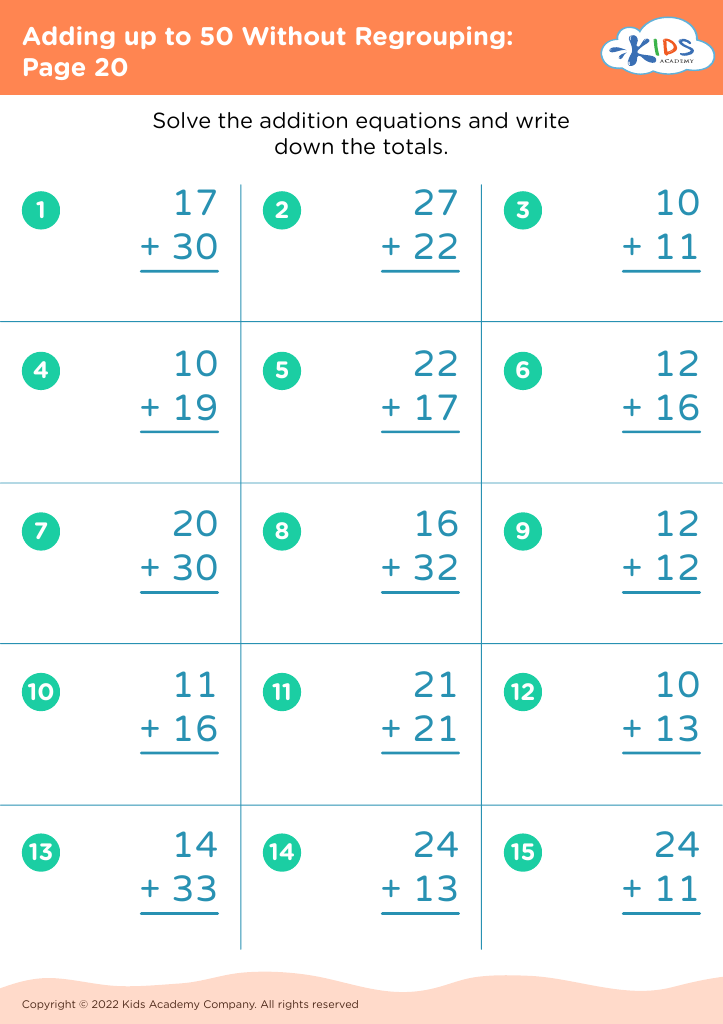
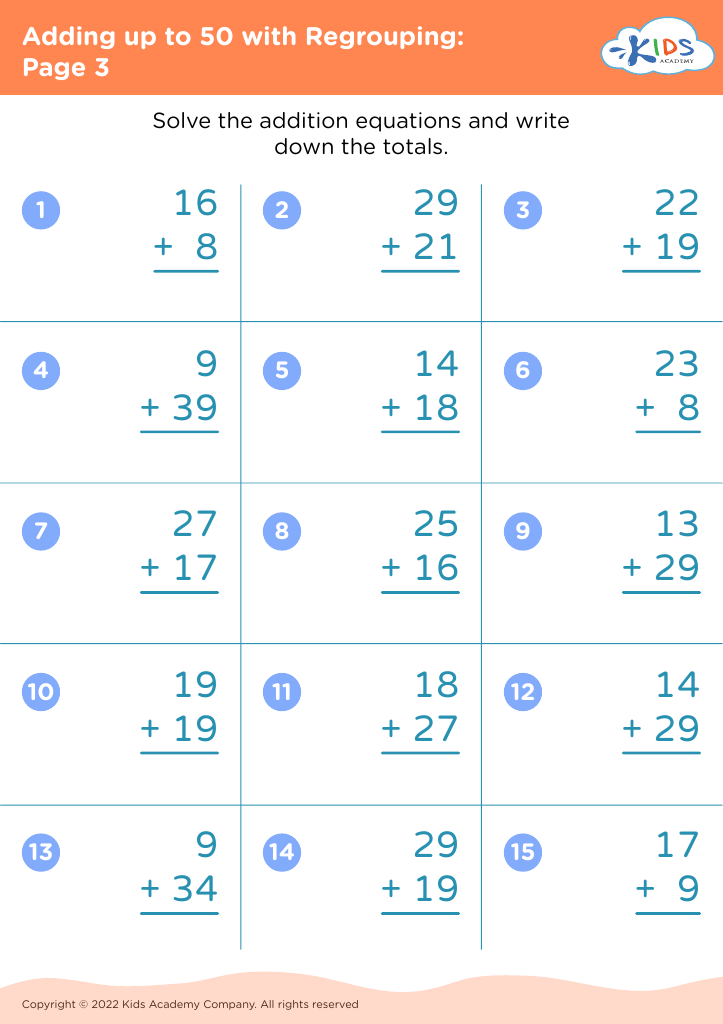
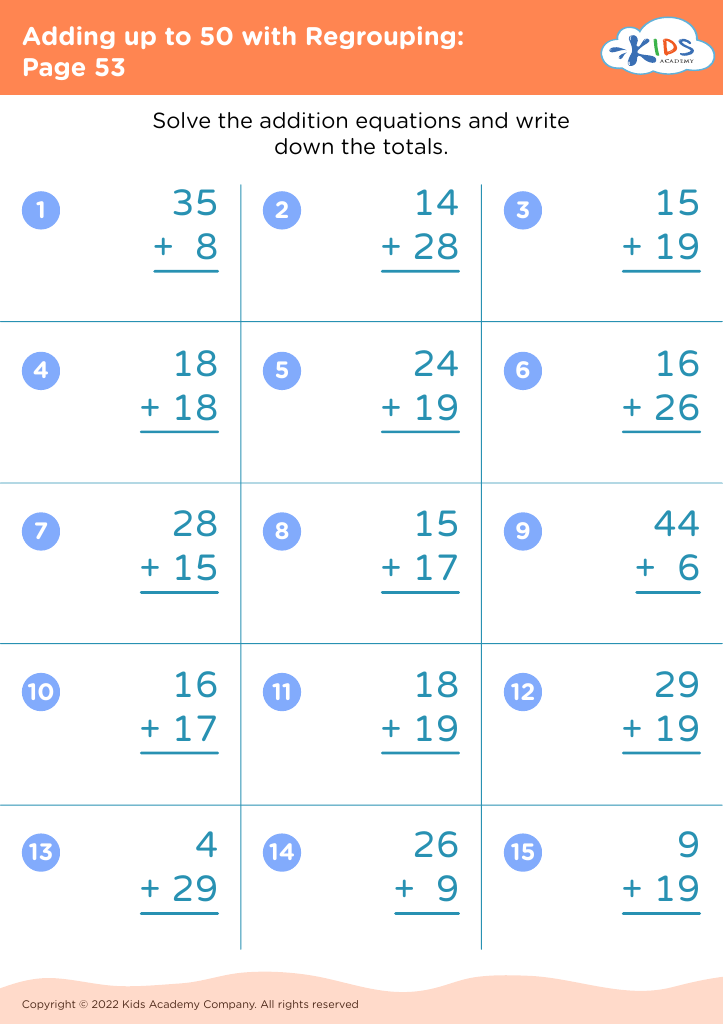




Practice counting and adding up to 50 is crucial for 7-year-olds as it forms the foundation of their mathematical skills. At this developmental stage, children are beginning to understand the relationships between numbers and how they can be manipulated. Mastering the ability to count and add to 50 promotes number sense, a vital concept that helps them recognize patterns, make connections, and solve problems efficiently.
Furthermore, counting to 50 enhances children's cognitive abilities and instills confidence in their mathematical skills. It prepares them for more complex operations such as subtraction, multiplication, and division, which they will encounter in later grades. Engaging in these practices also develops their fine motor skills, especially when integrating physical counting resources like blocks or counters.
From a broader perspective, strong foundational math skills contribute to academic success overall, helping students feel more prepared for subjects that require critical thinking and data analysis. By supporting children in their counting and addition practice, parents and teachers not only foster academic growth but also promote a positive attitude toward math. This early intervention encourages a lifelong appreciation for mathematics, leading to greater achievements in school and beyond. Thus, it is vital for adults to actively engage children in these essential practices.








