Problem Solving Adding up to 50 Worksheets for 7-Year-Olds
3 filtered results
-
From - To
Discover our engaging "Problem Solving Adding Up to 50 Worksheets" tailored specifically for 7-year-olds! These worksheets are designed to enhance mathematical skills through fun and interactive problem-solving activities. Young learners will practice addition up to 50, developing essential counting and reasoning abilities. Each worksheet features colorful illustrations and real-life scenarios to captivate students' attention and make learning enjoyable. Perfect for classroom use or at home, these worksheets help children build confidence while mastering essential math concepts. Encourage your child's love for learning and watch them excel in their math skills with our thoughtfully crafted activities today!
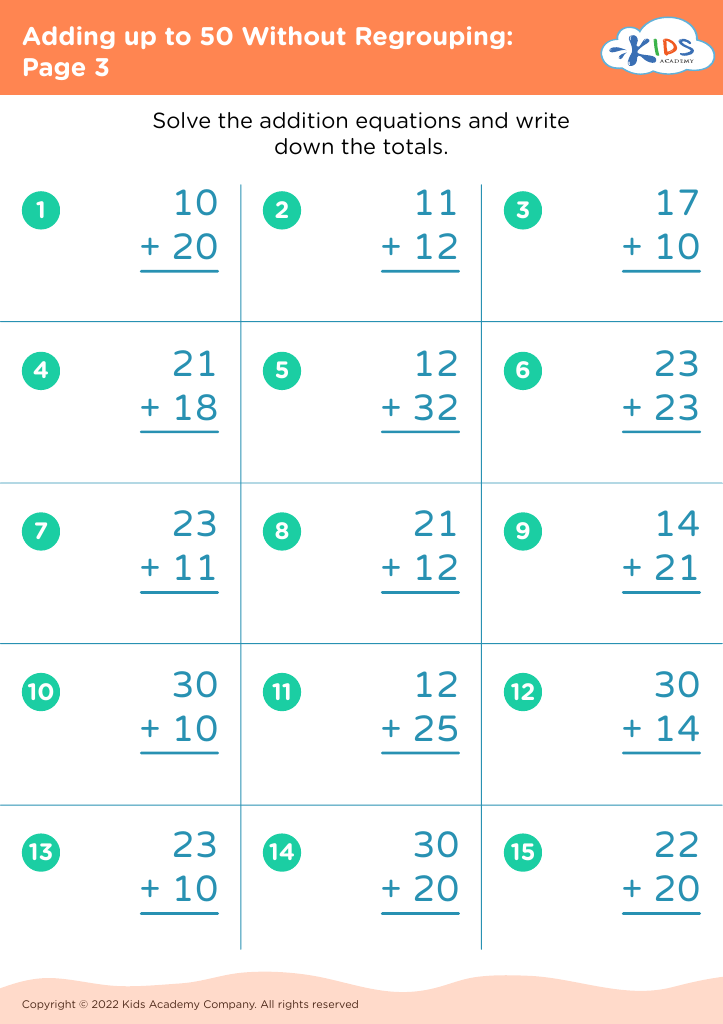
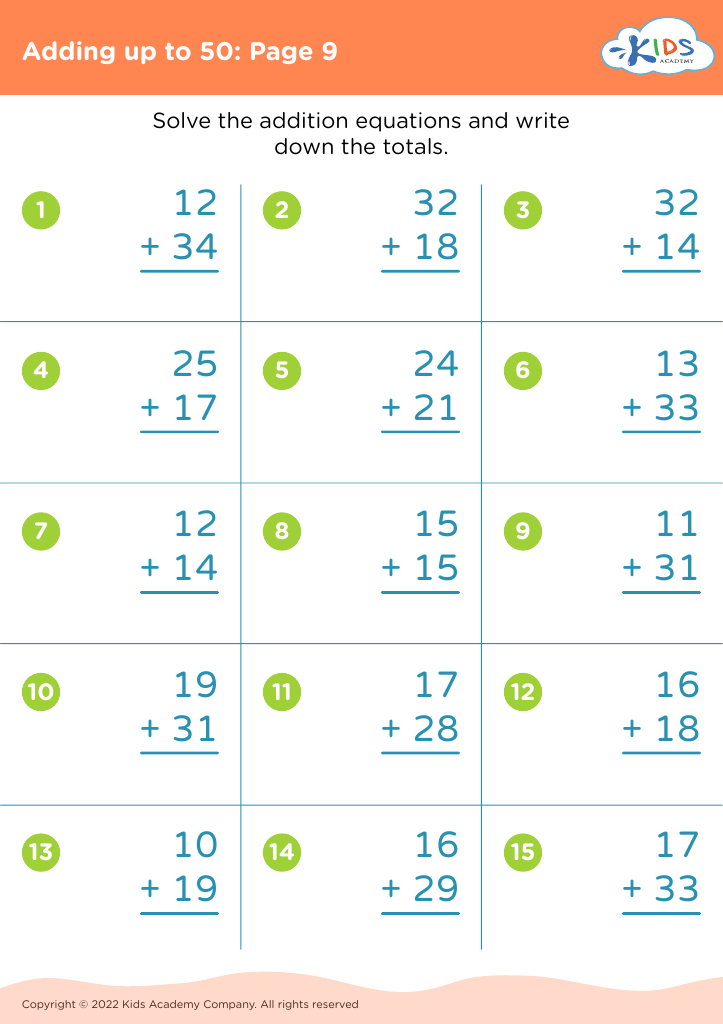
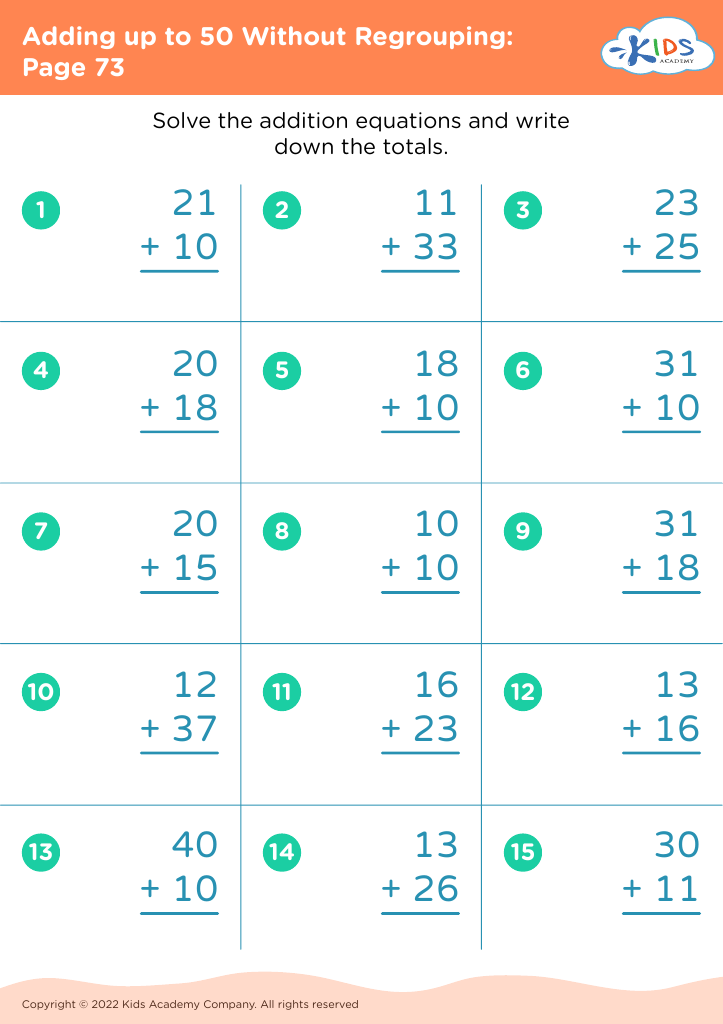




Problem solving adding up to 50 is a crucial mathematical skill for 7-year-olds that parents and teachers should prioritize for several reasons. Firstly, this skill helps young learners develop a solid foundational understanding of addition, which is essential for future mathematical concepts. Mastering addition sets the stage for more advanced operations such as subtraction, multiplication, and division.
Moreover, problem-solving abilities encourage critical thinking and enhance cognitive skills. When children engage in exercises that require them to strategically reach the sum of 50, they learn to analyze problems, break them down into manageable steps, and explore various methods to find solutions. This analytical approach is beneficial not just in math but in real-life situations that require reasoning and decision-making.
Additionally, learning to add up to 50 can boost a child's confidence and attitude towards mathematics. Success in these tasks fosters a sense of achievement and can reduce math anxiety, making them more willing to tackle increasingly complex problems. Lastly, these skills are essential in everyday scenarios—such as budgeting or measuring—providing lessons that extend beyond the classroom, illustrating the real-world applications of mathematics. Overall, focusing on problem solving in early education can significantly impact a child’s overall academic journey and personal growth.








