
Arithmetic practice Math Worksheets for 7-Year-Olds
3 filtered results
Difficulty Level
Grade
Age
-
From - To
Subject
Activity
Standards
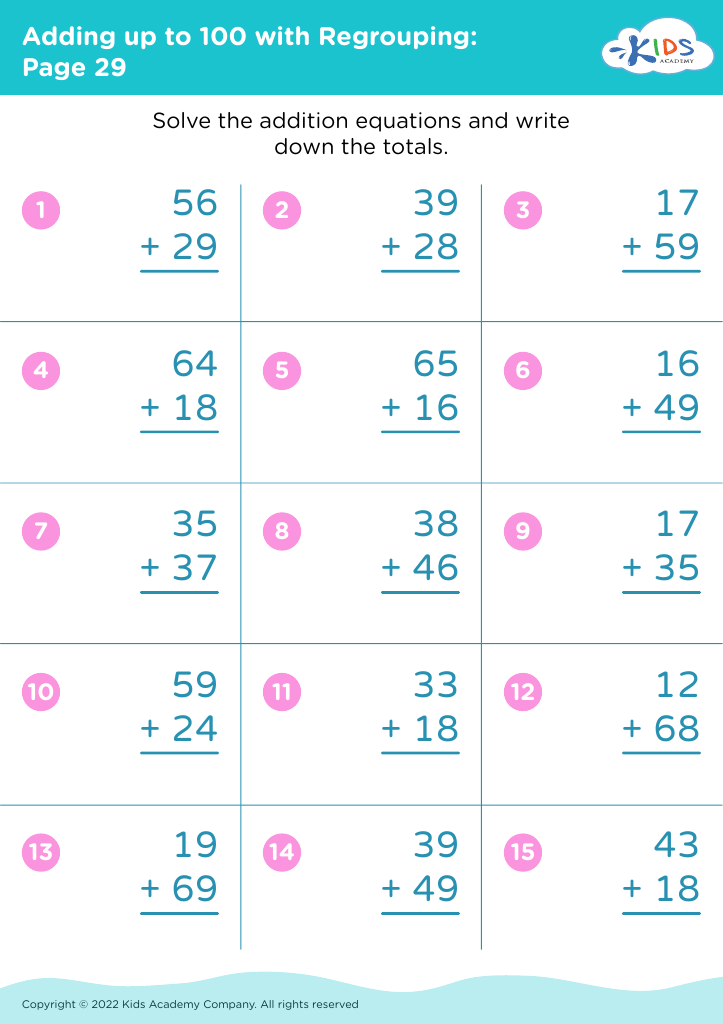
Discover an engaging collection of arithmetic practice math worksheets designed specifically for 7-year-olds! Our printable resources help young learners develop essential math skills, including addition, subtraction, and understanding number patterns. With colorful and interactive layouts, these worksheets make learning fun while reinforcing fundamental concepts in a visually appealing way. Perfect for home or classroom use, our exercises encourage children to practice at their own pace, enhancing both their confidence and proficiency in arithmetic. Whether you're a teacher, parent, or tutor, you'll find a variety of worksheets tailored to meet the needs of every 7-year-old mathematician. Get started on the path to math mastery today!
Favorites
With answer key
Interactive
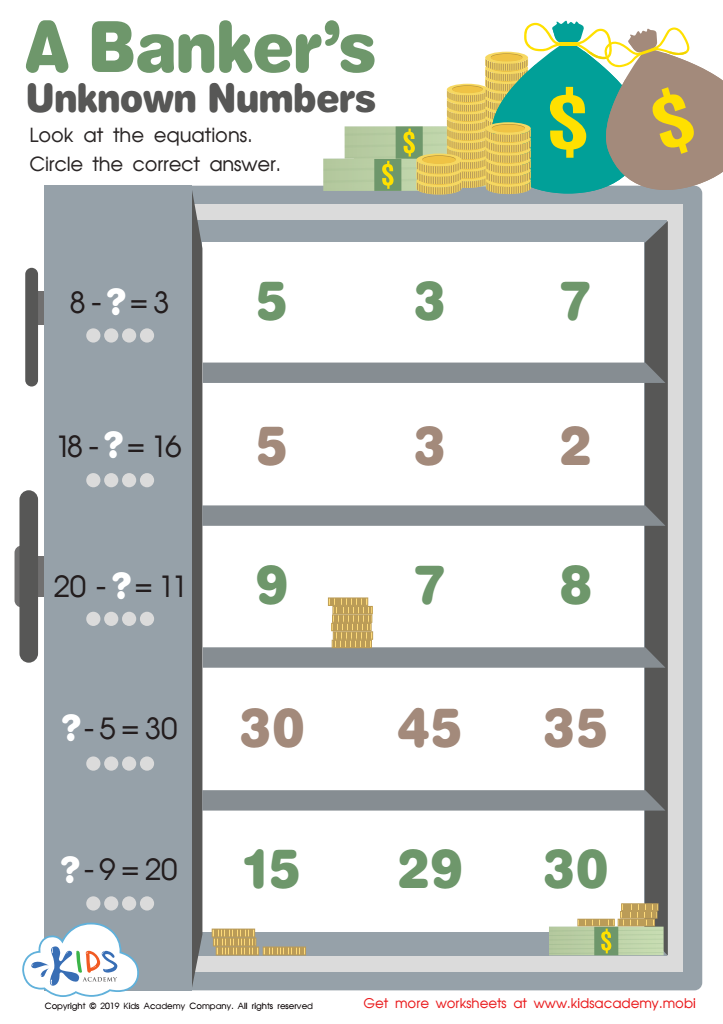
A Banker's Unknown Numbers Worksheet
At the bank, bankers count and record money properly to avoid losses. In this worksheet, kids count money and solve simple equations to find the correct answer. Help your kids work through the equations and circle the answer.
 Assign to My Students
A Banker's Unknown Numbers Worksheet
Worksheet
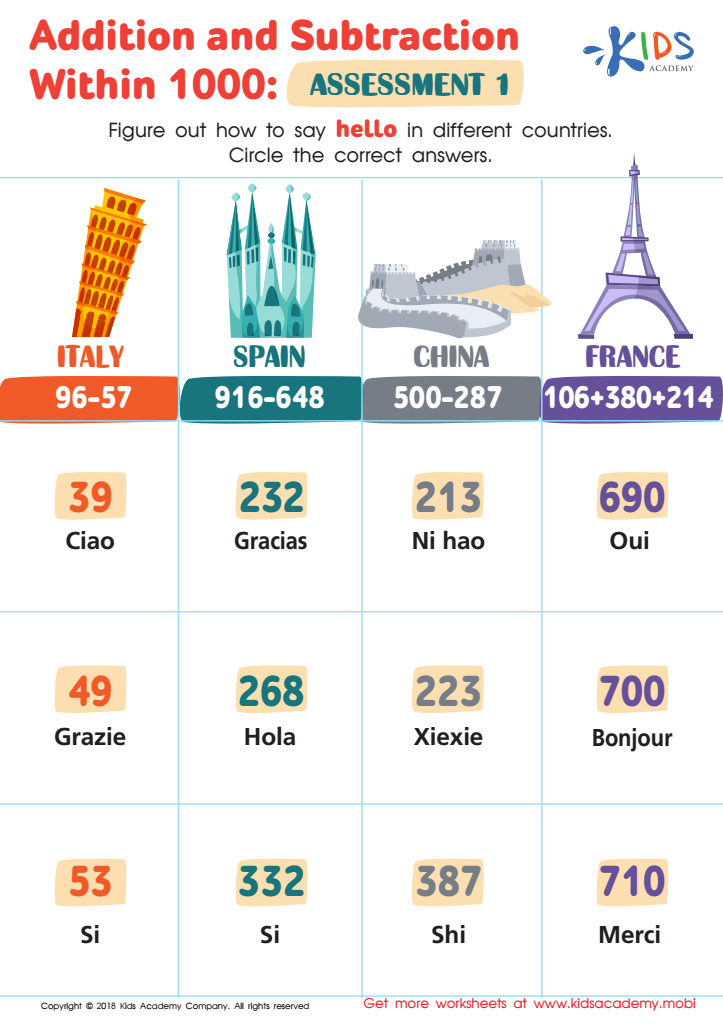
Addition and Subtraction Within 1000: Assessment 1 Worksheet
As your students grow, their knowledge and skills do too. Use this worksheet to test their adeptness in adding and subtracting numbers in the 1000s and introduce them to different ways to say hello. Let them circle the correct answers.
Addition and Subtraction Within 1000: Assessment 1 Worksheet
Worksheet
Join Kids Academy for Free
Who is primarily going to use this learning content?








Arithmetic practice is essential for 7-year-olds, as it serves as the foundation for their mathematical understanding and overall academic success. At this age, children are developing their number sense, which is critical for problem-solving and logical thinking. Regular practice helps reinforce core skills such as addition, subtraction, and the beginnings of multiplication, ensuring that students can tackle increasingly complex arithmetic as they progress in school.
Moreover, strong arithmetic skills build confidence in young learners. When children practice consistently, they gain fluency, which fosters a sense of achievement. This confidence in math can positively influence their performance in other subjects, as many disciplines require mathematical reasoning.
For parents and teachers, supporting arithmetic practice reinforces the importance of a growth mindset. It shows children that mistakes are part of learning, encouraging perseverance. Additionally, arithmetic can often be made enjoyable through games and real-world applications, making practice more engaging.
Investing time in arithmetic practice also sets children up for future learning opportunities in science, technology, engineering, and math (STEM) fields. Ultimately, arithmetic forms a crucial part of a child’s education, equipping them with vital skills necessary for everyday life and intellectual growth.








