
Story sequencing Math Worksheets for 7-Year-Olds
3 filtered results
Difficulty Level
Grade
Age
-
From - To
Subject
Activity
Standards
Discover our engaging Story Sequencing Math Worksheets designed specifically for 7-year-olds! These worksheets integrate essential math skills with creative storytelling, making learning both fun and effective. Kids will enhance their comprehension and problem-solving abilities as they sequence events in stories and solve related math problems. Our resources encourage critical thinking and help reinforce numerical concepts in a playful yet educational manner. Perfect for classroom use or at-home learning, these worksheets promote a deeper understanding of math through narrative contexts. Spark your child's love for math and storytelling today with our thoughtfully crafted worksheets that entertain and educate simultaneously!
Favorites
With answer key
Interactive
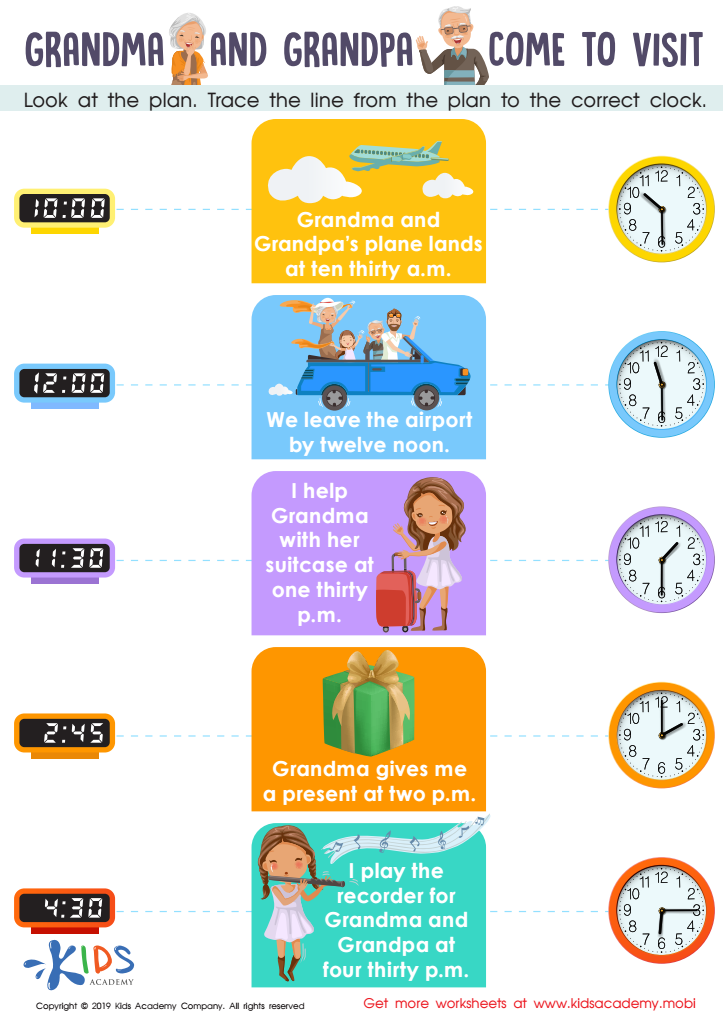
Grandpa and Grandma Come to Visit Worksheet
Have your kids learn about time using this worksheet. It contains pictures, accompanying texts and a clock, which you can use to help them trace the plan. Grandparents' visits and trips to their house are the perfect opportunity to practice this skill. Talk to your kids about the plan and watch them trace it to the correct clock.
 Assign to My Students
Grandpa and Grandma Come to Visit Worksheet
Worksheet
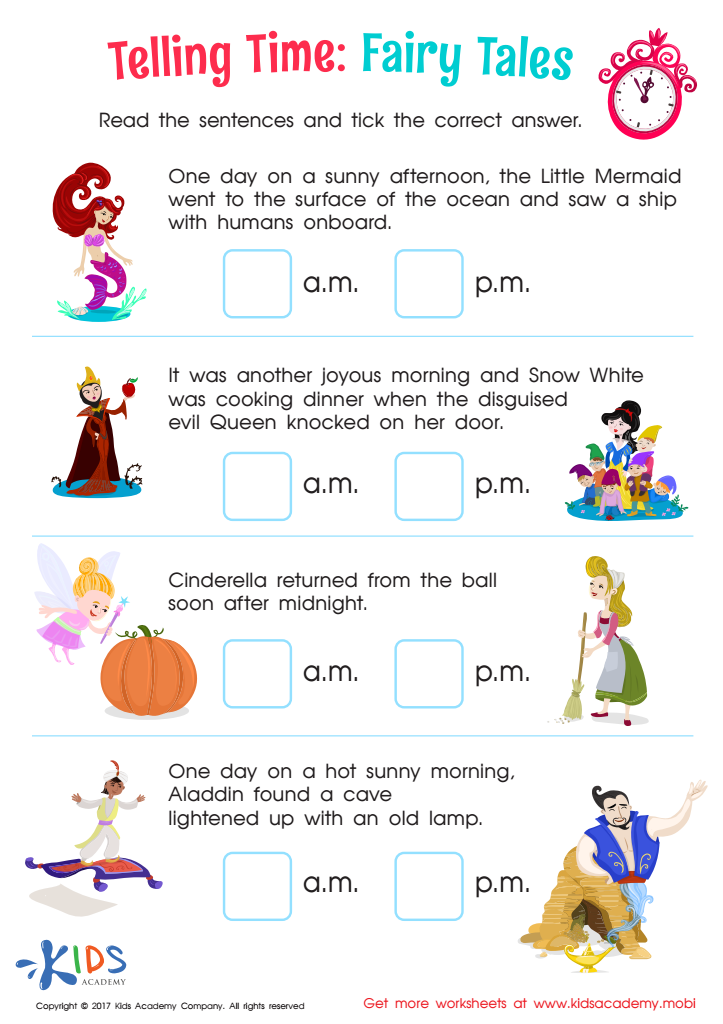
Telling Time: Fairy Tales Worksheet
Bring your child's imagination to life with classic fairy tales! This colorful telling time worksheet has it all: The Little Mermaid, Cinderella, and more! Plus, your child will have fun learning to distinguish a.m. from p.m. with this charming worksheet.
Telling Time: Fairy Tales Worksheet
Worksheet
Join Kids Academy for Free
Who is primarily going to use this learning content?








Story sequencing in math for 7-year-olds is crucial for several reasons. First, it enhances children's comprehension skills; when students learn to sequence events in a story, they gain the ability to logically arrange mathematical processes. Understanding the order in which steps must be taken in math problems mirrors the narrative structure in a story, fostering critical thinking and problem-solving skills.
Second, story sequencing helps children grasp foundational math concepts like addition and subtraction. For example, a math story problem involving buying apples can train children to follow the sequence of purchasing and eating those apples, reinforcing their understanding of operations in a relatable context.
Moreover, incorporating story elements into math encourages engagement, as children find connections between math and real-world scenarios. This relevance makes learning more appealing, fostering a positive attitude towards mathematics.
Lastly, story sequencing promotes communication skills as children learn to express their understanding of mathematical ideas verbally or through writing. By discussing and methodically working through story-based math problems, children build confidence in sharing their reasoning, a vital skill for both academics and social interactions. Therefore, embedding story sequencing in math lessons serves to develop well-rounded, capable learners.








