
Comparing objects Worksheets for Ages 8-9
3 filtered results
Difficulty Level
Grade
Age
-
From - To
Subject
Activity
Standards
Discover the joy of learning with our "Comparing Objects Worksheets for Ages 8-9." These carefully designed activities help your child sharpen their analytical skills by comparing and contrasting objects based on various attributes such as size, color, and shape. Perfect for 2nd and 3rd graders, these worksheets are engaging and educational, tailored to align with key learning benchmarks. Equipped with vivid illustrations and clear instructions, they make complex ideas simple and fun to grasp. Boost your child's observational and critical thinking skills, all while fostering a love for learning. Download now and watch them excel!
Favorites
With answer key
Interactive
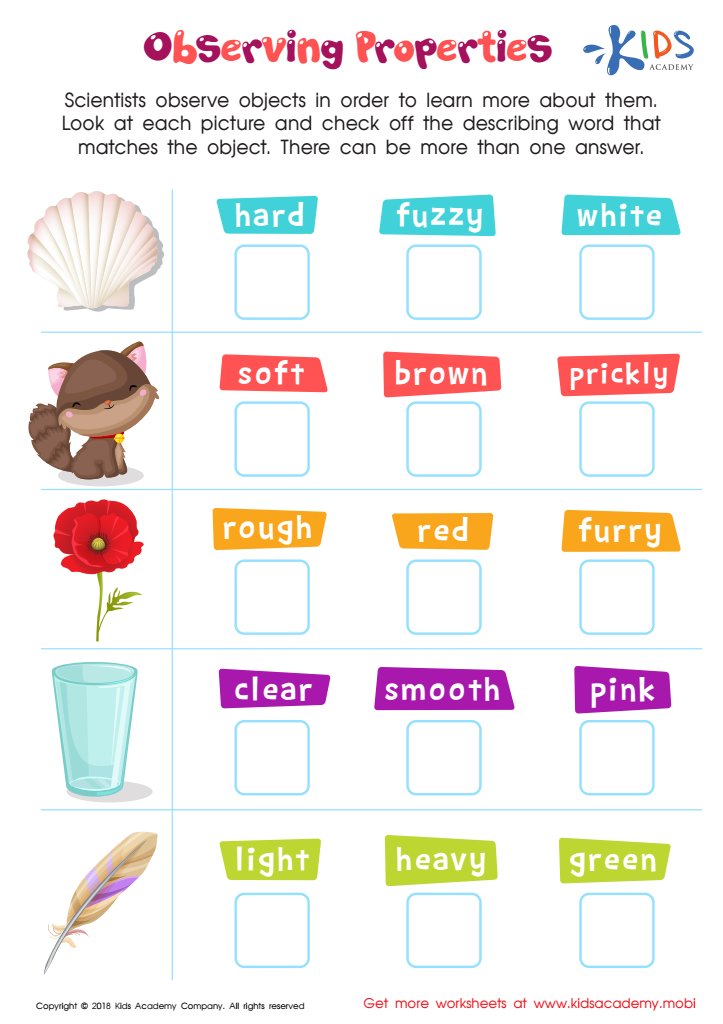
Observing Properties Worksheet
Encourage your kid's interest in science with this fun worksheet! Let them identify the five objects on the left, then choose the most accurate word from the options on the right. There might be more than one answer, so remind them to take their time observing the objects.
 Assign to My Students
Observing Properties Worksheet
Worksheet
Join Kids Academy for Free
Who is primarily going to use this learning content?



At ages 8-9, children are naturally curious and eager to learn about the world around them. Comparing objects is a fundamental educational exercise that enriches their cognitive and observational skills. When children compare objects by size, weight, shape, and other attributes, they enhance their critical thinking and problem-solving abilities. This skill is foundational for more advanced concepts in math and science, such as measurement, volume, and categorization.
Moreover, comparing objects helps children build an understanding of similarities and differences, an important aspect of logical reasoning and classification. This activity promotes language development as they learn to articulate their observations and reasoning. When parents and teachers engage children in these comparisons, they foster a growth mindset where the child learns through exploration and questioning.
Socially, comparing objects can be a collaborative activity that teaches children to work together, share perspectives, and develop empathy by understanding that different views can coexist.
Overall, nurturing the skill of comparing objects at this age lays a strong educational foundation. It also involves practical, everyday learning, making education seamless and engaging. Therefore, parents and teachers should prioritize these activities to support holistic child development.








