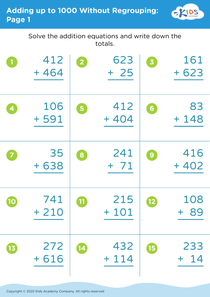
Mathematical reasoning Adding up to 1000 with Regrouping Worksheets for Ages 8-9
3 filtered results
-
From - To
Enhance your child's mathematical reasoning with our "Adding up to 1000 with Regrouping Worksheets" designed for ages 8-9. These engaging, printable worksheets help young learners practice adding large numbers with regrouping, building a strong foundation in essential math skills. Each worksheet challenges students to approach problems step-by-step, improving critical thinking and problem-solving abilities. The vivid and well-structured exercises are crafted to make learning fun and effective, boosting both confidence and competence in math. Equip your child for future success with our expertly designed resources that turn math practice into an enjoyable adventure. Get started today!
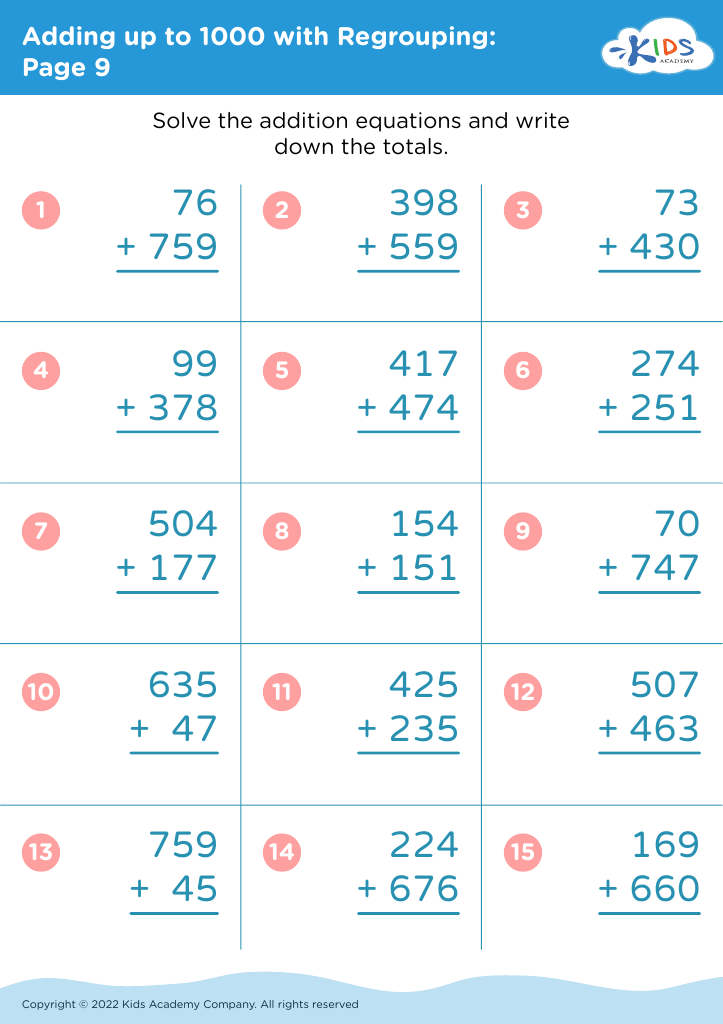
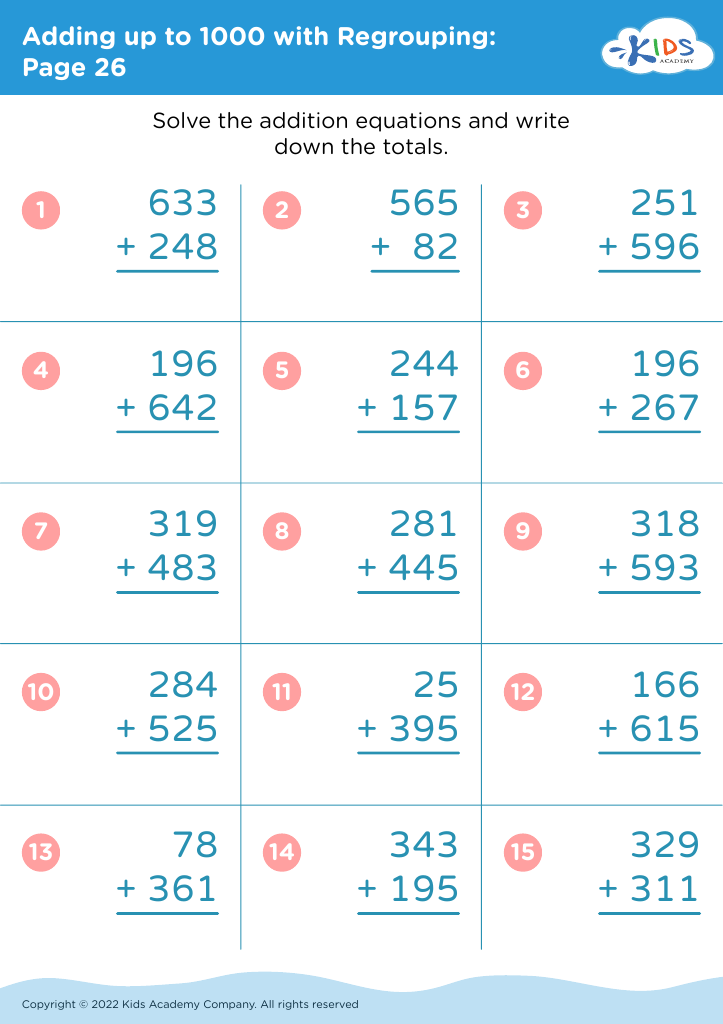
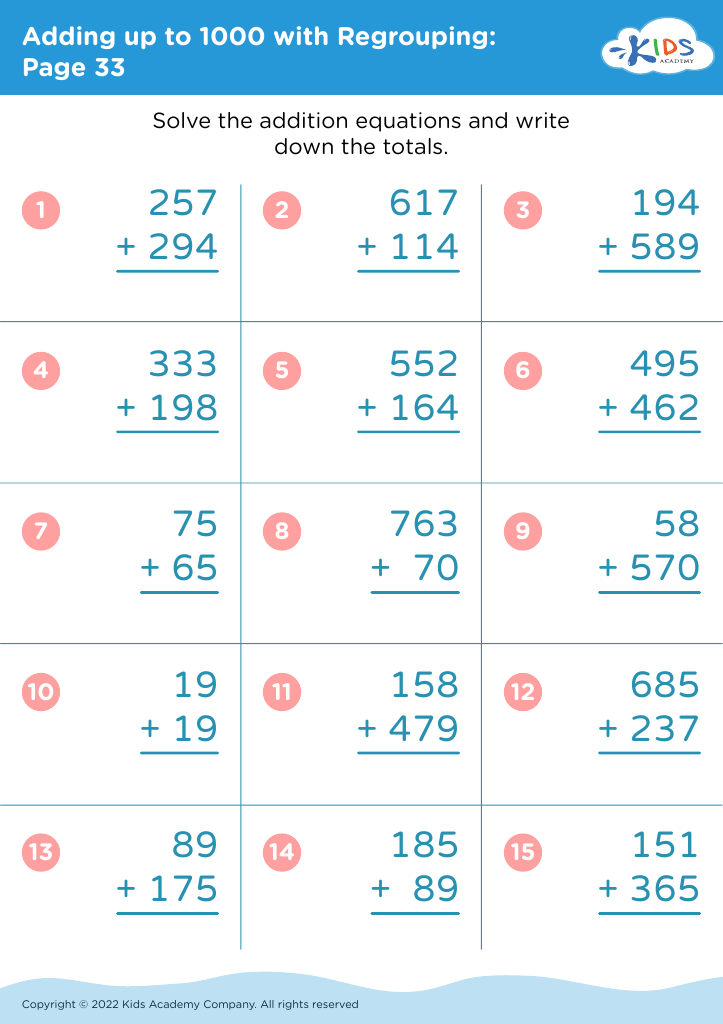


Mathematical reasoning and the ability to add numbers up to 1000 with regrouping are crucial skills for children aged 8-9 due to several important reasons. Firstly, these skills lay the groundwork for higher-level mathematics. Understanding the concept of regrouping helps kids comprehend place value, which is fundamental in operations like addition, subtraction, multiplication, and division. For example, recognizing that 456 + 178 involves combining units, tens, and hundreds accurately ensures they can manage more complicated arithmetic in later stages.
Secondly, mathematical reasoning fosters critical thinking and problem-solving abilities. When kids solve addition problems requiring regrouping, they are not just performing mechanical operations; they are reasoning logically about number relationships and developing a structured way of thinking. Skills gained here can be applied to real-life situations, such as managing money, time, or other practical computations.
Additionally, mastering these skills boosts confidence and contributes to a positive attitude toward math as a subject. Children are naturally curious and resilient; when they overcome challenges like adding large numbers, their self-esteem improves and motivates them to tackle even more complex problems.
In essence, focusing on mathematical reasoning and regrouping for young children sets a strong educational foundation, equips them with lifelong skills, and nurtures a constructive attitude towards learning and problem-solving.