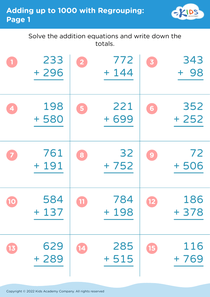
Basic Math Skills Adding up to 1000 Without Regrouping Worksheets for Ages 8-9
3 filtered results
-
From - To
Welcome to our "Basic Math Skills Adding up to 1000 Without Regrouping Worksheets" for children ages 8-9! Our engaging worksheets offer young learners a fun and effective way to practice their addition skills, enabling them to confidently add numbers without regrouping. Each worksheet focuses on building fluency and accuracy in adding numbers up to 1000, fostering a strong mathematical foundation. With vibrant illustrations and progressive difficulty levels, these worksheets are perfect for both classroom and home learning. Support your child's math journey and watch their confidence grow as they master basic addition skills while having fun!
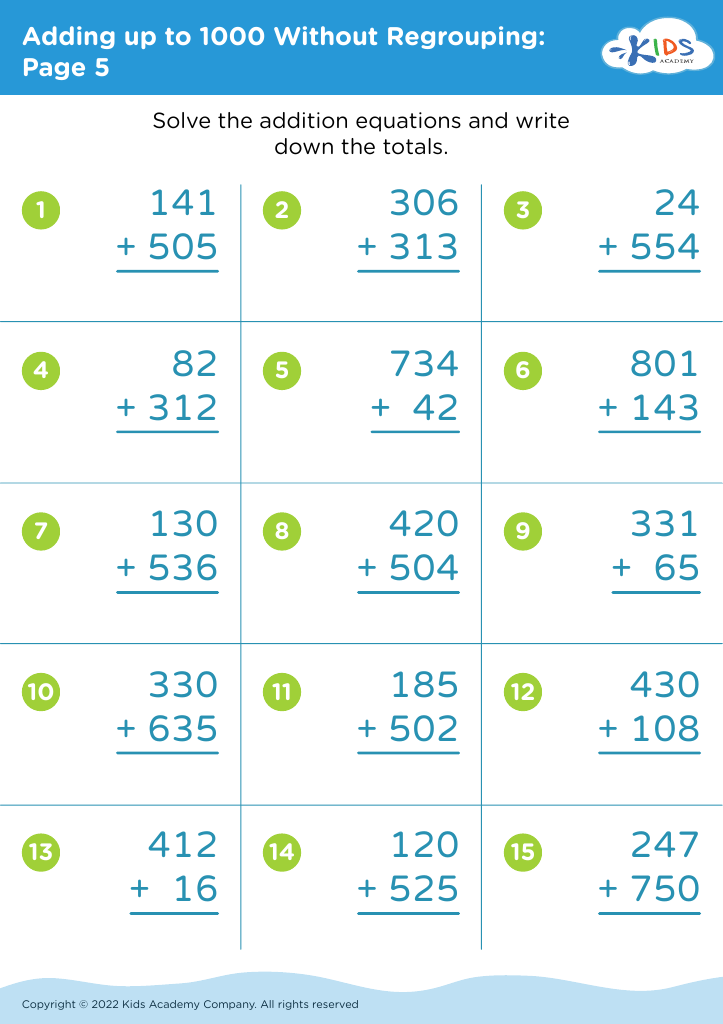
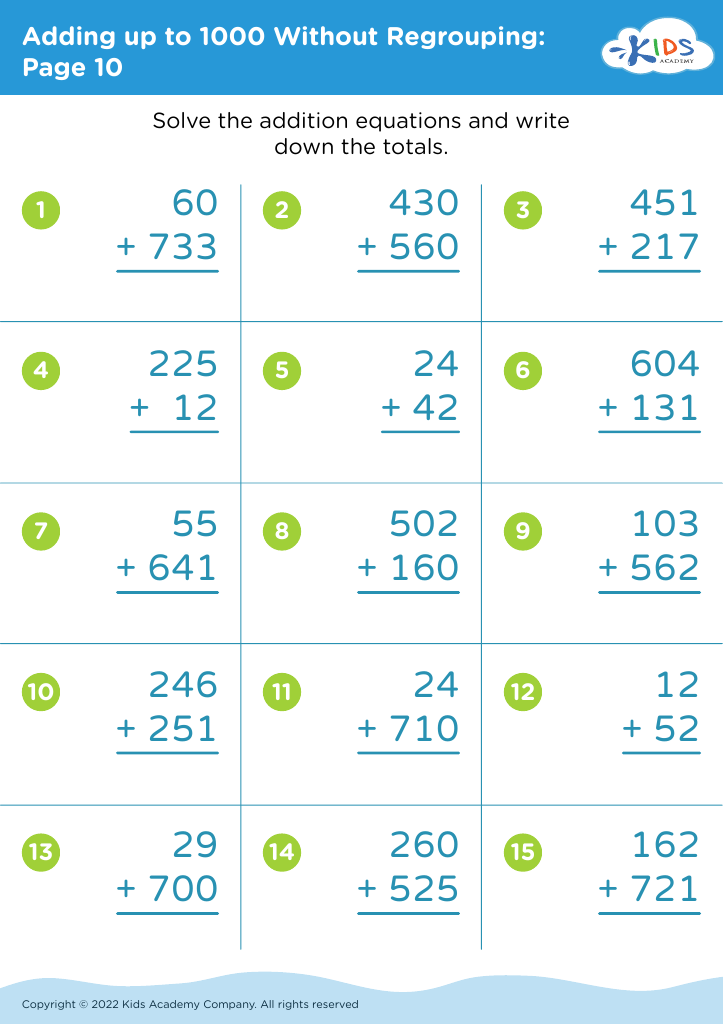
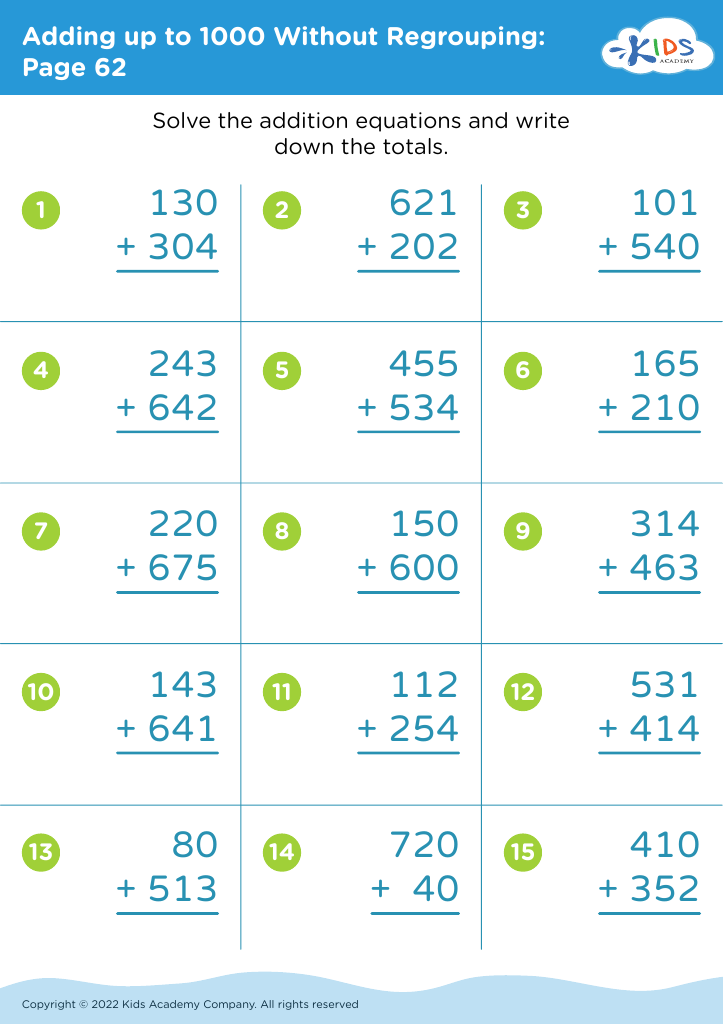


Developing basic math skills, particularly the ability to add numbers up to 1000 without regrouping, is critical for children aged 8-9. At this stage, children are transitioning from concrete to more abstract mathematical concepts, making it an essential time for building foundational skills. Mastery of adding without regrouping not only boosts numerical fluency but also enhances critical thinking and problem-solving abilities.
When children can confidently add numbers to 1000, they gain a sense of accomplishment and boost their self-esteem, paving the way for tackling more challenging mathematical concepts in the future. This skill also helps them grasp more complex operations, like subtraction and multi-digit addition.
Moreover, understanding these basic math skills promotes financial literacy as children learn to manage money and make sense of everyday math scenarios. For parents and teachers alike, fostering these skills supports overall academic success and prepares children for real-life applications of mathematics. Engaging kids with fun and interactive activities can make learning these skills enjoyable, sparking a lasting interest in math. Ultimately, the ability to add without regrouping lays the groundwork for higher-level math challenges, ensuring that children are well-equipped for future grade levels.