Develop counting skills Adding up to 1000 Without Regrouping Worksheets for Ages 8-9
3 filtered results
-
From - To
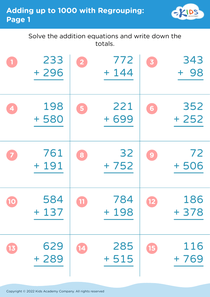
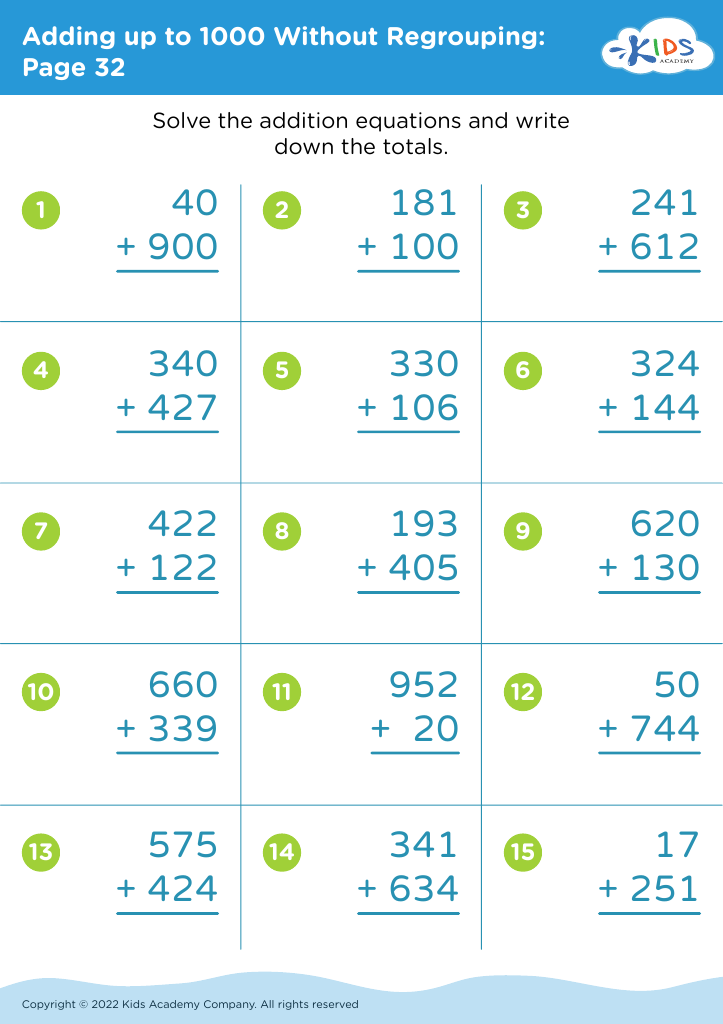
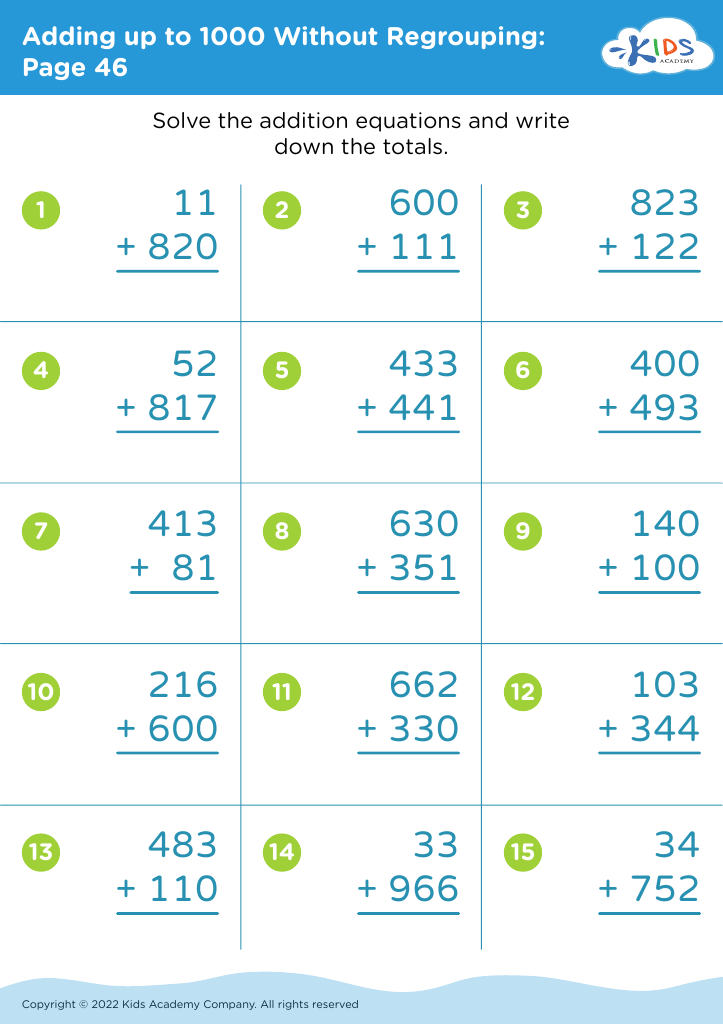
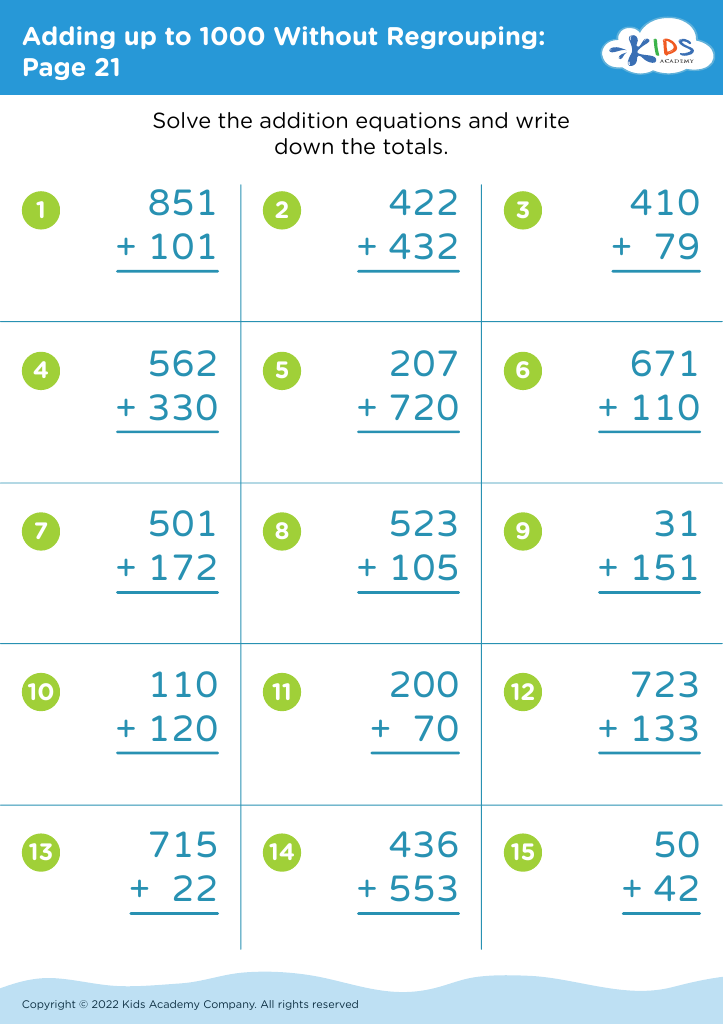
Our "Adding up to 1000 Without Regrouping Worksheets" for ages 8-9 are perfect for helping young learners develop essential counting skills. Each engaging worksheet is meticulously designed to provide children with ample practice in basic addition, ensuring they grasp the foundational concepts without the complexity of regrouping. Through diverse exercises and fun challenges, kids will enhance their numerical fluency and arithmetic confidence. Ideal for classroom use or at-home practice, these worksheets are your go-to resource for making math both enjoyable and educational for your child. Unlock their potential in mathematics today with our expertly crafted printables!


Developing counting skills and addition up to 1,000 without regrouping is crucial for children ages 8-9 as it builds a solid foundation for their arithmetic and overall mathematical understanding. At this developmental stage, mastering addition skills facilitates mental arithmetic, enhances problem-solving abilities, and promotes confidence in handling numbers. By focusing on non-regrouping addition, children are able to solidify their comprehension of place values, which is essential for more advanced calculations involving regrouping (or carrying over).
Moreover, proficiency in addition up to 1,000 supports better comprehension of real-world applications such as money handling, measurement in cooking and construction, and time management. These skills are not only academically significant but also boost a child’s independence and practical life skills.
For parents and teachers, strengthening these skills means creating an engaging and supportive learning environment. Frequent practice through games, interactive activities, and real-life scenarios can make the learning process enjoyable while emphasizing the importance. Consistency and encouragement from adults enable children to overcome challenges and develop a positive attitude toward math. Ultimately, emphasizing counting and addition at this age makes complex mathematical concepts more accessible and paves the way for future academic achievements.