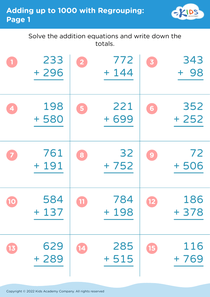
Improving counting skills Adding up to 1000 Without Regrouping Worksheets for Ages 8-9
4 filtered results
-
From - To
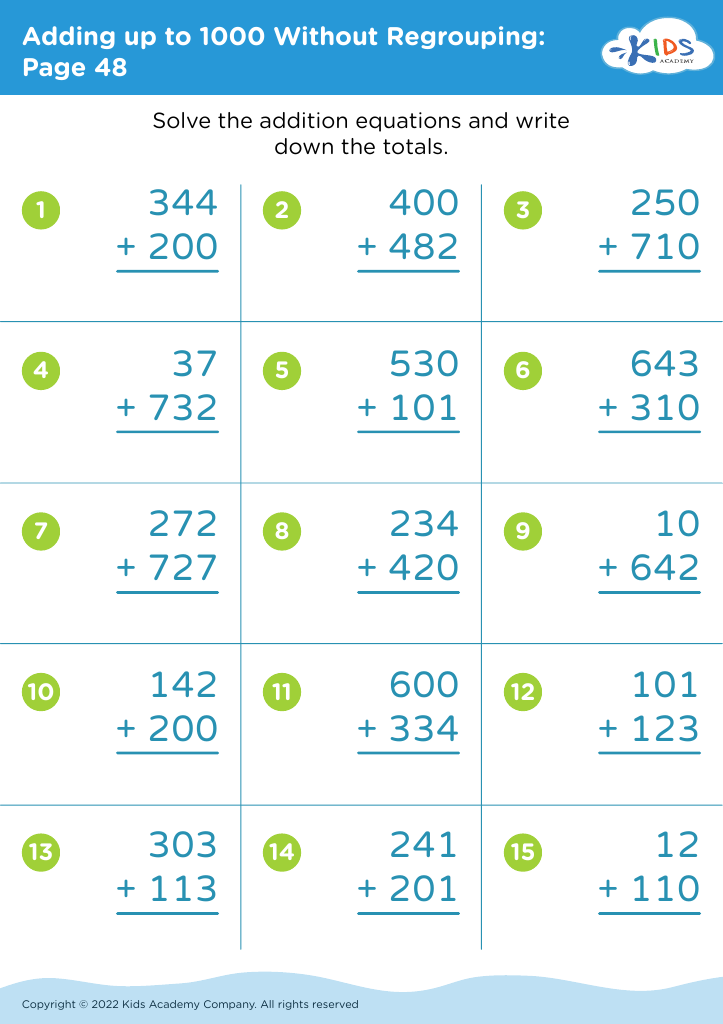
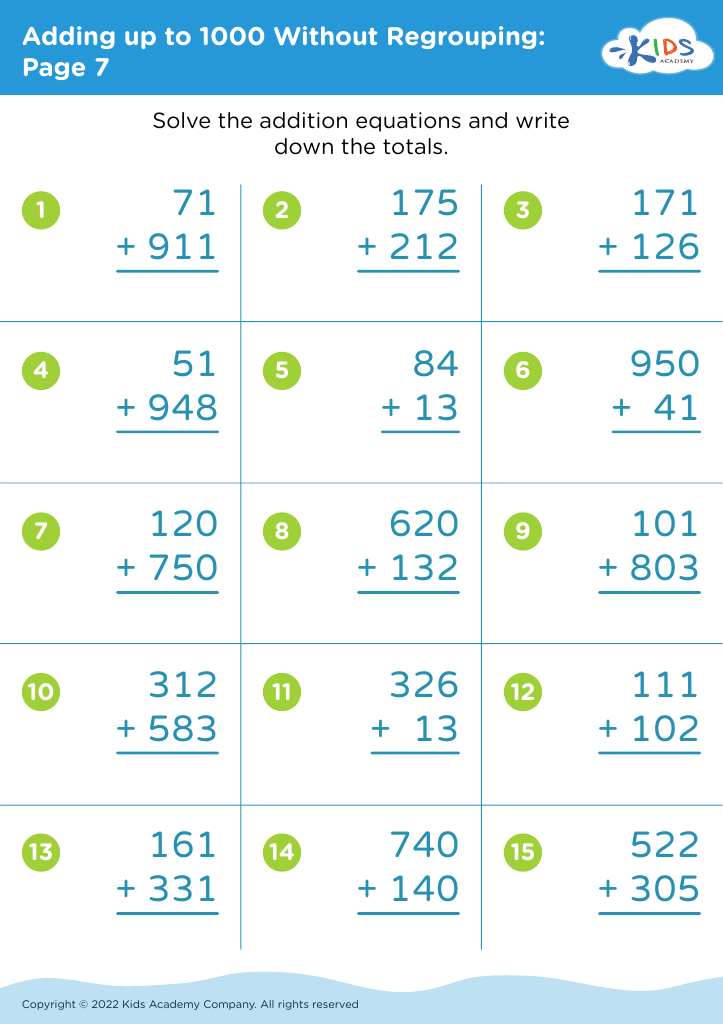
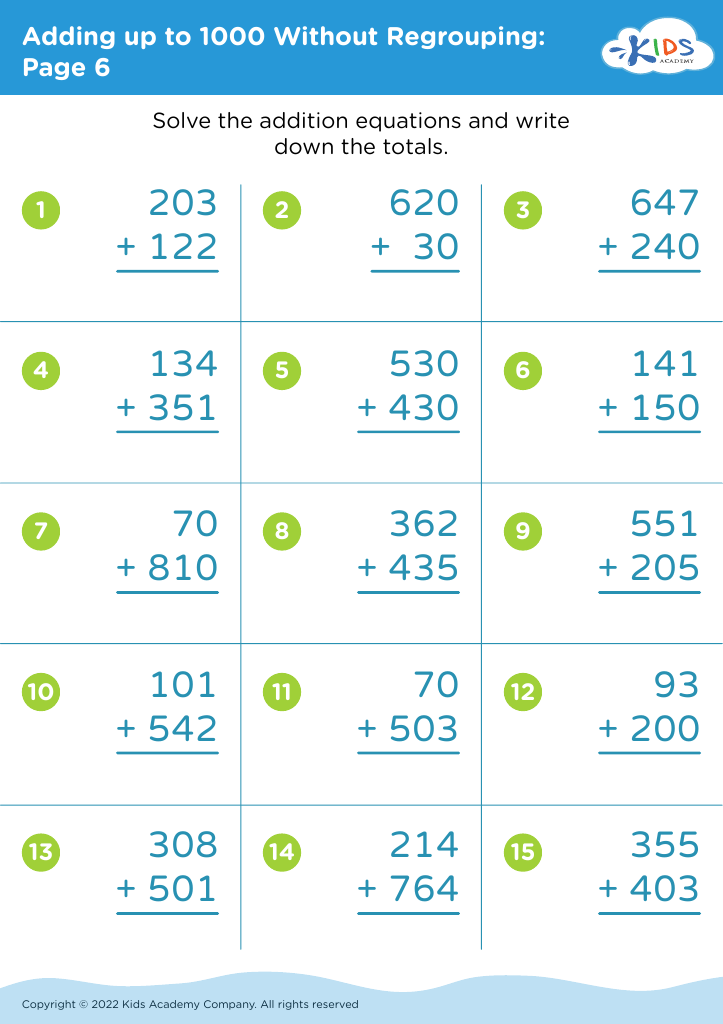
Enhance your child's counting abilities with our "Improving Counting Skills: Adding Up to 1000 Without Regrouping Worksheets" designed for ages 8-9. These engaging and educational worksheets help young learners master addition without the need for regrouping, fostering confidence and proficiency in math. Tailored to make learning fun and effective, our worksheets offer a variety of problems that build a strong foundation in arithmetic. Accessible and convenient, these resources are perfect for both classroom and home use, ensuring your child achieves their full mathematical potential. Start boosting your child's counting skills today!
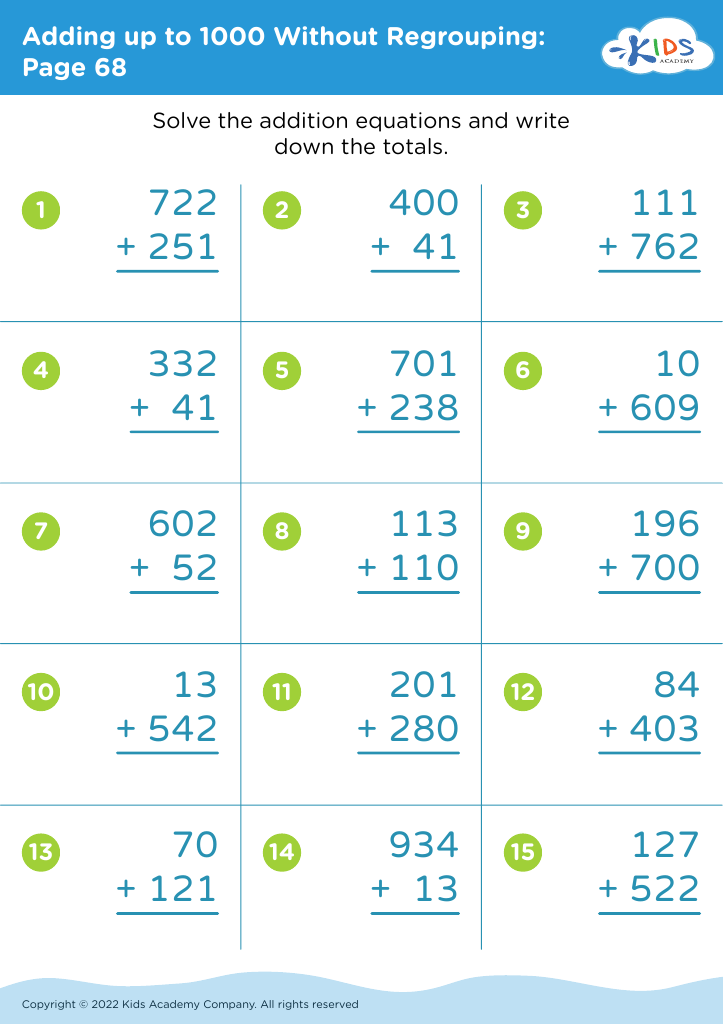


Improving counting skills without regrouping for children aged 8-9 is vital for foundational math development. At this age, students transition from basic arithmetic to more complex operations. Strengthening their ability to add up to 1,000 without regrouping ensures they fully grasp the value of each digit in different place values – units, tens, and hundreds.
Mastering these skills bolsters their number sense, making it easier to understand larger operations in the future, including subtraction, multiplication, and division. Comprehending addition concepts develops critical thinking, problem-solving abilities, and enhances logical reasoning.
Moreover, competency in addition boosts confidence. When children realize they can add large numbers accurately, they feel more secure in their mathematical abilities, fostering a positive attitude towards the subject. This self-assurance can lead to better performance not only in math but across other curriculum areas that require analytical skills.
For parents and teachers, emphasizing these skills fosters a strong educational foundation, preparing children for more challenging math concepts. Early proficiency predicts future success; hence, making a focused effort now equates to lifelong benefits. Supporting children in mastering these skills cultivates an ability to approach complex problems systematically, promoting educational growth and success.