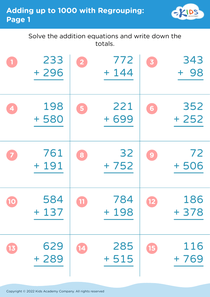
Recognize patterns Adding up to 1000 Without Regrouping Worksheets for Ages 8-9
3 filtered results
-
From - To
Enhance your child's math skills with our "Recognize Patterns Adding Up to 1000 Without Regrouping Worksheets" designed specifically for ages 8-9. These engaging worksheets focus on developing pattern recognition skills while mastering addition within 1000. By identifying numerical patterns, children will build a solid foundation in math concepts and boost confidence. The user-friendly format ensures a fun learning experience, making complex ideas accessible to young learners. Perfect for classroom use or at-home practice, our worksheets are an essential resource for reinforcing math skills in a playful, effective manner. Unlock your child's potential and make math enjoyable today!
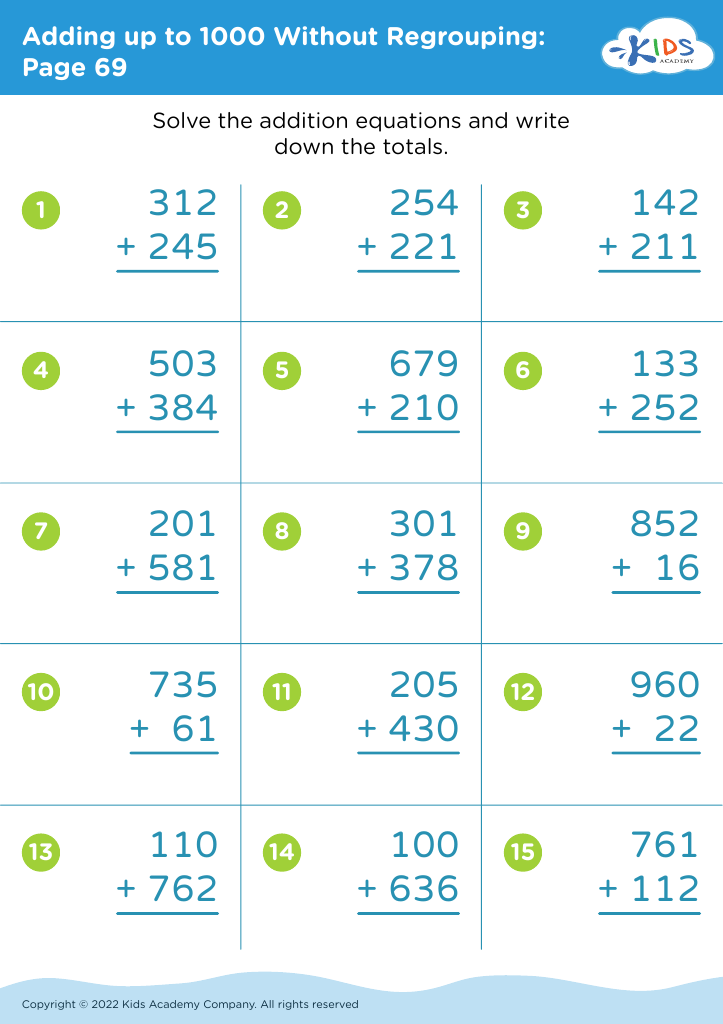
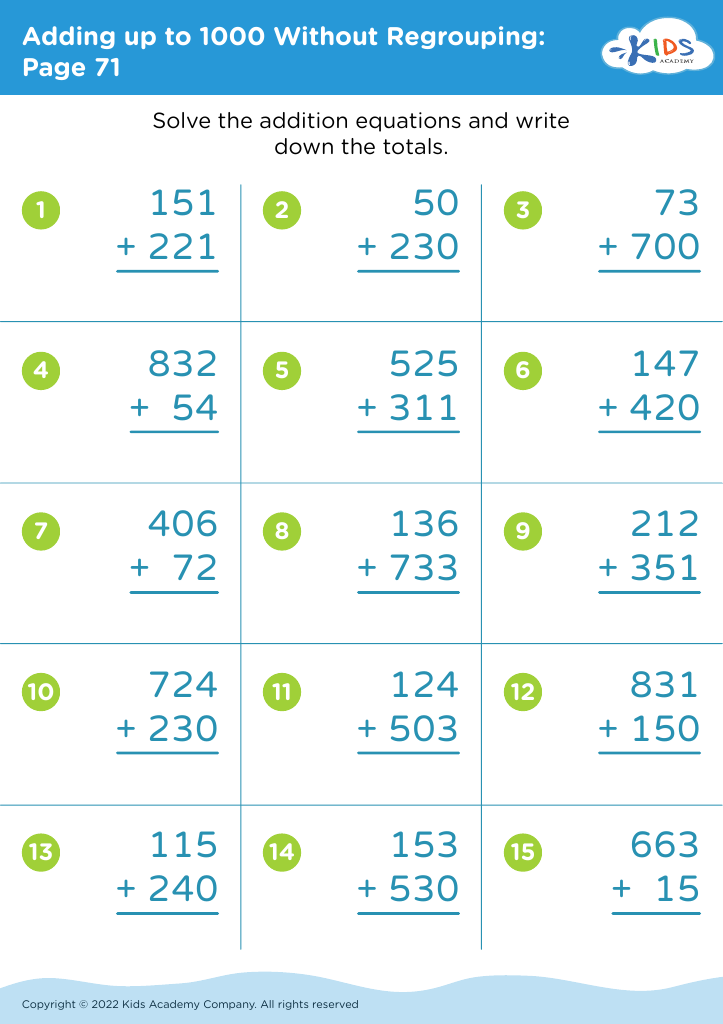
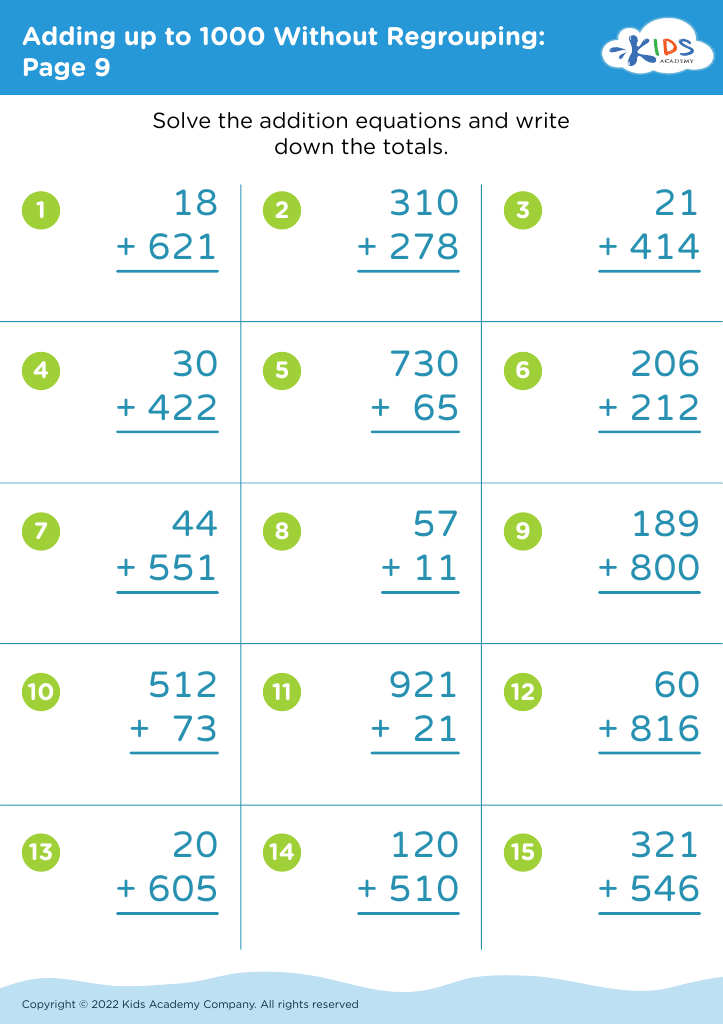


Recognizing patterns while adding up to 1000 without regrouping is a vital skill for students aged 8-9, and it holds significant importance for both parents and teachers. First, understanding these patterns enhances numerical fluency, which serves as the building block for more complicated arithmetic later. By acknowledging relationships among numbers—such as pairs that sum to ten or sequences of numbers—the students develop confidence in their calculations.
Furthermore, this skill promotes critical thinking and problem-solving abilities. When children can identify patterns, they become adept at making predictions about numbers and can tackle more challenging mathematical concepts with ease. This foundational knowledge also allows for quicker mental calculations, minimizing reliance on calculators in day-to-day tasks.
From a parental perspective, reinforcing pattern recognition at home enables a fun and engaging learning environment, sparking a child’s interest in math. Teachers can utilize this skill to reinforce classroom strategies, enhancing collaborative learning experiences.
Ultimately, recognizing patterns in math empowers students during their formative years and contributes significantly to their overall academic success in mathematics, paving the way for mastery of future topics and applications in real-world situations.