Understanding division Adding up to 1000 Without Regrouping Worksheets for Ages 8-9
3 filtered results
-
From - To
Explore our engaging "Understanding Division Adding Up to 1000 Without Regrouping Worksheets" designed specifically for children aged 8-9. These worksheets provide a comprehensive approach to division concepts without the complexities of regrouping. Designed to strengthen foundational math skills, students will learn to divide numbers effectively, boosting their confidence and proficiency. Each worksheet features age-appropriate problems and colorful illustrations that make learning fun. With a variety of exercises, children will gain a deeper understanding of how division relates to addition and subtraction, enhancing their overall arithmetic skills. Perfect for classroom practice or homeschooling, these resources ensure a solid mathematical foundation for young learners.
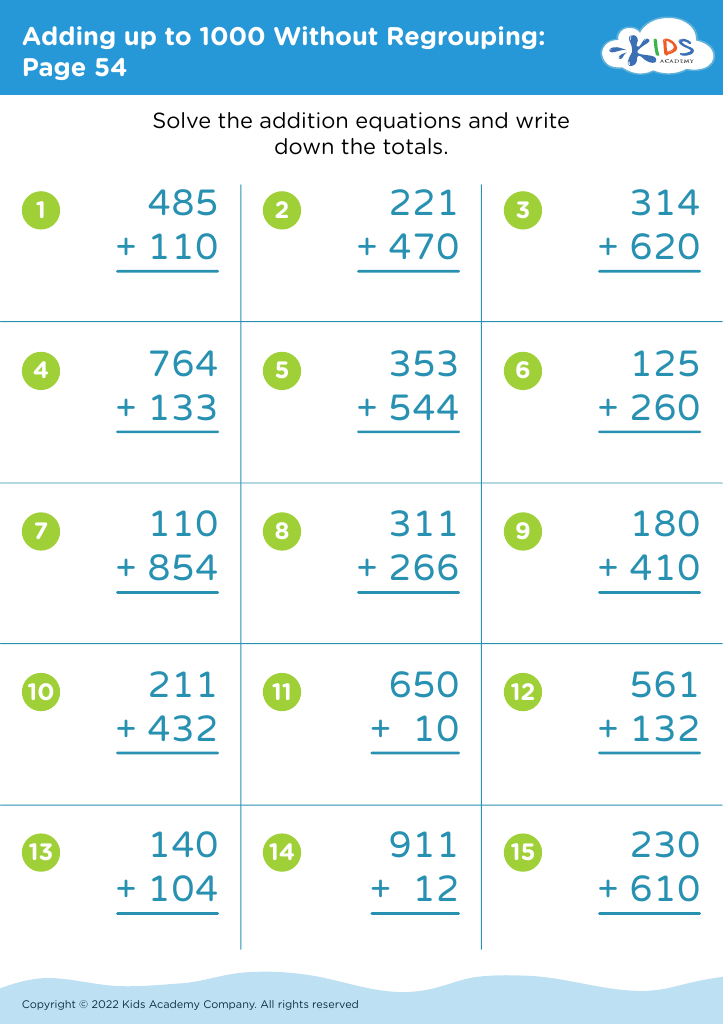
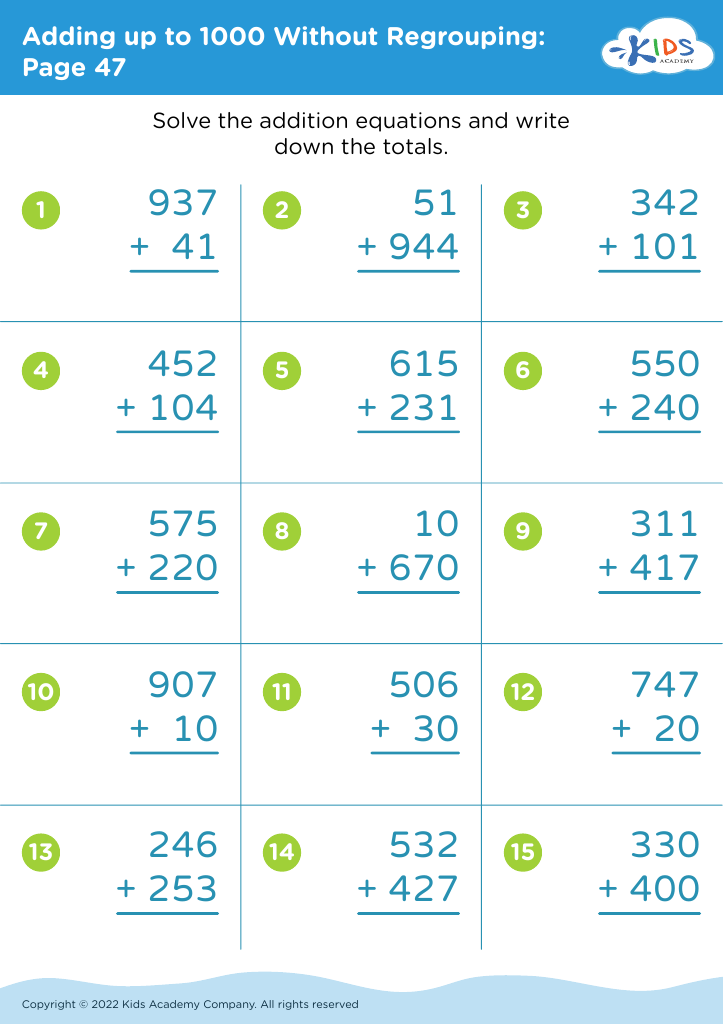
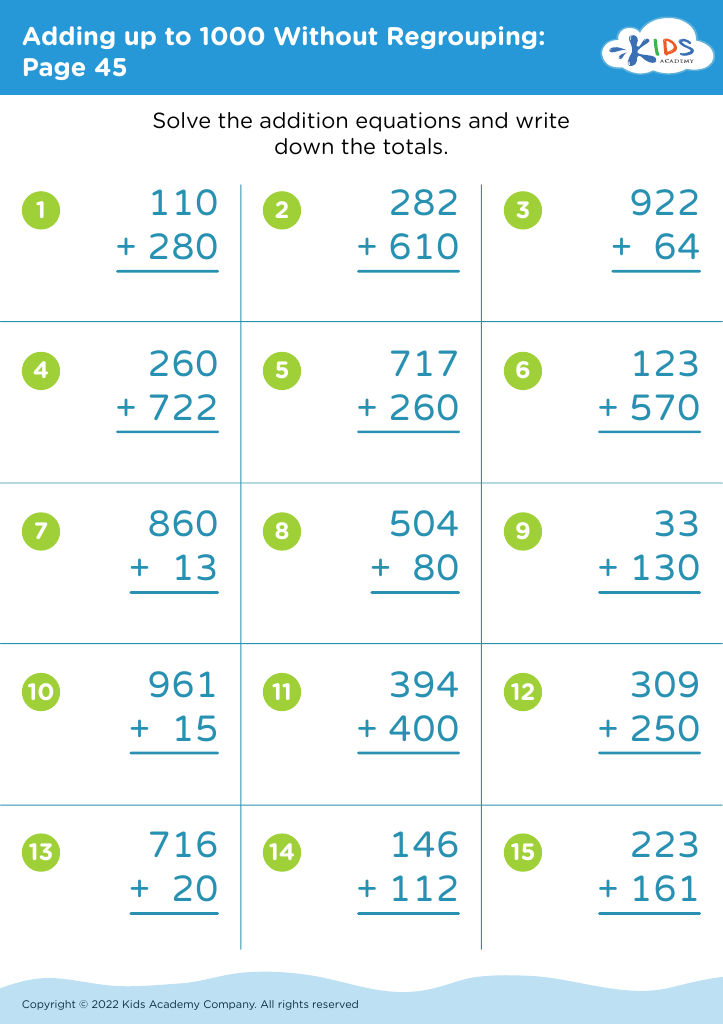


Understanding division and the ability to add up to 1000 without regrouping are essential skills for children aged 8-9. Mastering these concepts serves as a building block for more complex mathematical operations encountered in higher grades and everyday life.
For parents and teachers, prioritizing these skills helps to cultivate a strong mathematical foundation. Division promotes critical thinking and problem-solving abilities, as children learn to break down larger concepts into manageable parts. This enhances their capacity to tackle more difficult tasks in mathematics, science, and practical scenarios.
Adding up to 1000 without regrouping allows students to develop their mental math skills, boosting their confidence. It fosters numerical fluency, enabling children to perform calculations efficiently and accurately. Such skills translate directly into enhanced performance in school assessments and daily life situations, like budgeting or measuring.
Moreover, when teachers and parents focus on these skills, they lay the groundwork for a child’s positive attitude towards mathematics. Early exposure leads to improved perseverance and resilience in tackling challenging tasks. Ultimately, guiding children in these areas not only enriches their academic prospects but also instills lifelong skills beneficial in numerous real-world applications. Investing time and resources in these fundamental abilities pays dividends in a child's overall educational journey.