Basic Addition Skills Adding up to 1000 Worksheets for Ages 8-9
3 filtered results
-
From - To
Unlock your child's full potential in basic addition with our "Basic Addition Skills: Adding up to 1000 Worksheets" designed specifically for ages 8-9. These engaging and expertly crafted worksheets help kids build a strong foundation in addition while boosting their confidence and problem-solving skills. Through various fun activities and exercises, children will master adding numbers up to 1000, making math learning both exciting and effective. Perfect for classrooms or at-home practice, our worksheets cater to different learning styles, ensuring every child progresses at their own pace. Foster a love for math with Kids Academy's top-notch resources!
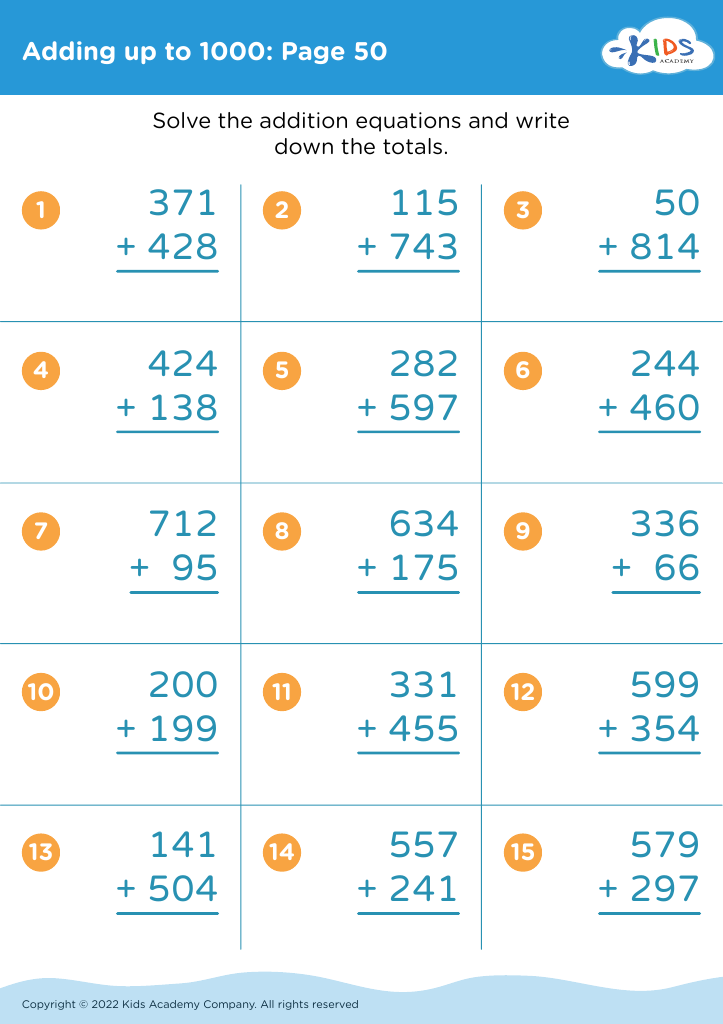
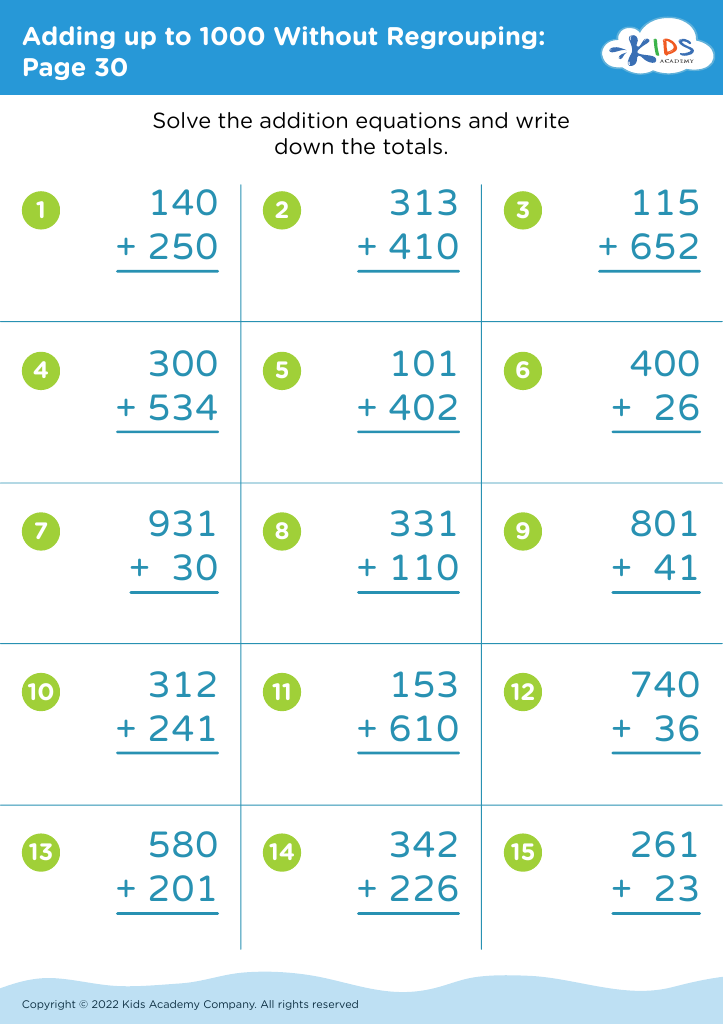
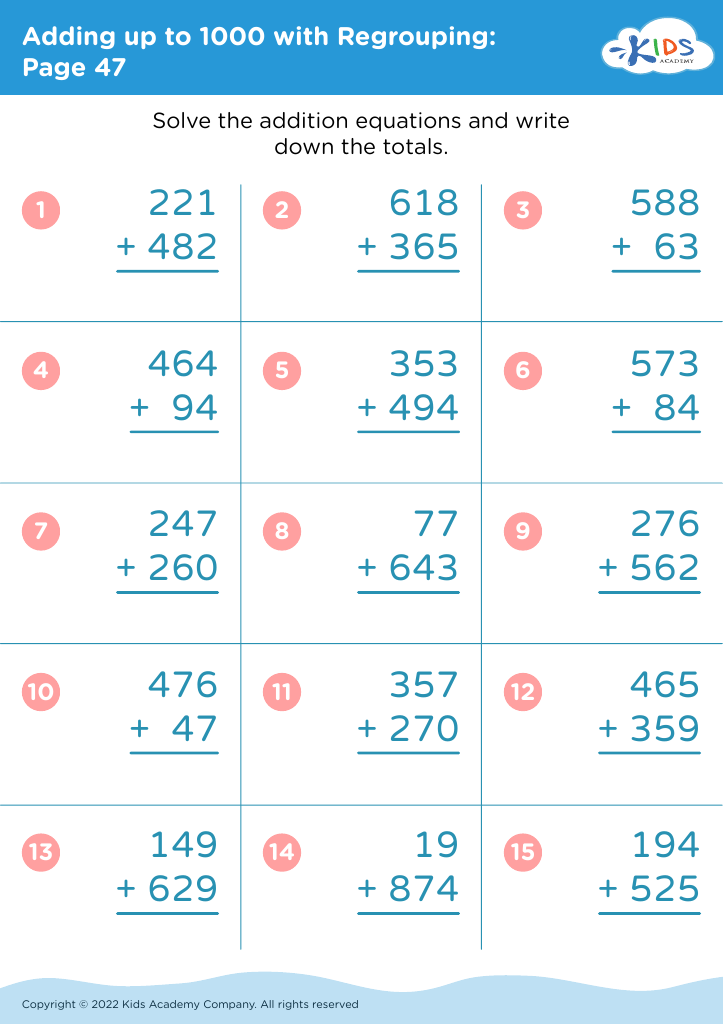



At around ages 8 to 9, children are at a crucial stage in their cognitive and mathematical development. Mastering basic addition skills that encompass numbers up to 1000 is essential for several reasons. First, it forms the cornerstone of more complex arithmetic and problem-solving skills. Without a strong understanding of basic addition, children may struggle with more advanced topics like multiplication, division, and fractions, which can impede overall mathematical progress.
Additionally, developing proficiency in addition nurtures critical thinking and logical reasoning abilities. It requires children to recognize patterns, understand the relationship between numbers, and enhance mental calculation skills. Such cognitive benefits extend beyond mathematics, promoting better performance in other academic areas and everyday decision-making.
Moreover, confidence in mathematical skills influences a child’s attitude towards learning. Success in addition can build self-esteem, reduce math anxiety, and foster a positive mindset towards challenging problems. This foundation not only impacts their academic trajectory but also their long-term relationship with education.
Parents and teachers who prioritize these skills contribute to a child’s overall growth and ability to navigate a world increasingly driven by data and numbers. By focusing on these basic yet pivotal skills, we equip children with the tools they need for future success in both academic and real-life situations.








