Problem Solving Adding up to 1000 Worksheets for Ages 8-9
3 filtered results
-
From - To
Enhance your child's math skills with our engaging Problem Solving Worksheets focused on adding up to 1000, specially designed for ages 8-9. These interactive worksheets help young learners develop critical thinking and problem-solving abilities while mastering addition up to 1000. Our resources provide a variety of fun and challenging exercises, promoting a deep understanding of mathematical concepts through real-life scenarios. With vibrant visuals and easy-to-follow instructions, your child will love tackling each problem. Perfect for home practice or classroom activities, these worksheets lay a solid foundation for future math success. Download and start inspiring confidence in problem-solving today!
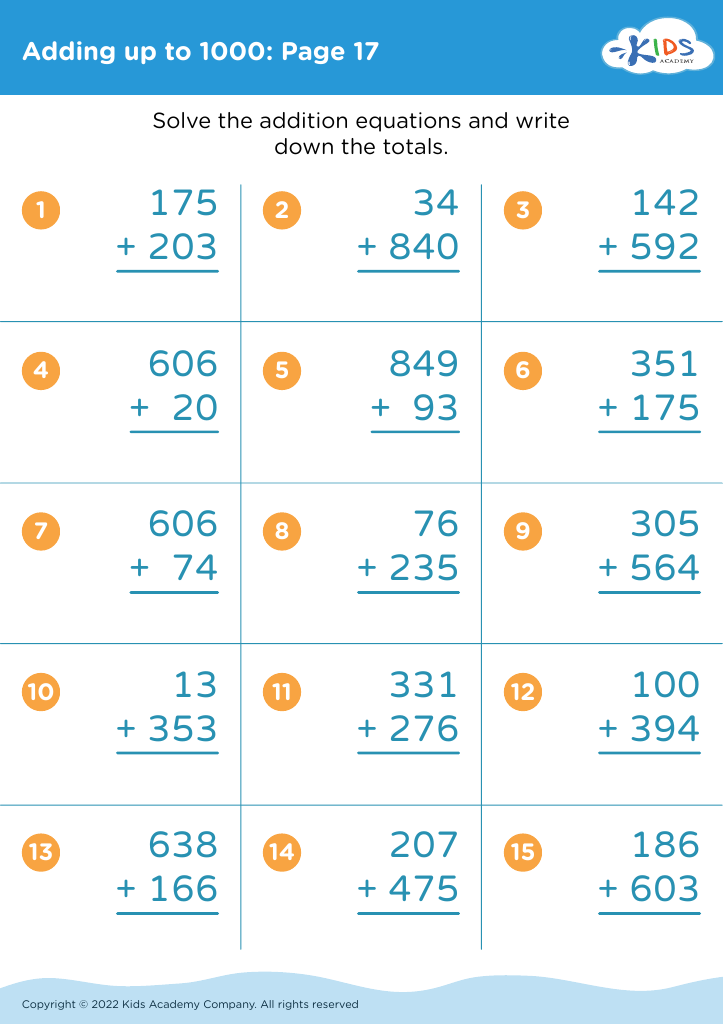
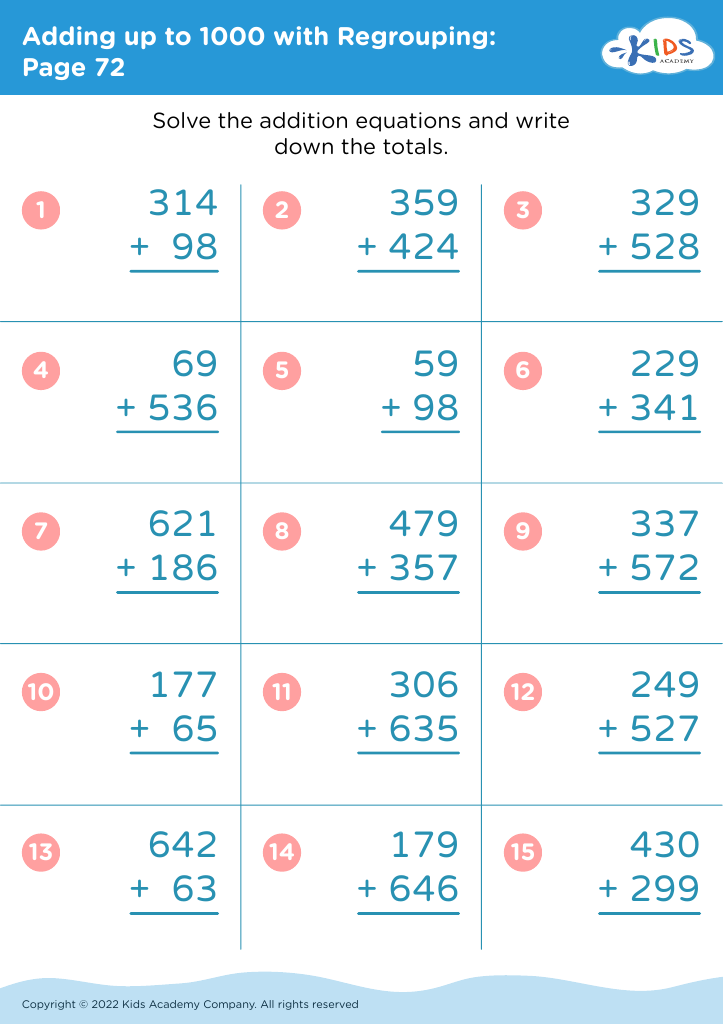
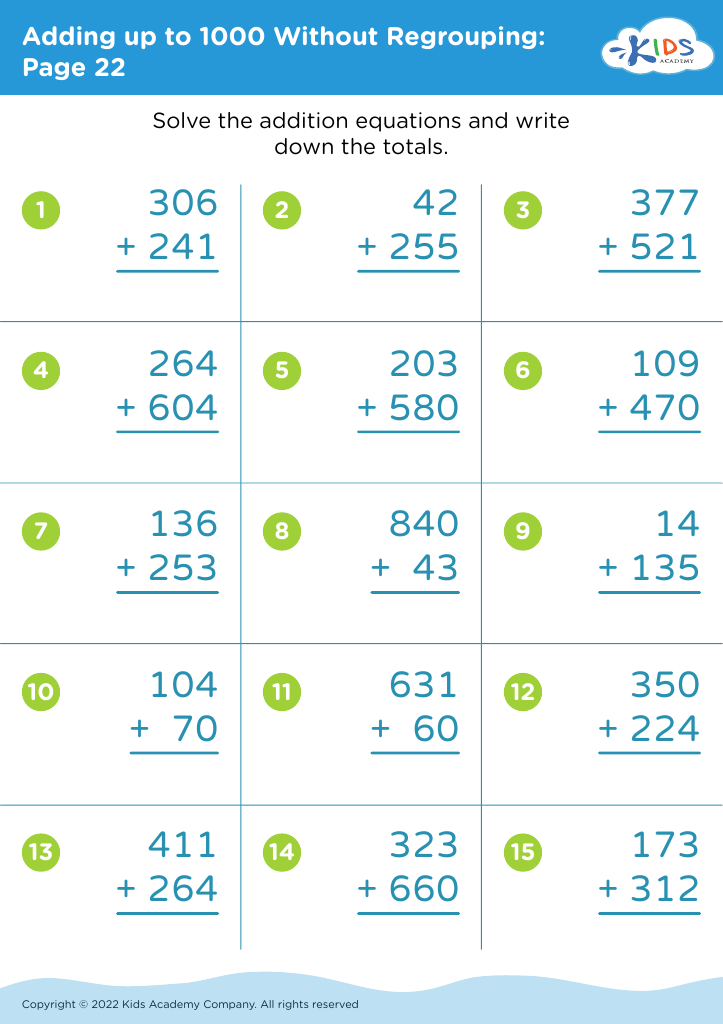



Problem-solving skills, especially when it involves adding up to 1000, are crucial for children aged 8-9. At this age, students are transitioning from basic arithmetic to more complex mathematical concepts. Mastering addition up to 1000 not only strengthens their numerical fluency but also enhances their critical thinking and reasoning abilities.
When parents and teachers emphasize problem-solving in this context, they help children develop a robust mathematical foundation essential for future academic success. It encourages students to explore multiple strategies for tackling problems, promoting creativity and adaptability. Furthermore, solving problems helps children learn to analyze situations, make informed decisions, and understand the relevance of math in everyday life.
Engaging with addition tasks involving larger numbers also prepares students for real-world scenarios, like budgeting or calculating expenses. It fosters perseverance, as they learn that challenges can be overcome with practice and innovative thinking.
Ultimately, cultivating strong problem-solving skills in young learners builds confidence and a positive attitude toward mathematics, laying the groundwork for lifelong learning and application in all areas of their lives. Thus, fostering skills in this area is essential for parents and teachers alike, underscoring its significance for holistic child development.








