Recognize patterns Adding up to 1000 Worksheets for Ages 8-9
6 filtered results
-
From - To
Explore our engaging "Recognize Patterns Adding up to 1000 Worksheets" designed specifically for children aged 8-9! These worksheets provide an exciting way to enhance mathematical understanding by recognizing numerical patterns. As students practice addition and improve their number sense, they will develop critical thinking skills necessary for solving more complex problems. Our user-friendly format makes learning fun and interactive, and the variety of challenging exercises fosters both independence and teamwork. Parents and educators will appreciate the alignment with core math standards, ensuring each worksheet is a valuable educational tool. Download these resources today and watch your child's confidence in math soar!
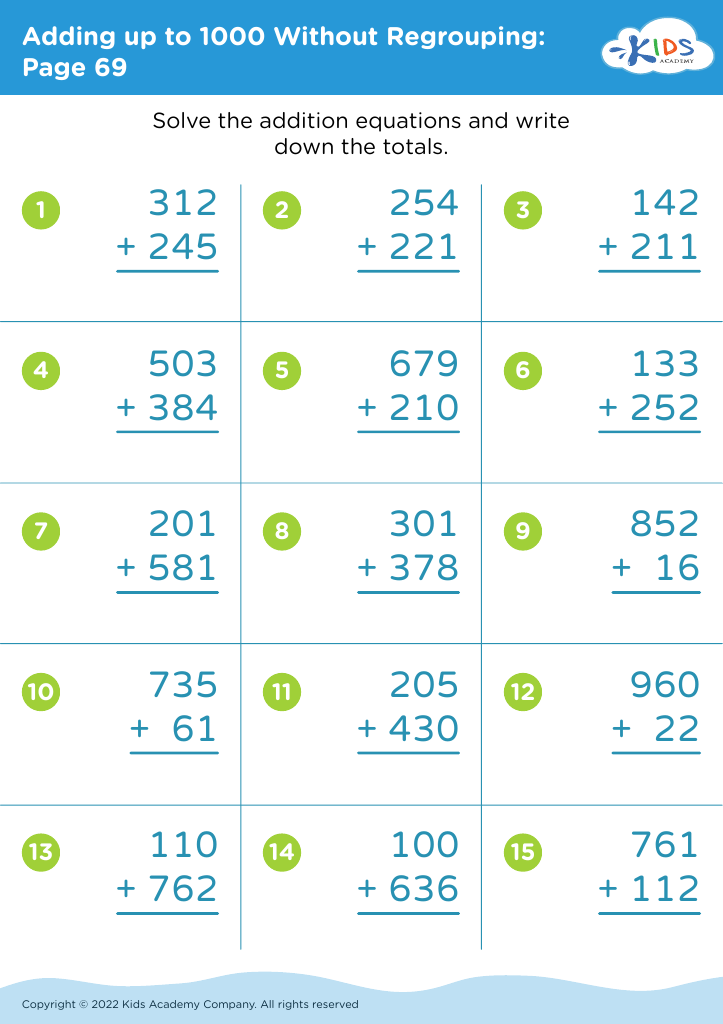
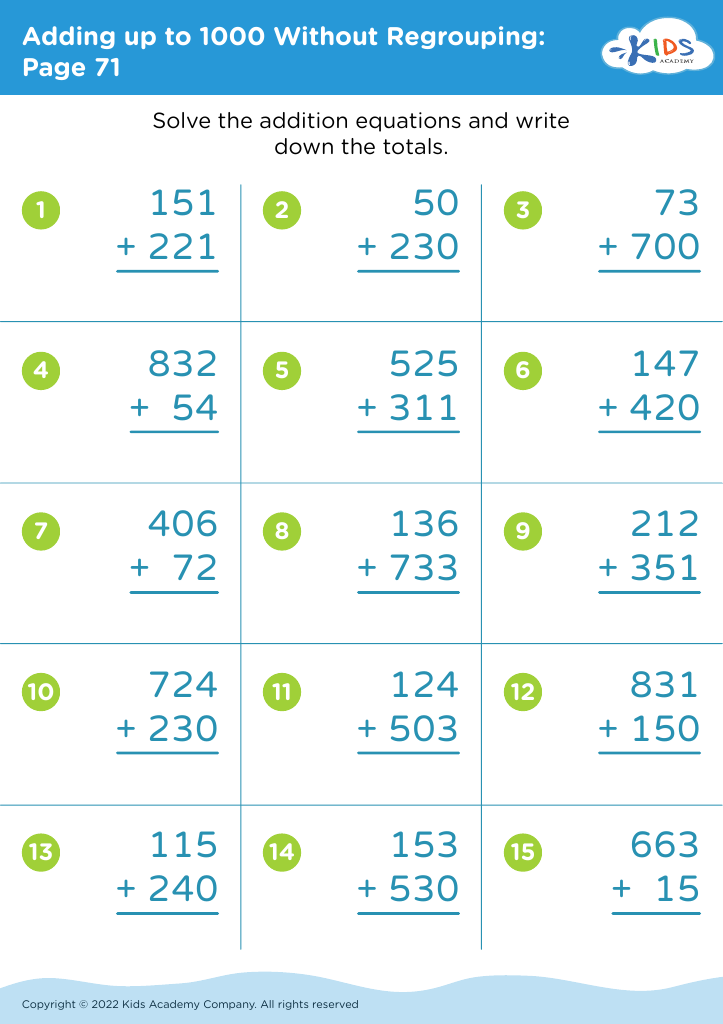
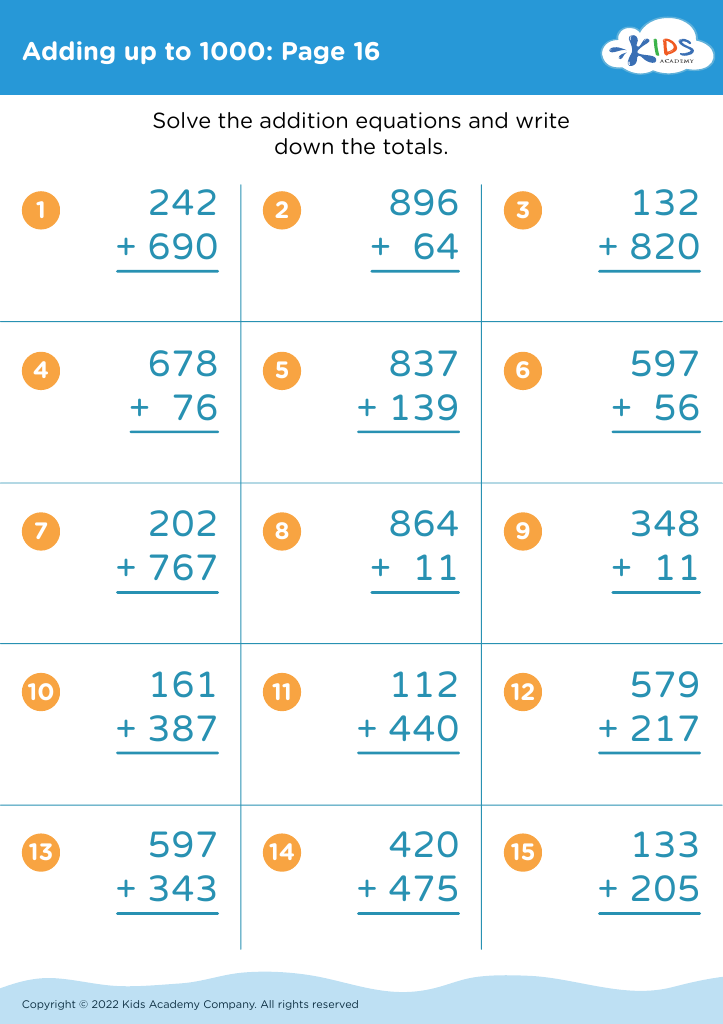
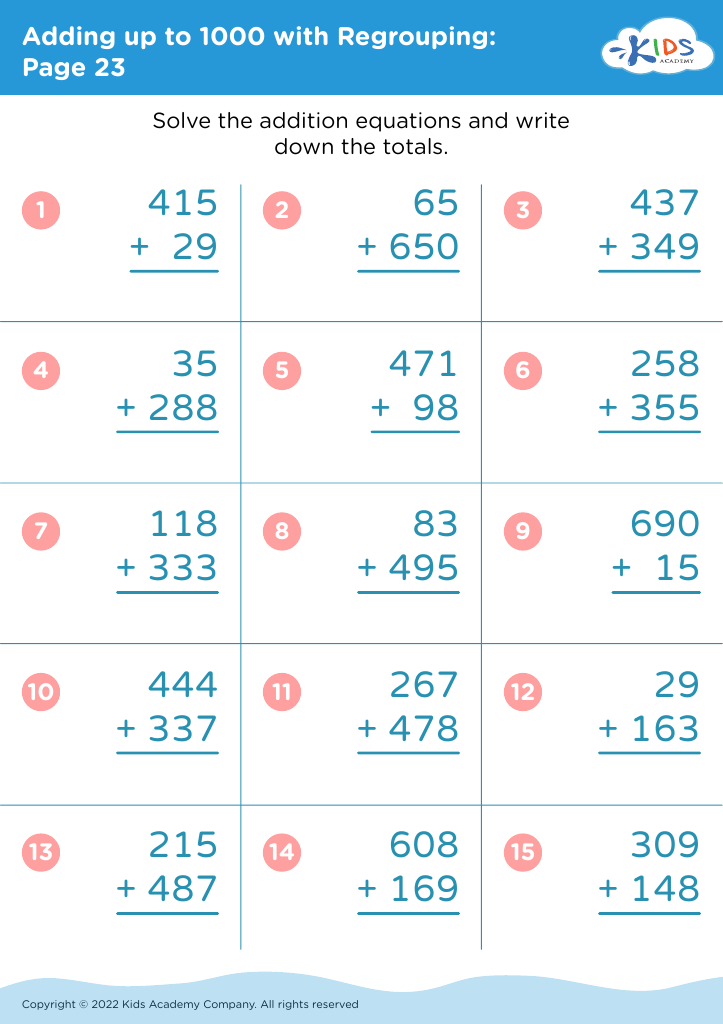
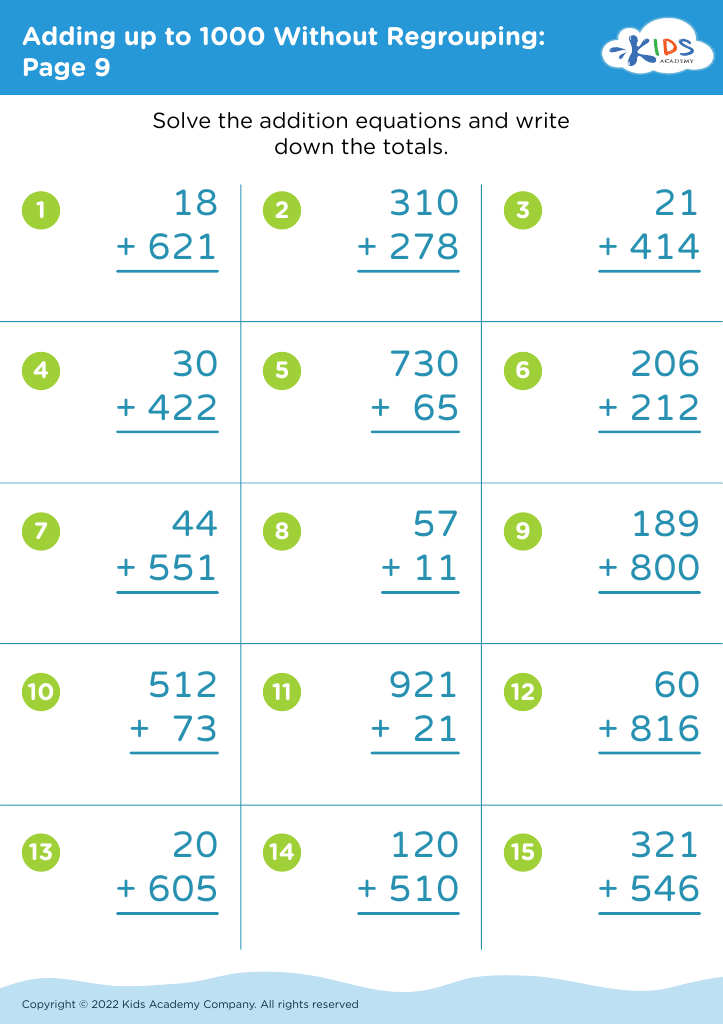
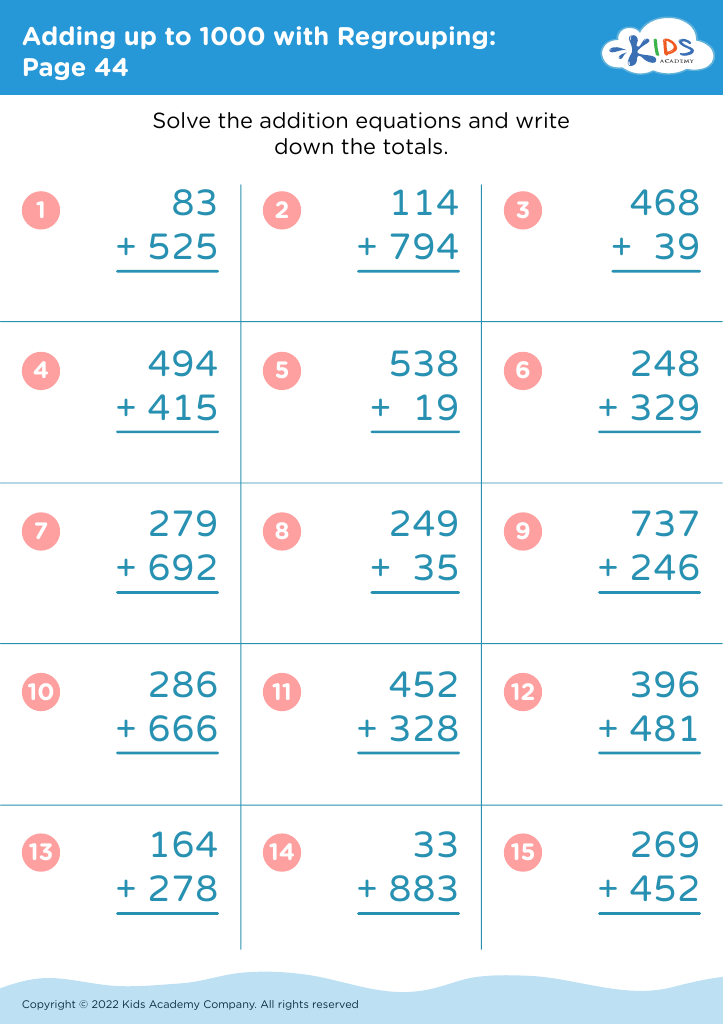



Recognizing patterns is a foundational skill in mathematics that significantly enhances a child's ability to understand various concepts, particularly in addition and number sense. For children ages 8-9, being able to identify and manipulate numbers that add up to 1000 introduces them to larger numbers and promotes their mental math abilities, critical for later mathematical operations.
When children understand patterns, they can solve problems more efficiently by identifying relationships between numbers, such as seeing that 500 + 500 = 1000 or 300 + 700 = 1000. This skill corroborates their understanding of place value and strengthens their overall fluency with numbers. Additionally, pattern recognition fosters predictive reasoning, helping students anticipate outcomes in math, which is crucial for future algebraic skills.
Moreover, acknowledging these patterns aids in building confidence, encouraging students to explore mathematical relationships creatively rather than mechanically following rules. For parents and teachers, this is vital as it lays a solid groundwork for higher-level mathematics, promoting lifelong learning and problem-solving skills. In today's data-driven world, strong math competencies help students navigate everyday challenges and prepare for advanced studies, making this concept worthy of attention and support.








