Addition Practice Addition Worksheets for Ages 8-9 - Page 3
49 filtered results
-
From - To
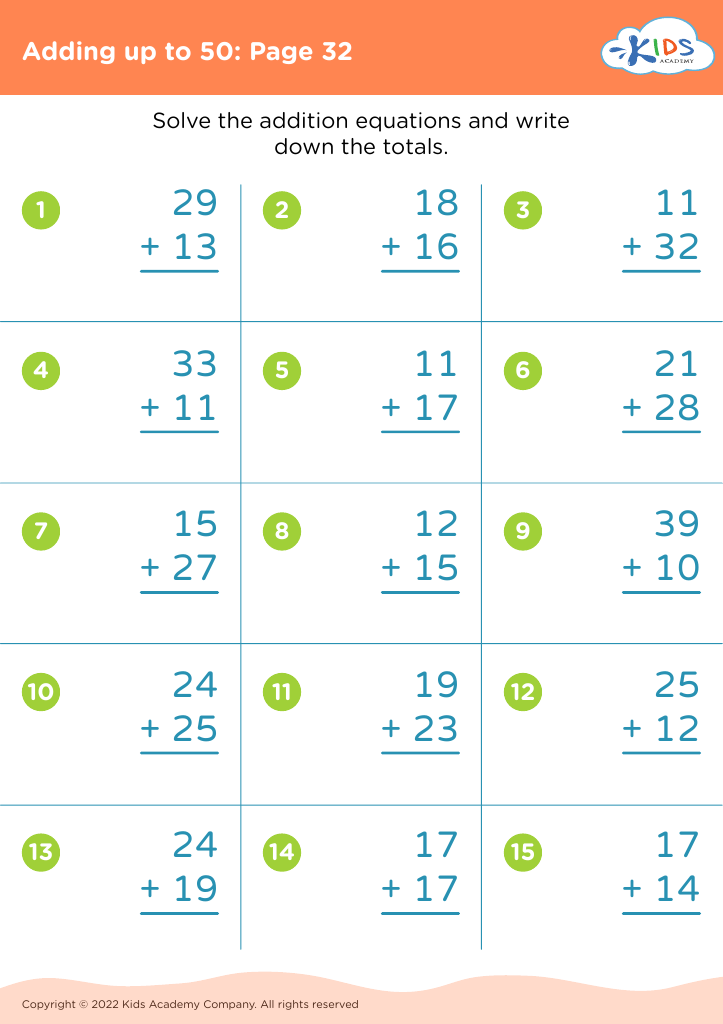








Parents and teachers should prioritize addition practice for children aged 8-9 as this age serves as a crucial developmental stage for math skills. At this time, students are transitioning from foundational arithmetic to more complex mathematical concepts. Mastery of addition lays the groundwork for future topics such as subtraction, multiplication, and even basic algebra. Additionally, strong addition skills build confidence in a child's abilities, fostering a positive attitude towards math.
Engaging in regular addition practice enhances mental math capabilities, encouraging children to think critically and solve problems more efficiently. This practice can also promote cognitive skills like memory and concentration, which are essential for academic success across all subjects. Furthermore, with the growing emphasis on standardized testing, strengthening addition skills can lead to better performance in assessments, paving the way for future educational opportunities.
Moreover, working on addition collectively brings parents and children closer, reinforcing support and engagement in the learning process. By addressing any difficulties promptly, educators and parents can ensure that students remain on track academically. Overall, addition practice is not just about arithmetic; it's about building a solid mathematical foundation that supports lifelong learning.








