
Understanding greater/less than Math Worksheets for Ages 8-9
3 filtered results
Difficulty Level
Grade
Age
-
From - To
Subject
Activity
Standards
Discover our engaging "Understanding Greater/Less Than Math Worksheets" designed specifically for children aged 8-9. These worksheets provide interactive and fun activities that help students grasp the concepts of comparing numbers effectively. Through a variety of exercises, children will learn to identify and use greater than (>) and less than (<) symbols with confidence. Our resources are perfect for reinforcing classroom learning or helping with home study. With colorful illustrations and age-appropriate challenges, these worksheets aim to strengthen math skills while making the learning experience enjoyable. Enhance your child’s mathematical understanding today with Kids Academy's thoughtfully crafted materials!
Favorites
With answer key
Interactive
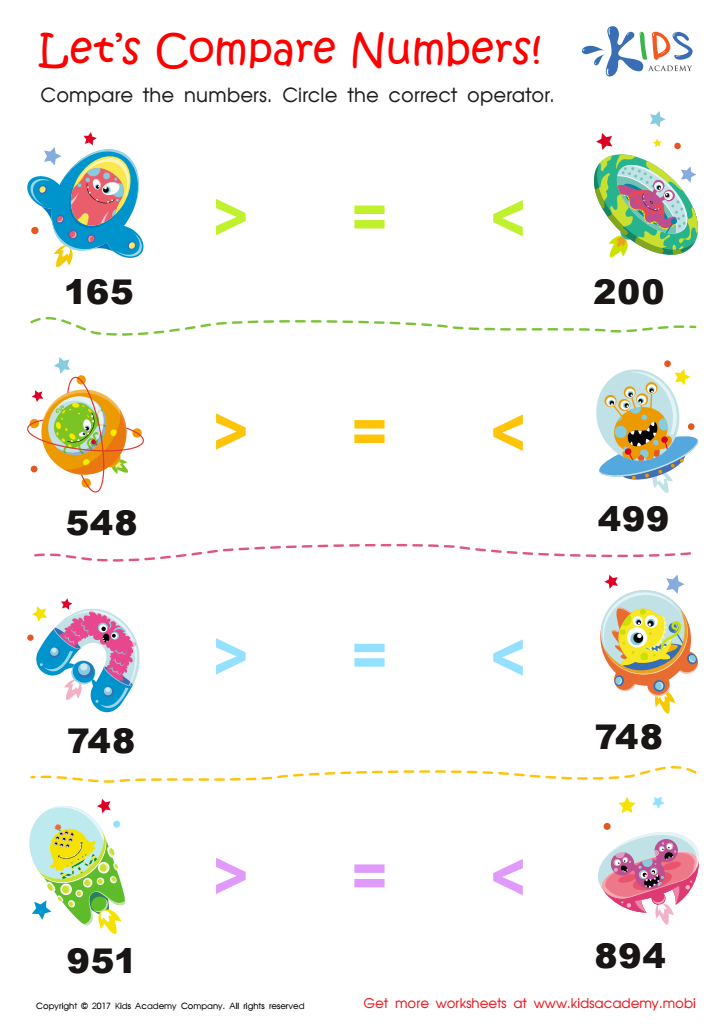
Comparing Numbers Worksheet for 2nd Grade
Alien friends are back to help your child learn to compare numbers using >, < and = symbols. This 2nd grade worksheet will challenge them with larger numbers!
 Assign to My Students
Comparing Numbers Worksheet for 2nd Grade
Worksheet
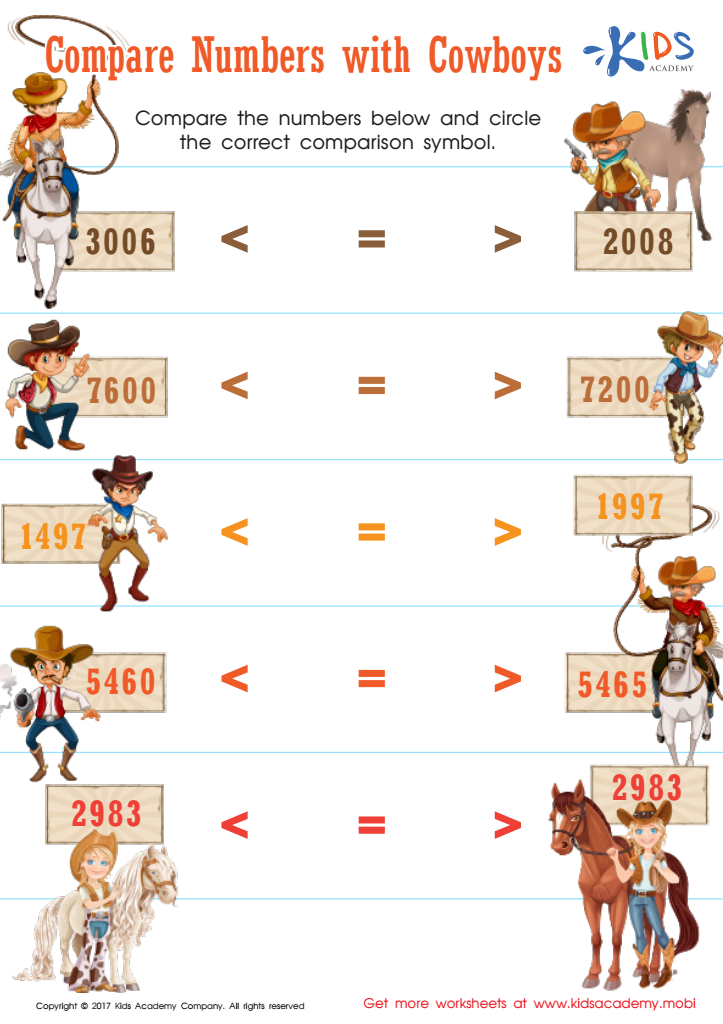
Compare Numbers Worksheet for 3rd Grade
Time to get a roundup on big numbers! Help your 3rd grader practice comparing thousands with this compare numbers worksheet. They'll use >, <, and = symbols for tricky numbers. Jump in and join the cowboys!
Compare Numbers Worksheet for 3rd Grade
Worksheet
Join Kids Academy for Free
Who is primarily going to use this learning content?







Understanding greater than and less than is an essential math concept for children ages 8-9, as it lays the foundation for more complex mathematical learning. Mastery of these ideas helps students develop critical thinking and comparison skills that are applicable across various subjects and real-life situations.
At this age, children are transitioning from simple arithmetic to multi-digit numbers and beginning to explore concepts like measurement, data, and basic algebra. Recognizing greater and less than helps them effectively organize numbers, create number lines, and understand place value. For instance, knowing that 45 is greater than 32 prepares students for addition or subtraction of larger numbers and fosters problem-solving skills.
Additionally, this understanding cultivates a sense of mathematical reasoning and improves confidence. Parents and teachers who prioritize these concepts can engage students in everyday discussions, emphasizing the relevance of math in decision-making or finance—like comparing prices or cooking measurements.
By fostering a solid grasp of these comparison skills, educators and parents empower children to face future mathematical challenges and instill lifelong learning habits. Therefore, actively engaging to understand greater than and less than is vital for a child’s overall academic development.








