Understanding regrouping Math Worksheets for Ages 8-9
4 filtered results
-
From - To
Unlock your child’s potential with our "Understanding Regrouping Math Worksheets for Ages 8-9". Designed for 3rd and 4th graders, these engaging resources help kids master the essential math skill of regrouping, crucial for addition and subtraction with larger numbers. With colorful, fun exercises and clear instructions, our worksheets make learning enjoyable and effective. They build confidence, boost problem-solving skills, and ensure a solid foundation in math. Perfect for classroom and at-home learning, these worksheets support children in reaching their full academic potential. Empower your young learner to excel in math with Kids Academy.
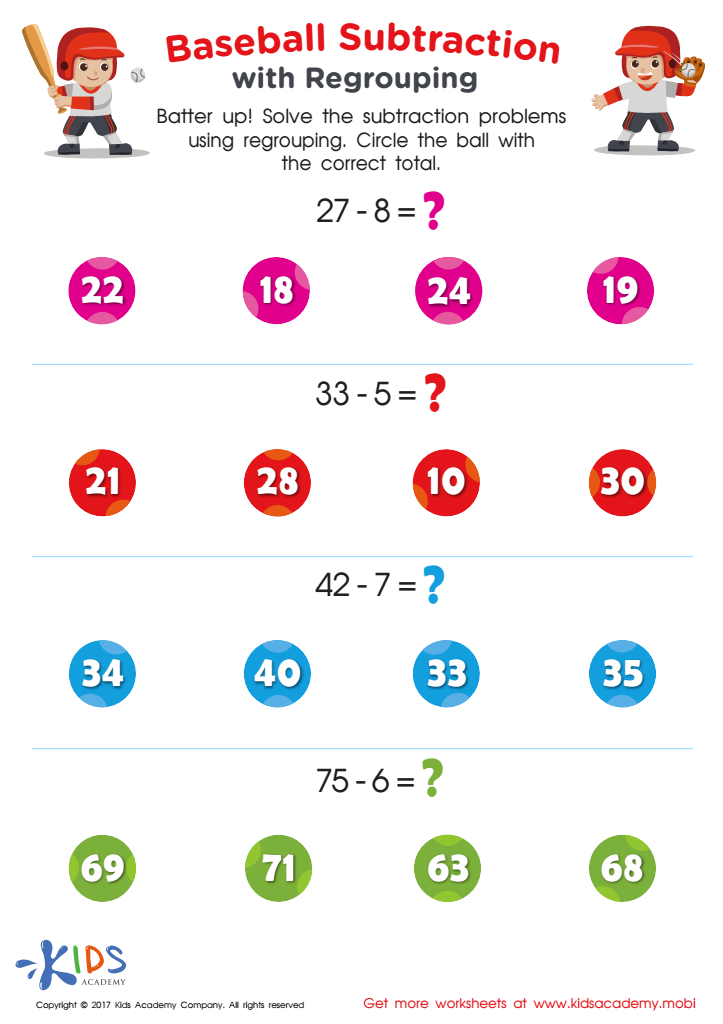
Subtraction With Regrouping for 2nd Grade Worksheet
 Assign to My Students
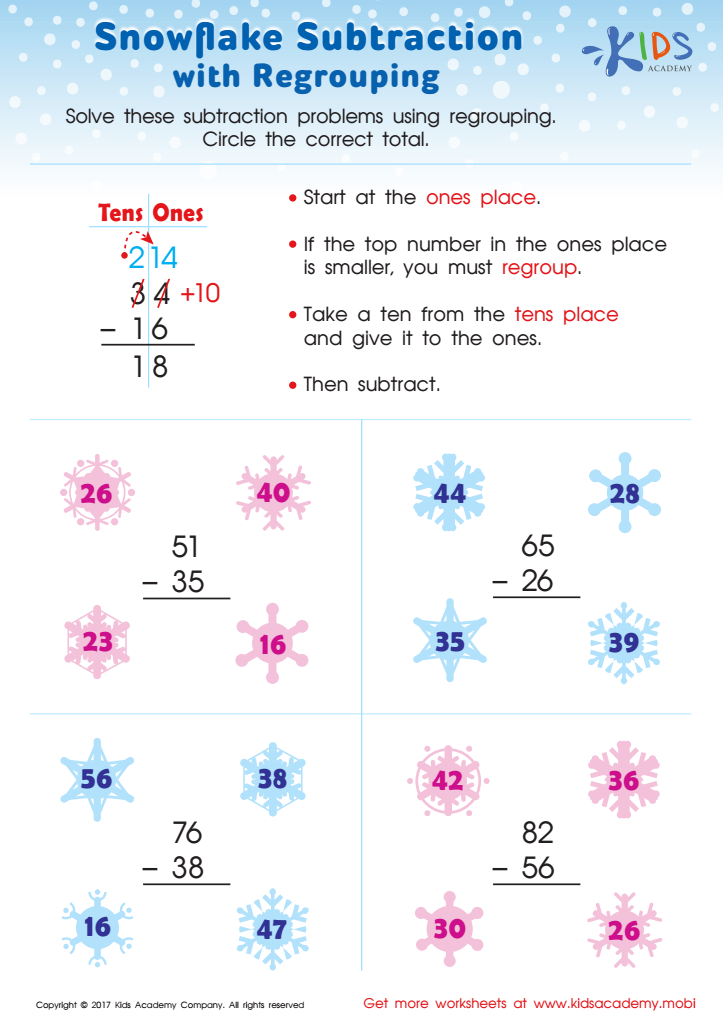
Subtraction With Regrouping Worksheet: Snowflake
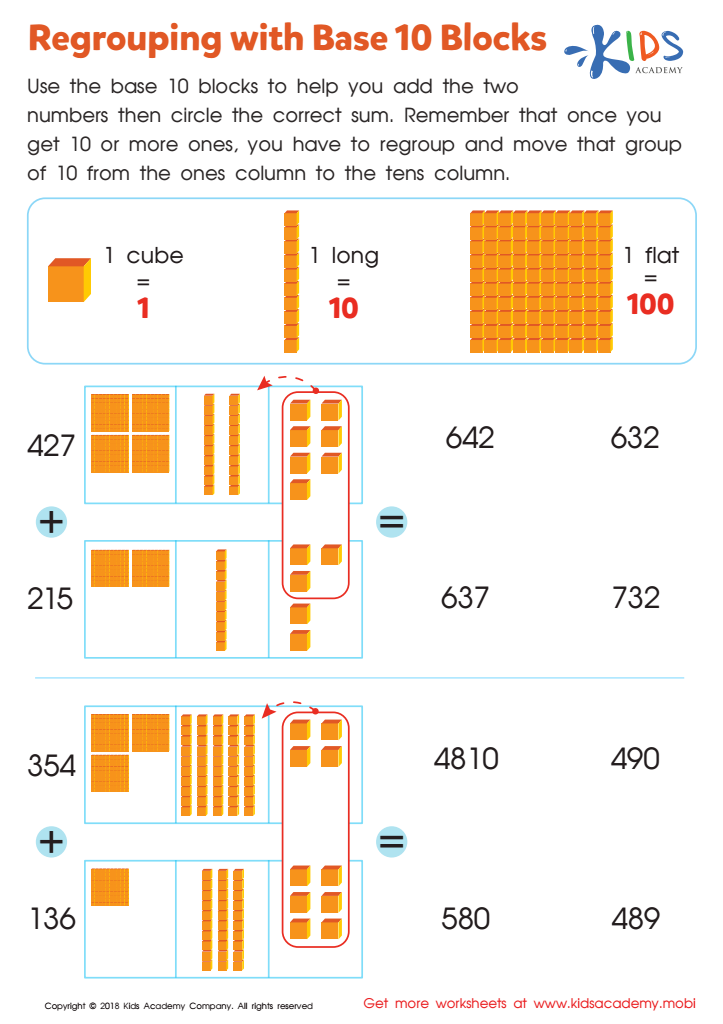
Regrouping with Base 10 Blocks Worksheet
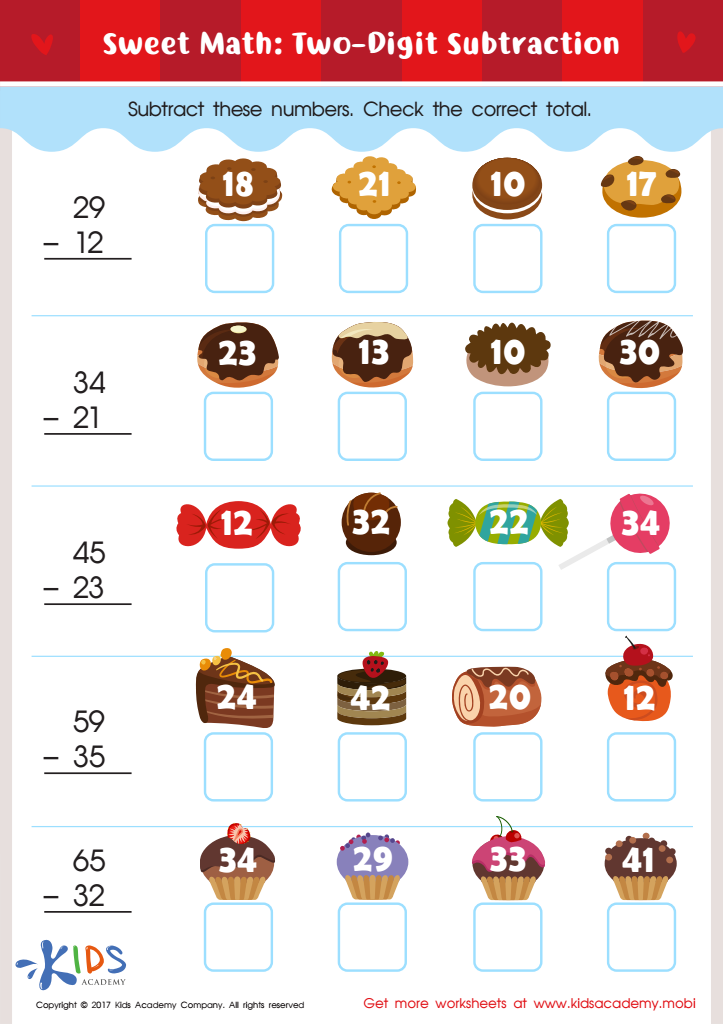
Two Digit Subtraction Worksheet


.jpg)




Understanding regrouping in math is a fundamental skill for 8-9-year-olds that parents and teachers should invest in. At this age, children are transitioning from simple arithmetic to more complex mathematical concepts, and regrouping is the cornerstone of this evolution. Regrouping, or "carrying" and "borrowing," is crucial for solving multi-digit addition and subtraction problems accurately. Without it, kids are likely to struggle as they face higher-level math in later grades.
When children grasp regrouping, they not only improve their accuracy but also their confidence in handling numbers. It fosters a deeper sense of number sense and fluency, helping them to manipulate numbers flexibly and see the relationships between larger and smaller units. This skill is also pertinent for developing logical thinking and problem-solving strategies, which are vital across all subjects of study.
For parents and teachers, focusing on regrouping means ensuring the student’s future academic success. Encouraging hands-on practice through manipulatives and real-life situations makes the concept tangibly meaningful, which solidifies their understanding. Ultimately, early mastery of regrouping forms a strong mathematical foundation, aiding not just in future classroom settings, but in everyday life scenarios involving budgeting, time management, and other essential skills. By prioritizing this learning, we set children up for lifelong competency in math and beyond.








