Mental math skills Mixed Times Tables Worksheets for Ages 8-9
3 filtered results
-
From - To
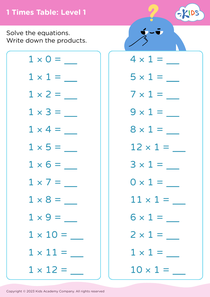
Enhance your child's math skills with our Mixed Times Tables Worksheets designed specifically for ages 8-9. These engaging worksheets focus on mental math skills, allowing children to practice multiplication facts while developing speed and accuracy. By tackling a variety of problems, kids can improve their number fluency, boost their confidence in math, and prepare for more advanced lessons. Our user-friendly format makes learning fun and interactive, ensuring that students gain a solid understanding of multiplication. Whether for classroom use or at-home reinforcement, these worksheets are an excellent resource for fostering mathematical growth in young learners. Start practicing today!
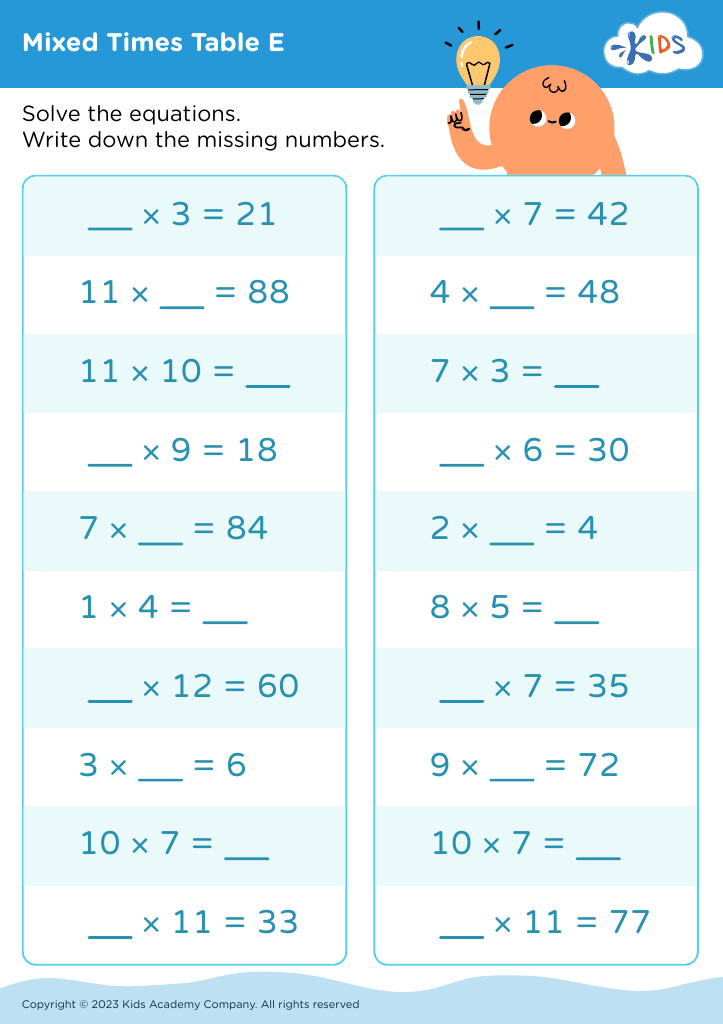
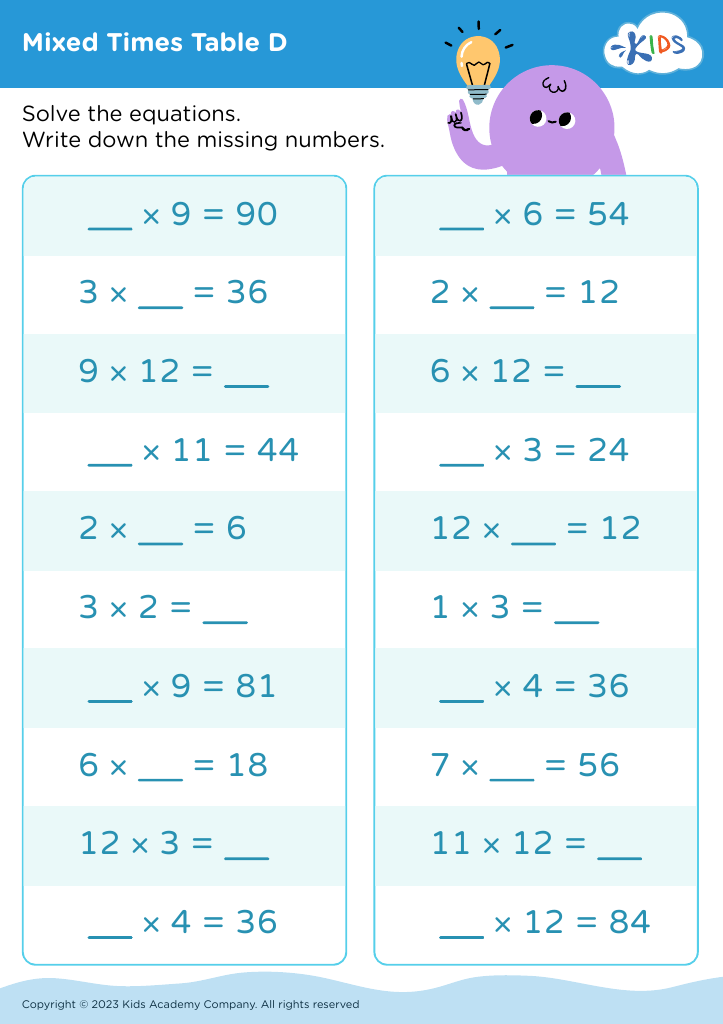
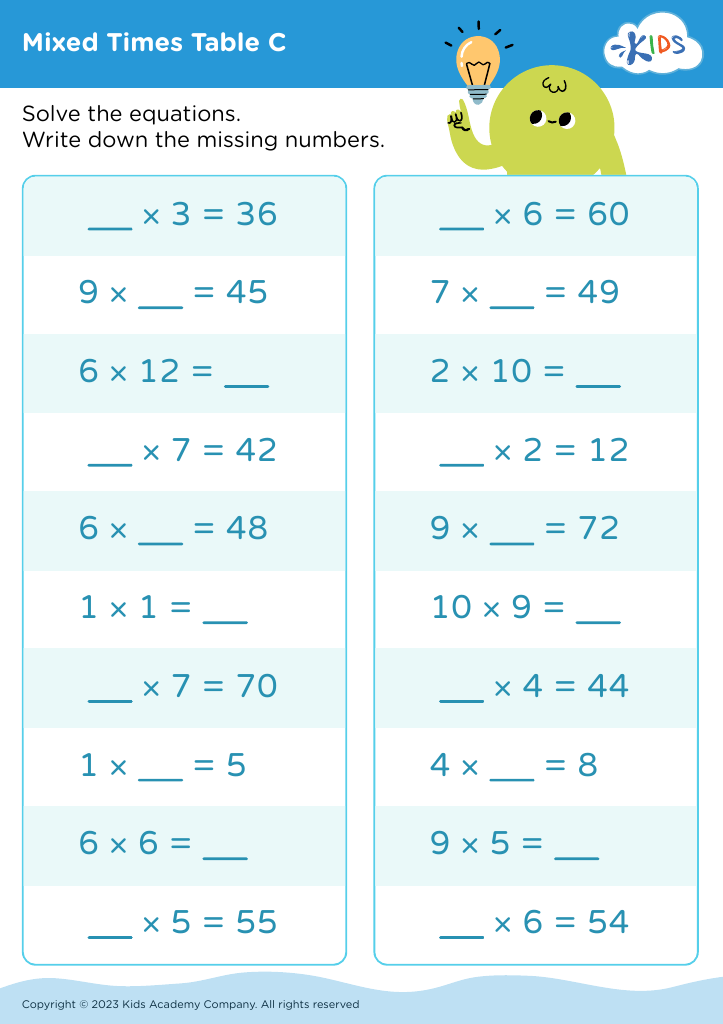


Parents and teachers should prioritize mental math skills, particularly mixed times tables, for children aged 8-9 because these skills form a crucial foundation for overall mathematical proficiency. At this age, children's cognitive abilities are rapidly developing, and enhancing their mental math capabilities boosts their confidence and critical thinking.
Mastering mixed times tables enables students to perform calculations efficiently, which is essential for future topics such as geometry, fractions, and algebra. Moreover, strong mental math skills encourage learners to approach math with a positive attitude, reducing anxiety associated with mathematics as they progress in their education.
Additionally, in an increasingly technology-driven world, the ability to perform quick calculations aids in everyday decision-making, such as budgeting or measuring. It equips children with practical skills that extend beyond the classroom.
Furthermore, enhancing mental math skills promotes greater engagement in lessons. As children recognize their developing abilities, their motivation and self-discipline typically improve.
By fostering a supportive environment that emphasizes mental math, parents and teachers can help cultivate resilient learners equipped with essential tools for lifelong success in math and beyond.