Comparing quantities Worksheets for 9-Year-Olds
3 filtered results
-
From - To
Help your 9-year-old master the art of comparing quantities with our engaging worksheets! Designed to bolster essential math skills, these worksheets cover a variety of fun and interactive activities that enable children to compare numbers, sizes, and volumes seamlessly. Our colorful illustrations and practical problems will keep kids motivated and excited to learn. Ideal for both classroom use and additional practice at home, these worksheets offer an enriching educational experience that’s perfect for developing confidence in math. Make learning fun and effective with our comparing quantities worksheets tailored specifically for 9-year-olds!
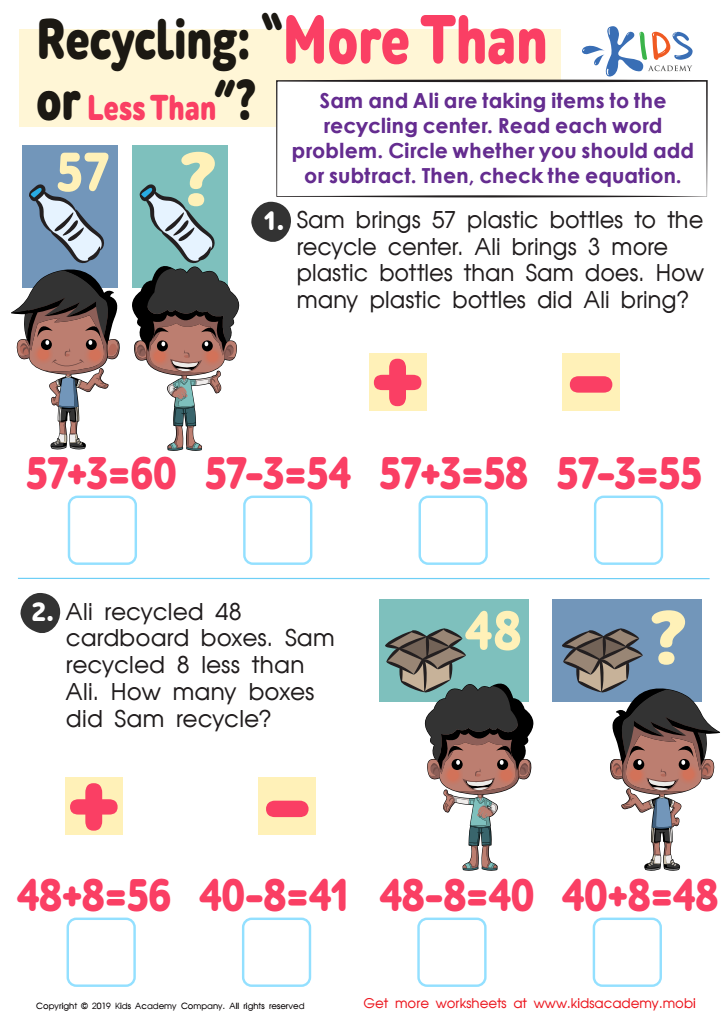
Recycling - More or Less Worksheet
 Assign to My Students



.jpg)


Comparing quantities is an essential math skill for 9-year-olds, central to their cognitive development and practical understanding of the world. Firstly, when children compare quantities, they grasp fundamental mathematical concepts such as greater than, less than, and equal to, which are foundational for more complex operations like addition, subtraction, multiplication, and division. This understanding is crucial for their academic progress.
Moreover, comparing quantities enhances critical thinking and problem-solving abilities. Children learn to analyze data, recognize patterns, and make logical decisions, skills that are valuable beyond maths, in daily life and future academic pursuits. For instance, they might compare the prices while shopping or measure ingredients while cooking, making these real-world applications very practical.
Additionally, these comparisons aid in developing spatial awareness and visualization skills. Students learn to understand scales and proportions, which are useful in subjects such as science and geography. Teachers and parents should also be aware that fostering these skills early builds children's confidence in their abilities, positively impacting their overall attitude towards learning.
Incorporating fun, interactive activities like measuring objects, using visual aids, and real-life scenarios can make learning to compare quantities engaging. By prioritizing this skill, parents and teachers lay a strong foundation for children’s educational and everyday competence.








