Recognizing Patterns Adding up to 1000 with Regrouping Worksheets for 9-Year-Olds
4 filtered results
-
From - To
Ensure your 9-year-old masters the essential skill of adding up to 1000 with regrouping through our engaging worksheets. At Kids Academy, we help young learners recognize number patterns, enhancing their mathematical capabilities. Our carefully designed materials combine fun and education, encouraging students to practice and improve their addition skills within a structured format. The worksheets support a smooth learning curve by introducing concepts in a step-by-step manner, assisting children in developing a deeper understanding of addition strategies. Empower your child to excel in math with our innovative resources, designed to build confidence and proficiency through pattern recognition and practice.
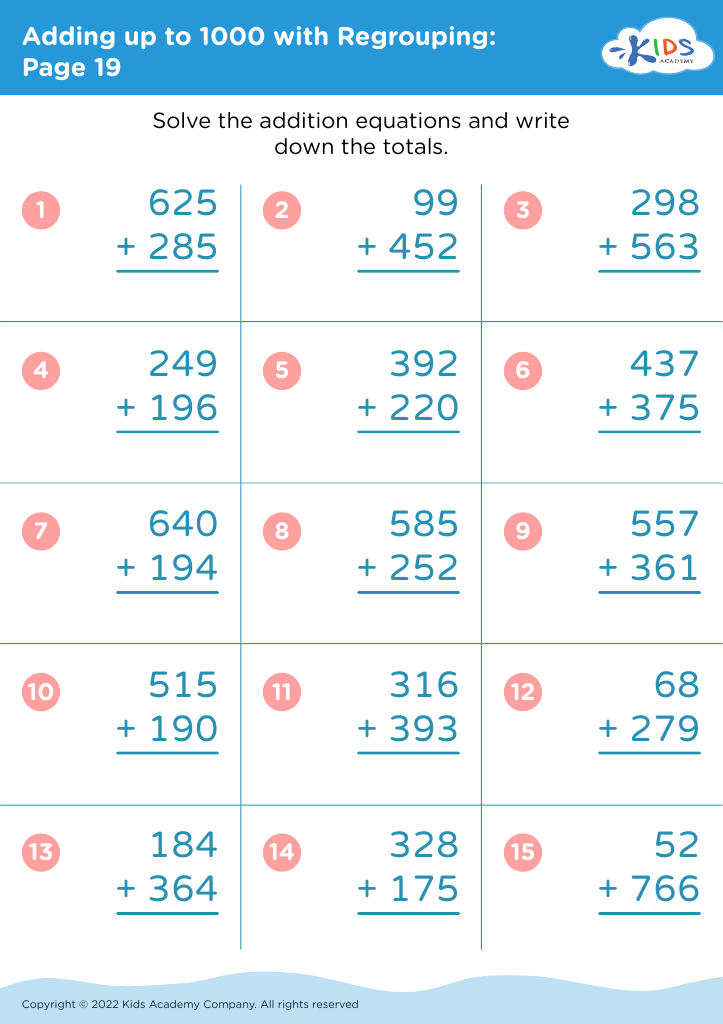
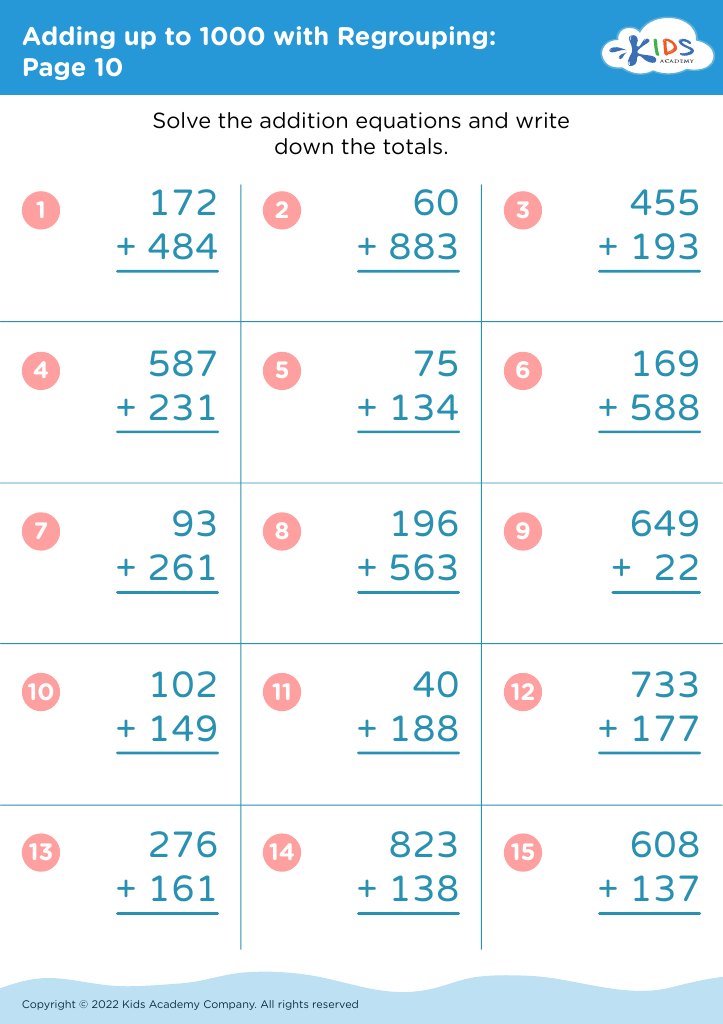
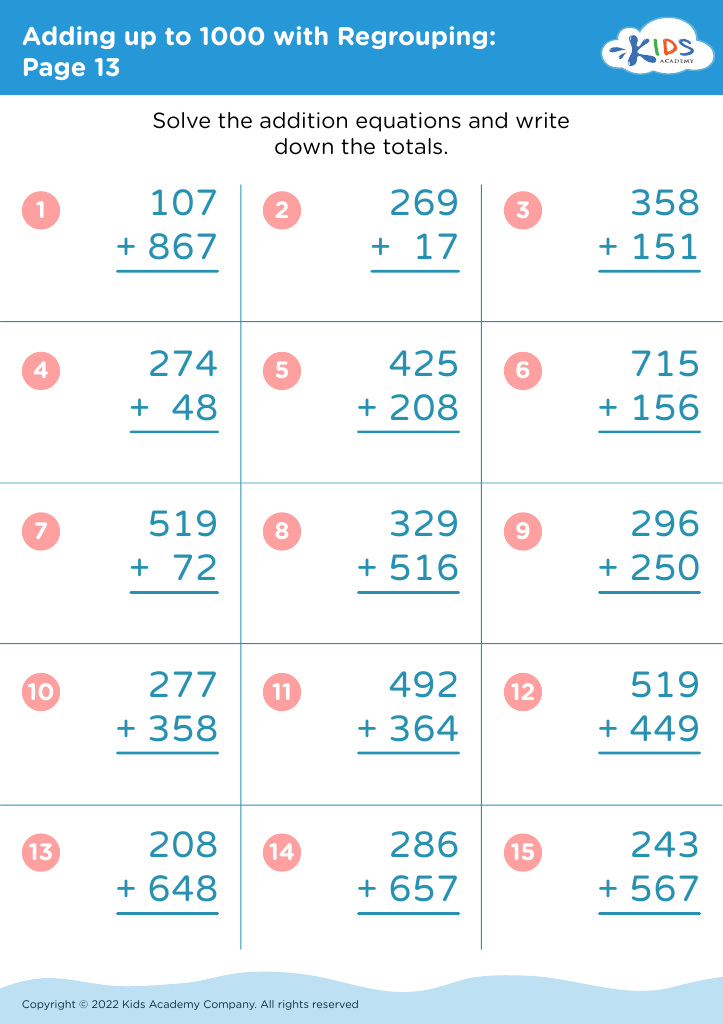
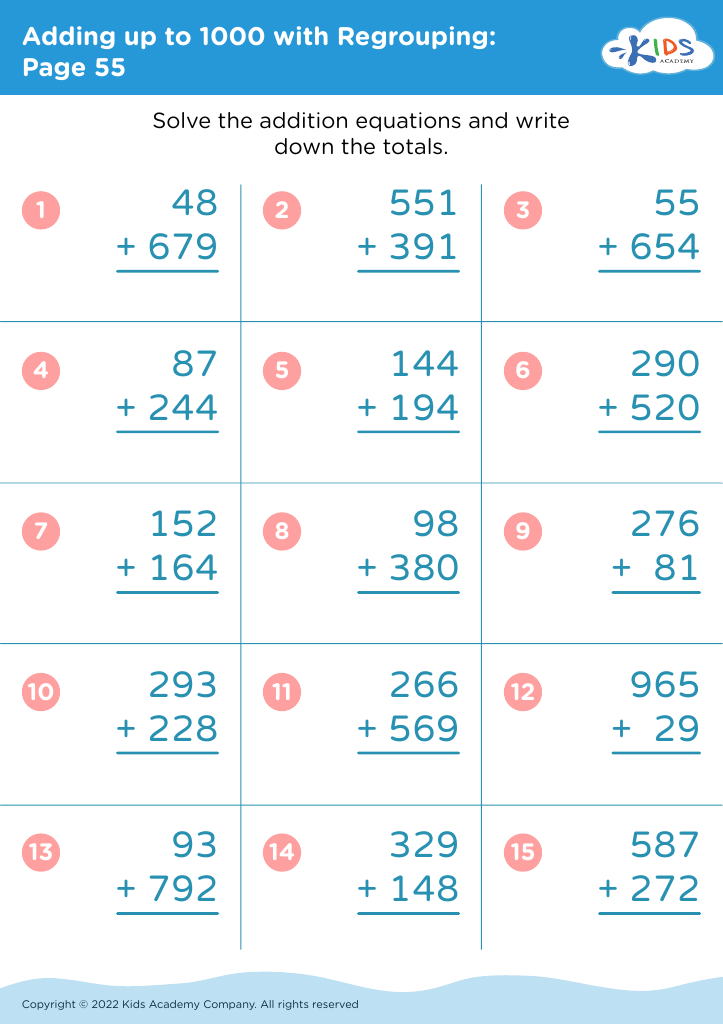


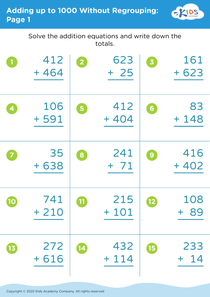
Recognizing patterns when adding up to 1000 with regrouping is a crucial skill for 9-year-olds, as it lays the foundation for more advanced mathematical concepts and problem-solving skills. At this age, children are transitioning from basic arithmetic to more complex calculations, and mastering this skill helps boost their confidence and proficiency in mathematics.
Firstly, understanding patterns in addition encourages logical thinking and number sense. This allows children to approach problems strategically, making it easier for them to identify shortcuts and verify their answers. For instance, recognizing that 492 + 508 can be simplified by rounding to 500 + 500 and then adjusting for the small differences fosters a deeper understanding of numerical relationships.
Secondly, regrouping, or carrying over, is a fundamental technique in arithmetic that ensures accurate computation. Mastery of this concept prevents common mistakes that can lead to frustration and anxiety around math. It is essential for operations involving larger numbers and is directly applicable to everyday situations, such as handling money or measuring quantities.
In addition, proficiency in these skills sets a solid groundwork for future topics like multiplication, division, and fractions. Building a strong mathematical foundation at age 9 promotes higher academic achievement and a positive attitude towards math, benefiting students throughout their educational journey and in everyday life. Including exercises and activities that reinforce these skills, both at home and in the classroom, can drastically improve mathematical fluency and confidence.