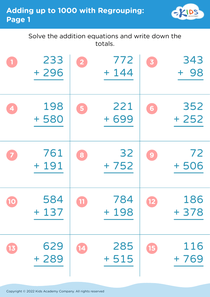
Improve counting skills Adding up to 1000 Without Regrouping Worksheets for 9-Year-Olds
4 filtered results
-
From - To
Enhance your child's arithmetic abilities with our "Improve Counting Skills: Adding up to 1000 Without Regrouping Worksheets for 9-Year-Olds." These engaging and expertly crafted worksheets are designed to bolster your child's confidence in adding numbers, without the complexity of regrouping. Perfect for 9-year-olds, these resources provide ample practice to improve accuracy and speed in basic addition. Each worksheet features easy-to-follow problems that gradually increase in difficulty, ensuring steady progression. With vibrant illustrations and a user-friendly layout, these printable exercises will make learning math enjoyable and rewarding. Spark a love for math today with our addition worksheets!
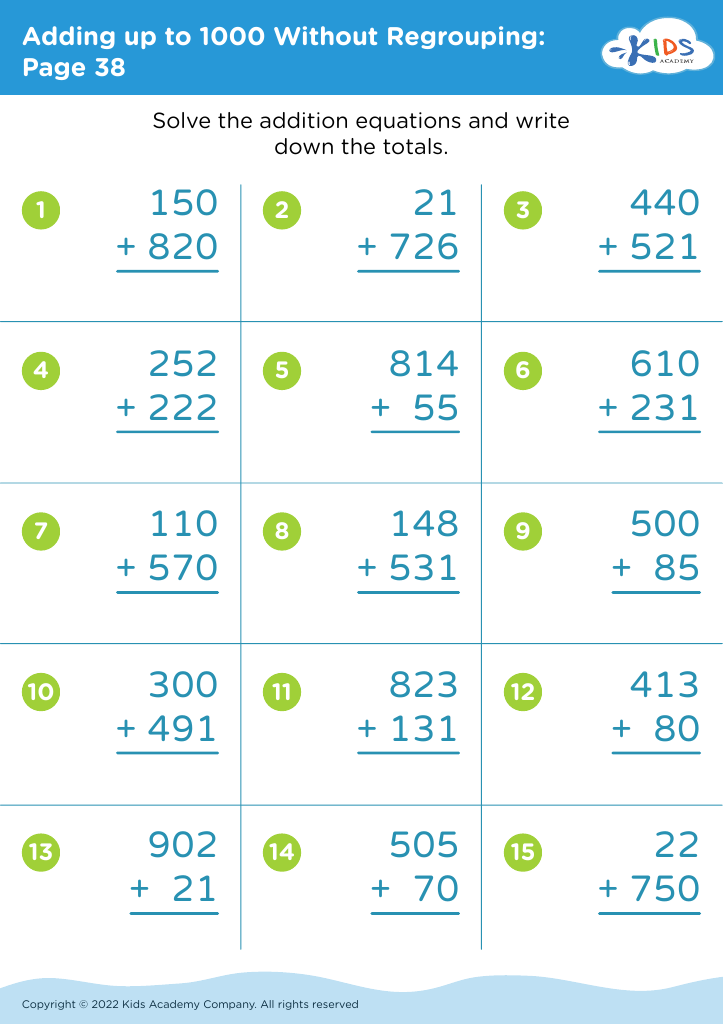
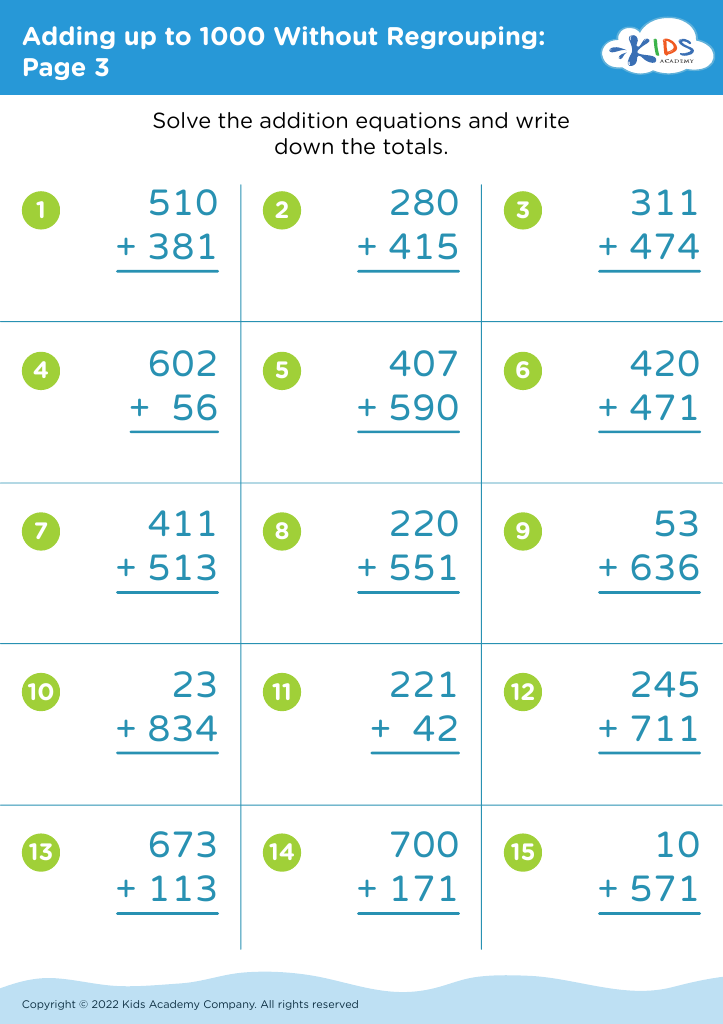
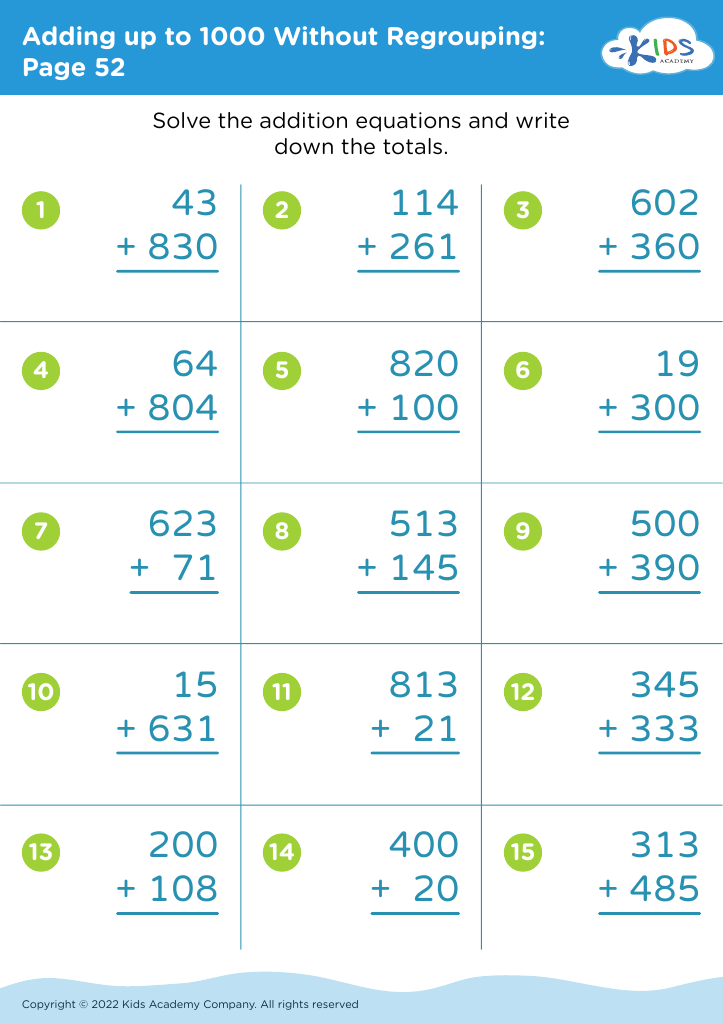
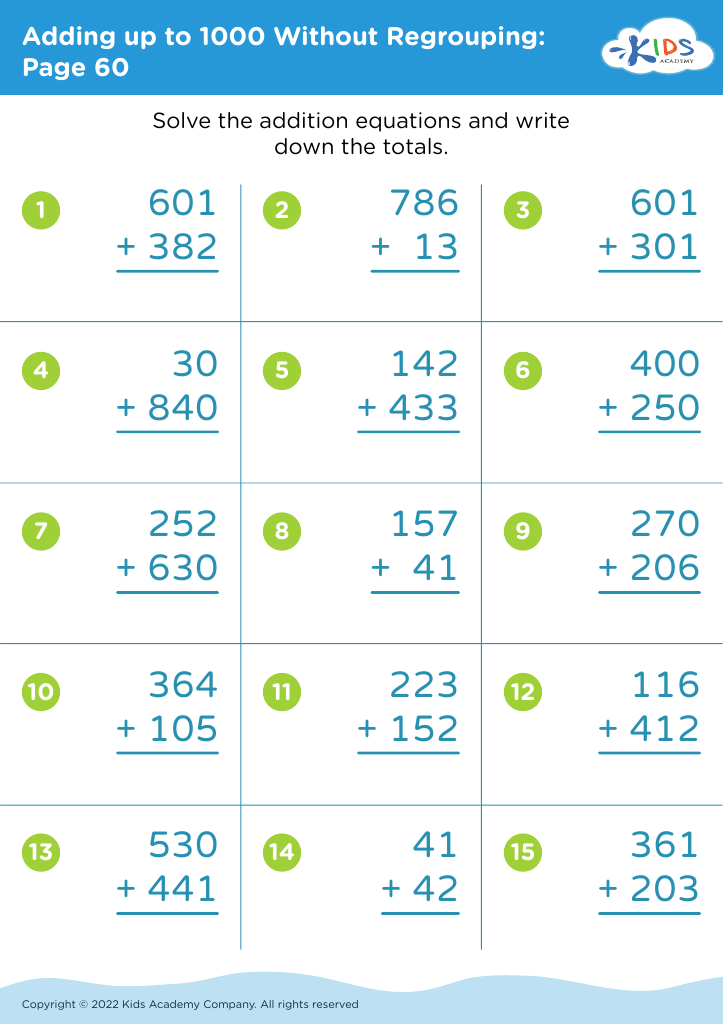


Fostering strong counting skills in 9-year-olds, especially the ability to add numbers up to 1000 without regrouping, is foundational for mathematical development. At this age, ensuring that children can confidently add large numbers without the aid of regrouping safeguards their number sense and comprehension of basic arithmetic principles. Mastery of this critical skill aids in developing mental math abilities, which enhances overall mathematical fluency.
Improved counting skills form the groundwork for more complex mathematical operations. This proficiency is instrumental when students progress to higher-level math topics like multiplication, division, fractions, and algebra. Without a solid grasp of basic addition, students may struggle with these advanced subjects, which can cause frustration and hinder academic progress.
Additionally, these counting skills have practical implications beyond the classroom. Effective numerical skills are used in everyday activities, including managing money, cooking, and performing day-to-day tasks. Strength in these areas builds confidence and autonomy in children.
Teachers and parents play a critical role by creating supportive environments where children can practice and refine these skills. Interactive exercises, engaging activities, and positive reinforcement can transform learning math into an enjoyable experience, laying a solid foundation for lifelong numeracy skills and fostering a positive attitude towards mathematics.