Shape Recognition Addition & Subtraction Worksheets for 9-Year-Olds
12 filtered results
-
From - To
Discover a fun and educational way to enhance your 9-year-old's math skills with our Shape Recognition Addition & Subtraction Worksheets! These engaging worksheets seamlessly blend the concepts of geometry and arithmetic. Your child will tackle addition and subtraction problems while identifying and interacting with various shapes. This method not only reinforces their math abilities but also promotes critical thinking and visual-spatial awareness. Perfect for both classroom use and at-home practice, these worksheets make learning enjoyable and effective. Dive into the world of shapes and numbers and watch your child's confidence in math soar!
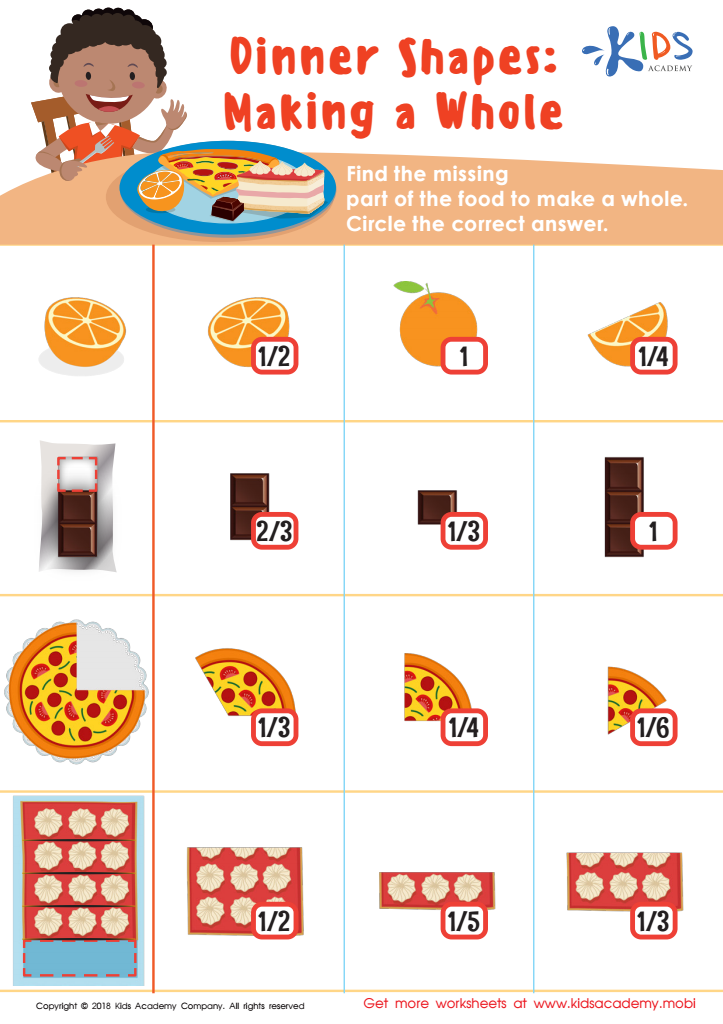
Dinner Shapes: Making a Whole Worksheet
 Assign to My Students








Shape recognition, addition, and subtraction create a foundational trio crucial for a 9-year-old’s cognitive and academic development, laying the groundwork for effective problem-solving and logical thinking. Parents and teachers should particularly care about this conjunction of skills for several reasons.
Shape recognition fosters spatial awareness, an essential skill that extends beyond geometry into daily life, such as navigating spaces and understanding maps. It enhances visual discrimination capabilities, enabling children to distinguish between different shapes, which is pivotal in understanding more complex mathematical concepts later on.
Meanwhile, addition and subtraction are the bedrock of numerical proficiency. Mastering these operations at an early age facilitates a seamless transition to more advanced topics, such as multiplication, division, and fractions. They also boost a child's ability to perform mental arithmetic and improve their problem-solving skills.
Integrating shape recognition with addition and subtraction makes learning more engaging and conceptually meaningful. For instance, by using shapes in arithmetic problems, children visualize abstract concepts more concretely, enhancing comprehension and retention. Moreover, such interdisciplinary exercises stimulate cognitive flexibility, encouraging kids to think creatively and develop a holistic understanding of mathematics.
Ultimately, blending shape recognition, and arithmetic caters to diverse learning styles, bolstering both mathematical and spatial skills, which are indispensable components of a well-rounded education.








