
Develop counting skills Addition Worksheets for 9-Year-Olds
3 filtered results
Difficulty Level
Grade
Age
-
From - To
Subject
Activity
Standards
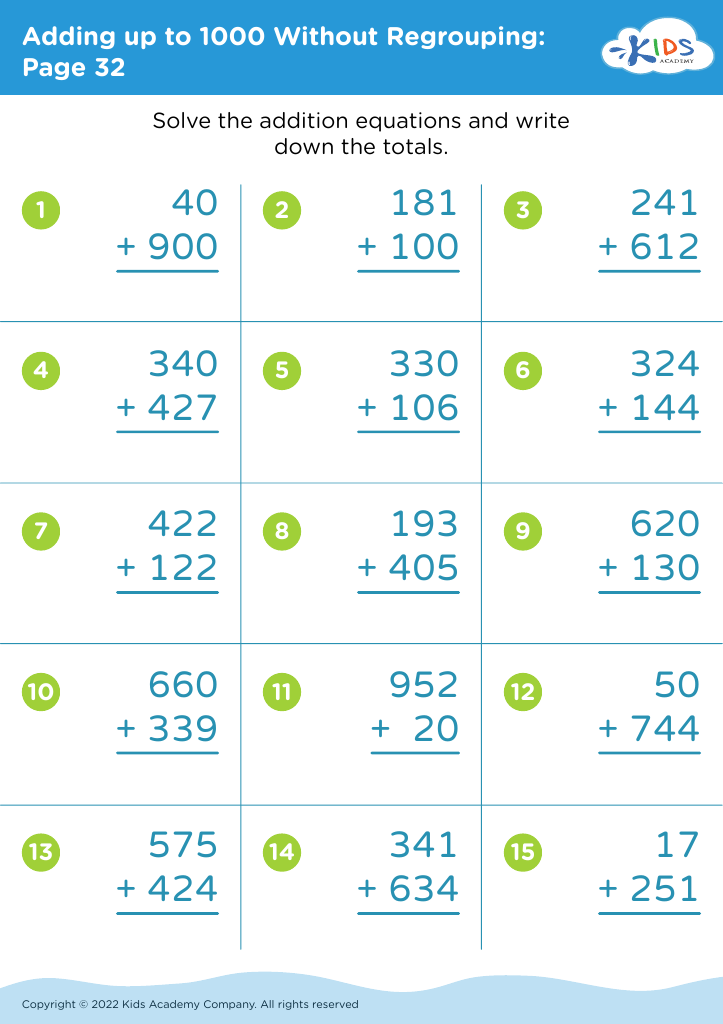
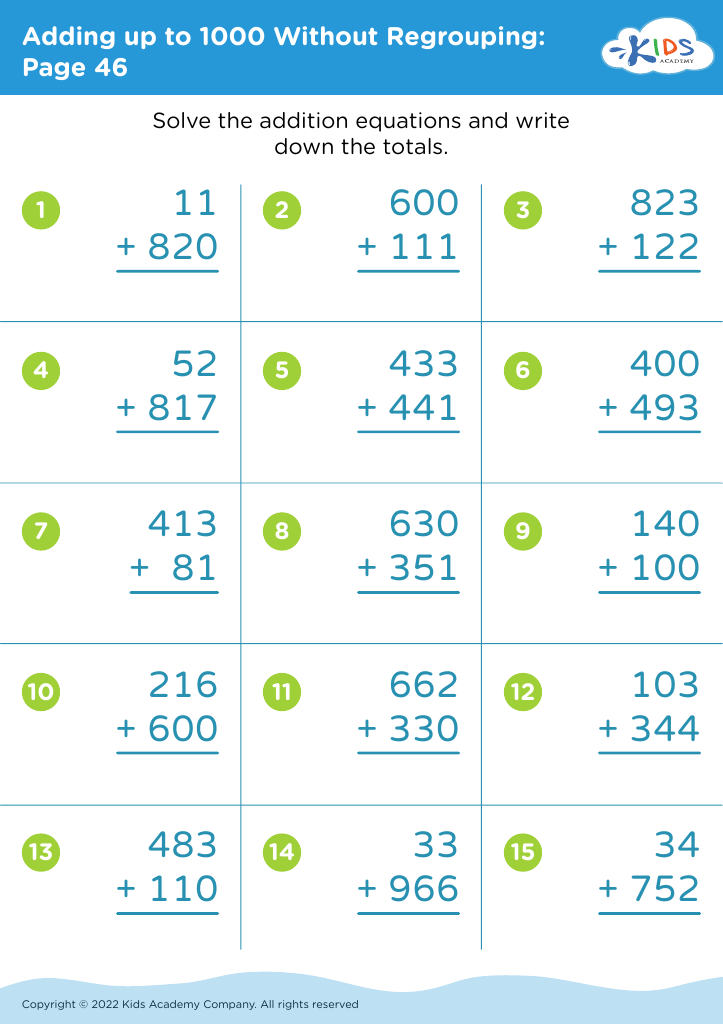
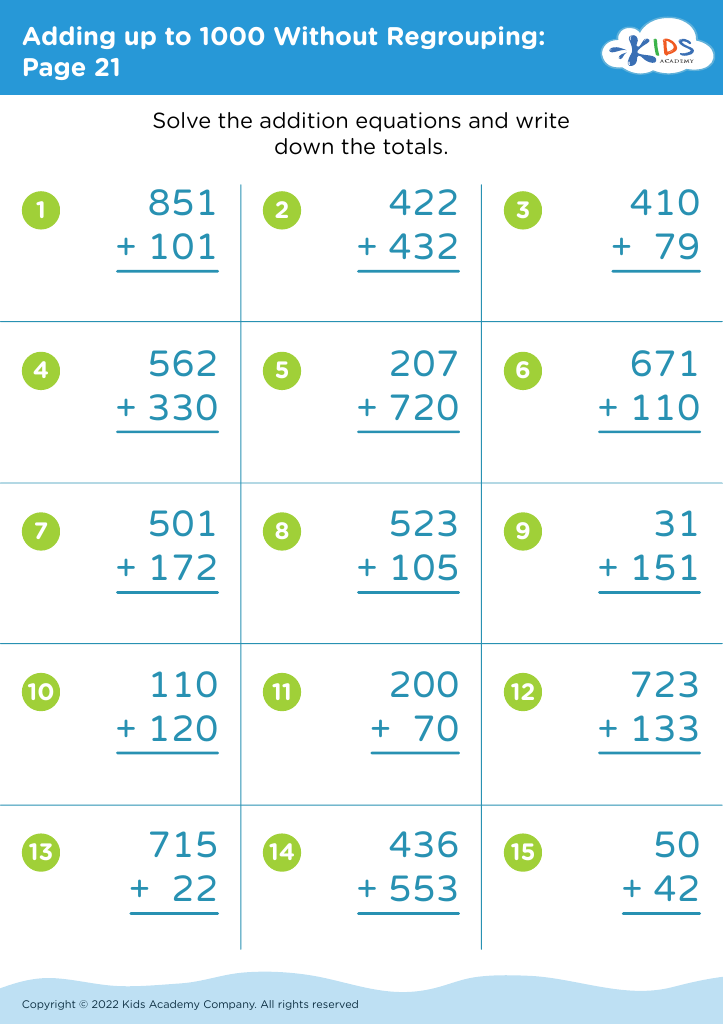
Enhance your child's mathematical journey with our collection of "Develop Counting Skills Addition Worksheets" suited for 9-year-olds. Specifically designed to advance their counting prowess, these worksheets provide a plethora of engaging exercises aimed at improving addition skills. Each sheet combines learning with fun to ensure children grasp fundamental concepts while fostering a love for math. Tailored pedagogical techniques help bridge the gap between counting and addition, creating a robust foundation for future math success. Perfect for both classroom and at-home practice, these worksheets simplify complex ideas, making addition intriguing and accessible to young learners.
Favorites
With answer key
Interactive
Join Kids Academy for Free
Who is primarily going to use this learning content?








Cultivating counting and addition skills in 9-year-old children is fundamental for their mathematical development and broader cognitive growth. At this age, kids are transitioning from basic arithmetic to more complex problem-solving tasks. Solid counting and addition abilities lay the groundwork for this shift, ensuring kids aren't just memorizing facts but also understanding underlying concepts.
Strong counting skills enhance a child's ability to recognize patterns, which is crucial not just in mathematics but also in everyday situations like time management and financial literacy. For instance, understanding these patterns helps them value money, comprehend time intervals, and measure ingredients in recipes.
Addition skills are essential for advancing in more complex arithmetic operations like subtraction, multiplication, and division. By grasping addition early, children are better equipped to tackle these new challenges, thereby building their confidence and interest in math. Regular practice also hones their problem-solving and critical-thinking abilities, skills essential in academic and real-life contexts. Moreover, proficiency in these foundational skills can boost self-esteem, leading to a positive attitude towards learning other subjects.
Therefore, parents and teachers play a crucial role in providing opportunities for practice through engaging, practical activities. This focus on foundational skills makes the journey through higher educational pursuits smoother and more enjoyable.








