Pattern recognition Addition Worksheets for 9-Year-Olds
3 filtered results
-
From - To
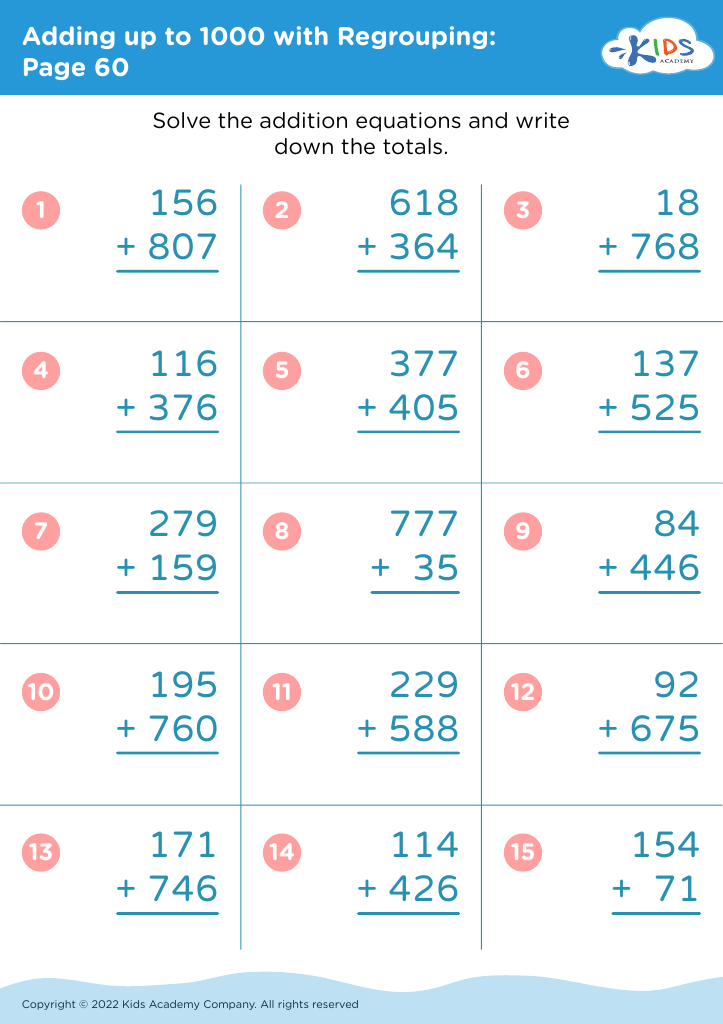
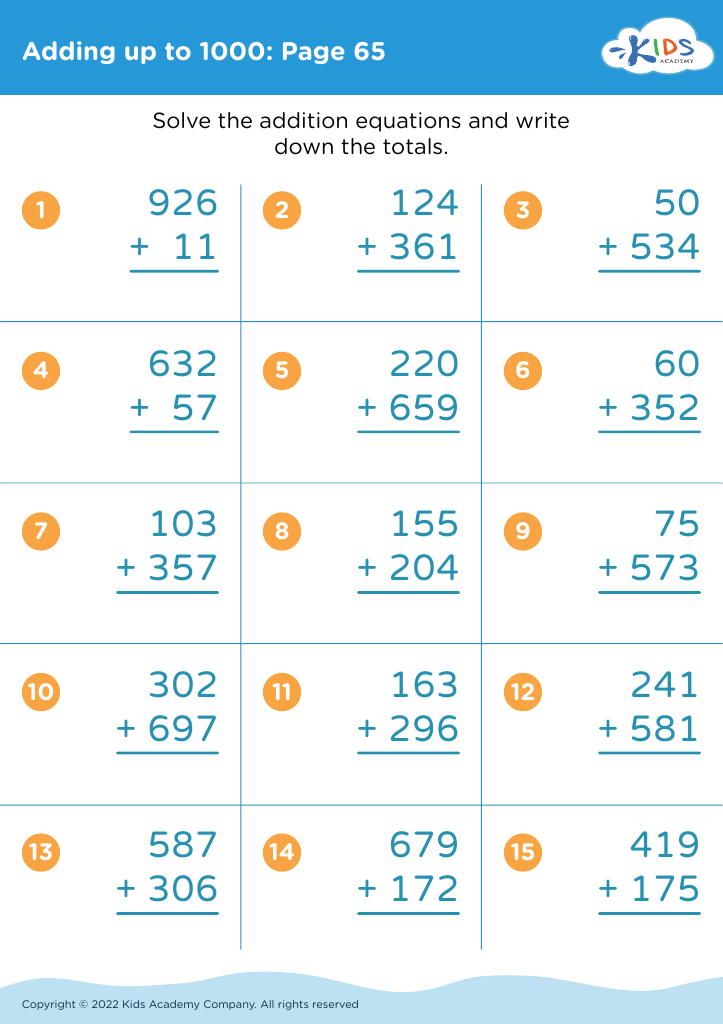
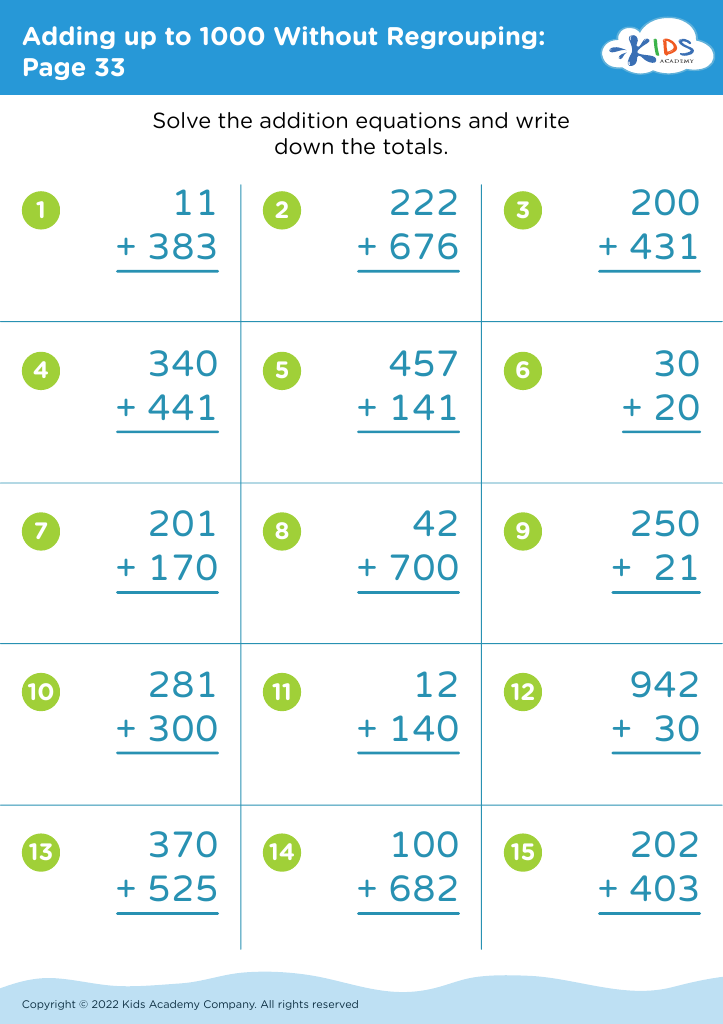
Our "Pattern Recognition Addition Worksheets for 9-Year-Olds" are designed to enrich your child's learning experience by merging essential math skills with engaging patterns. These worksheets boost critical thinking and analytical skills as kids identify patterns and solve addition problems simultaneously. Aimed specifically for 9-year-olds, each worksheet provides a blend of fun and learning that keeps young minds captivated while reinforcing addition principles. Explore endless fun and educational activities to strengthen math proficiency confidently and creatively. Perfect for classroom or home practice, our worksheets make math enjoyable and accessible for all students.








Pattern recognition and addition are foundational skills for 9-year-olds that can significantly impact their academic success and overall cognitive development. Firstly, pattern recognition forms the cornerstone of mathematical reasoning. By identifying and understanding patterns, children can make predictions, solve problems more efficiently, and grasp more complex mathematical concepts later, such as algebra and geometry. This skill transcends mathematics, extending to science, reading, and even daily life, where recognizing sequences and structures is crucial.
Addition, on the other hand, is a fundamental arithmetic skill that underlies many higher-level math operations. Proficiency in addition promotes numerical fluency, allowing children to tackle more challenging math tasks with confidence. When children practice addition within patterns, such as in skip counting or arithmetic sequences, they integrate and reinforce both skillsets simultaneously.
Furthermore, mastering these skills boosts children’s confidence, laying a solid foundation for future academic achievements. It encourages a positive attitude towards math, leading to a greater likelihood of pursuing STEM-related subjects. For teachers and parents, focusing on pattern recognition and addition equips children with critical thinking abilities and problem-solving skills that are essential in everyday decision making and learning.
Thus, investing time and resources in helping 9-year-olds develop these abilities can foster intellectual growth, academic success, and practical life skills.








