
Understanding Sequences Math Worksheets for 9-Year-Olds
7 filtered results
Difficulty Level
Grade
Age
-
From - To
Subject
Activity
Standards
Explore our "Understanding Sequences Math Worksheets" designed specifically for 9-year-olds to develop their comprehension of patterns and sequences! These engaging, age-appropriate worksheets challenge children to identify, analyze, and extend numerical patterns. By practicing with a range of exercises, young learners will enhance their problem-solving skills while enjoying interactive learning. Our worksheets provide instant feedback and are perfect for both classroom use and home practice. Encourage your child’s love for math and help them become confident in recognizing and creating sequences. Download now for fun, educational activities that make learning sequences enjoyable and effective!
Favorites
With answer key
Interactive
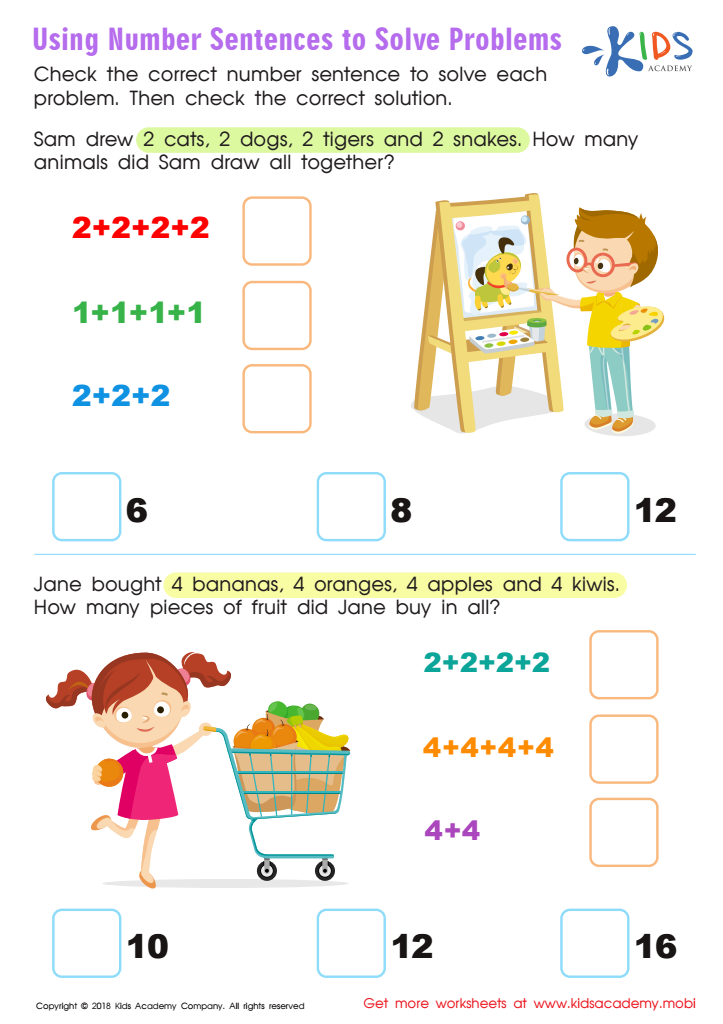
Using Number Sentences to Solve Problems Worksheet
Solving math problems requires an efficient strategy. Picture representation can help young mathematicians with basic addition problems, especially when it involves repeated addends. As they gain confidence, they'll be able to apply their number sentence solving abilities to more complex equations.
 Assign to My Students
Using Number Sentences to Solve Problems Worksheet
Worksheet
Join Kids Academy for Free
Who is primarily going to use this learning content?



%20(1).jpg)



Understanding sequences in math is crucial for 9-year-olds, as it forms the foundation for higher mathematical concepts. At this developmental stage, children are starting to grasp abstract ideas, and learning about sequences enhances their problem-solving skills and logical reasoning. Parents and teachers should care because mastering sequences helps children recognize patterns, which is not only vital in math but also in daily life.
Additionally, sequences connect various mathematical topics, such as addition, multiplication, and algebra. They introduce concepts of change and predictability, which are essential for later topics like functions and equations. By grasping the concept of sequences, children develop critical thinking and their ability to make predictions based on trends — skills that are applicable in science, technology, engineering, and everyday decision-making.
Moreover, fostering an early interest in sequences can motivate students by highlighting the patterns found in nature, art, and music, making mathematics more relatable and enjoyable. When parents and teachers emphasize the importance of understanding sequences, they equip children with essential tools for academic success and encourage a lifelong appreciation for math and its applications in the world around them.








