
Visual learning reinforcement Math Worksheets for 9-Year-Olds
3 filtered results
Difficulty Level
Grade
Age
-
From - To
Subject
Activity
Standards
Enhance your 9-year-old's math skills with our engaging visual learning reinforcement worksheets! Designed specifically for young learners, these worksheets use colorful illustrations and interactive elements to make complex concepts easier to understand. By incorporating visual aids, children can connect math problems to real-world scenarios, enhancing their comprehension and retention. Perfect for reinforcing topics such as addition, subtraction, multiplication, and division, our printable resources promote active learning while making math fun. Ideal for homeschooling or classroom use, these worksheets provide the essential support your child needs to boost their confidence and competence in math. Explore our collection and watch your child's skills flourish!
Favorites
With answer key
Interactive
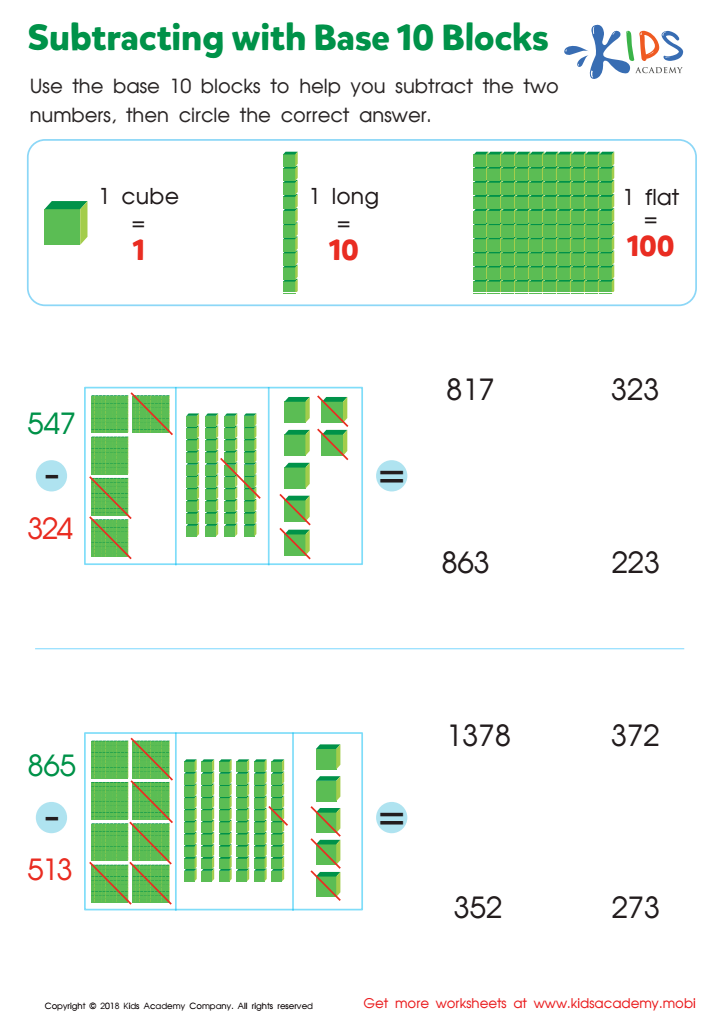
Subtracting with Base 10 Blocks Worksheet
Is your child having difficulty with 3-digit subtraction? They're not alone! Show your kid the idea behind subtracting with the help of Kids Academy's PDF worksheet. Colorful green base blocks are used to visualize the concept. Starting from the tens column, subtract each number and use the images for guidance. Allow your child to circle the correct answer for a comprehensive math lesson.
 Assign to My Students
Subtracting with Base 10 Blocks Worksheet
Worksheet
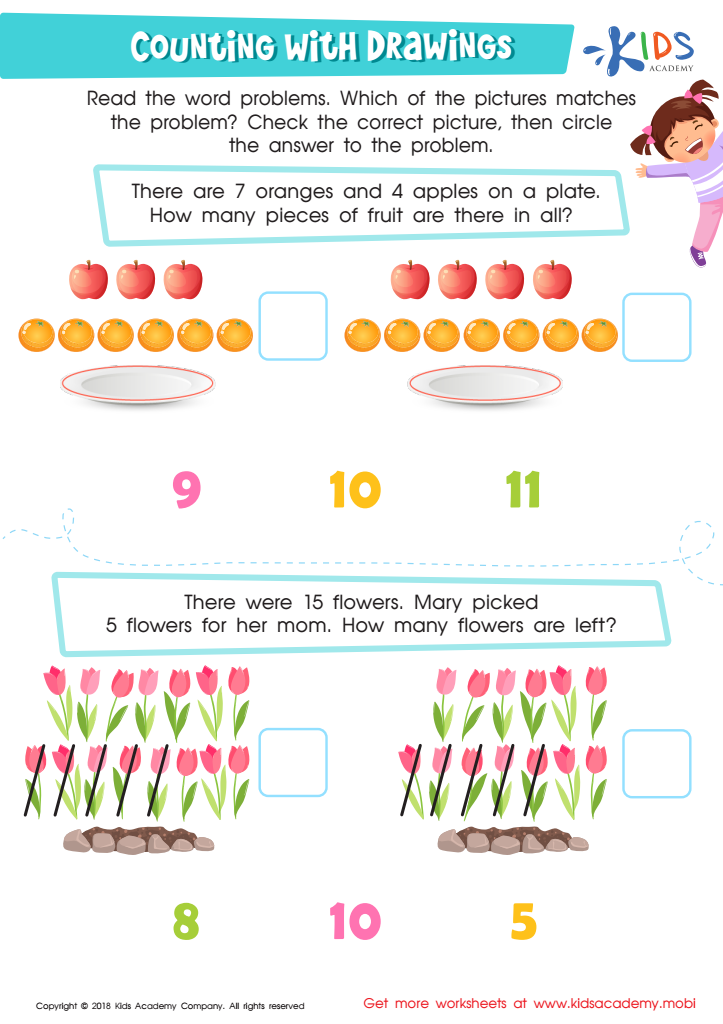
Counting with Drawings: Fruits & Chocolates Worksheet
Learning basic addition and subtraction has never been easier with this free worksheet! Young mathematicians can sort & count to get the right sum or difference for each problem. Plus, they'll practice fine motor skills by circling the correct answer. An ideal way to help kids build important visual recognition and discernment skills.
Counting with Drawings: Fruits & Chocolates Worksheet
Worksheet
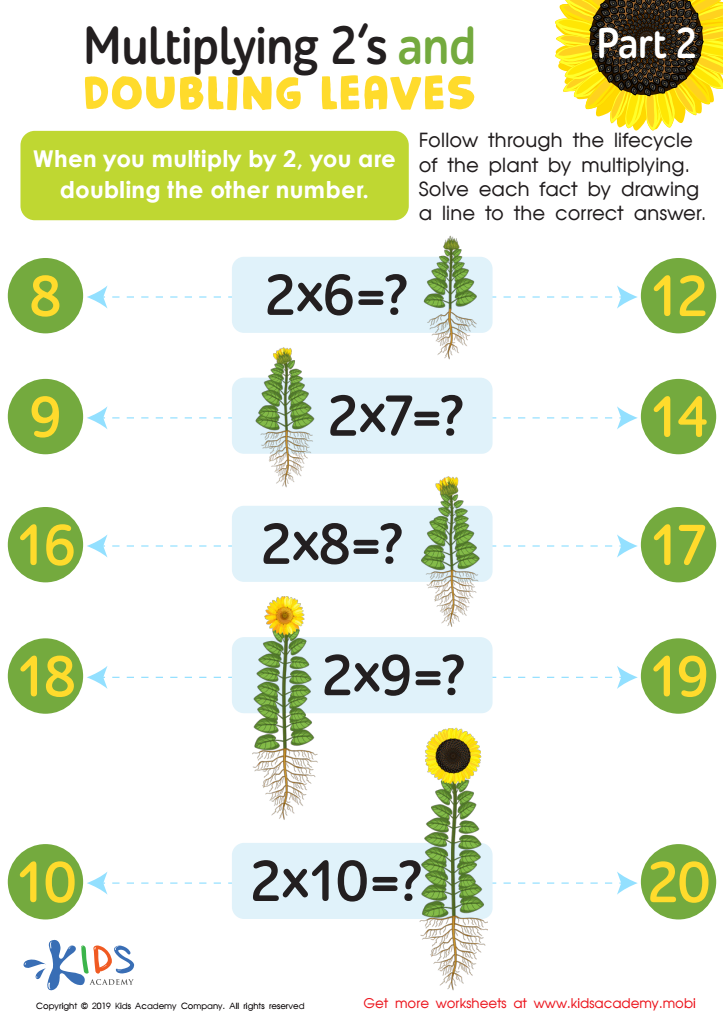
Multiplying 2’s and Doubling Leaves Part 2 Worksheet
Help your students master multiplication with these simple tips. Double the number for multiplying by 2 and use this interactive tracing sheet for solving each fact. Plus, it's colorful making it fun for your students to learn.
Multiplying 2’s and Doubling Leaves Part 2 Worksheet
Worksheet
Join Kids Academy for Free
Who is primarily going to use this learning content?







Visual learning reinforcement in math is crucial for 9-year-olds as it significantly enhances comprehension and retention of mathematical concepts. At this age, children are developing critical cognitive skills, and incorporating visual strategies—such as diagrams, charts, and manipulatives—helps them grasp abstract concepts like addition, subtraction, multiplication, and division more effectively.
Parents and teachers should care because children often have varying learning styles, and visual aids can engage visual learners in ways that traditional methods may not. For example, using visual representations of fractions can make it easier for children to understand how they function within a whole. Additionally, visuals help break down complex problems into manageable parts, fostering problem-solving skills and building confidence.
By reinforcing math concepts visually, educators and parents can create a rich learning environment that cultivates curiosity and a love for math. Visual learning also encourages active participation, allowing children to explore and discover mathematical relationships rather than passively receiving information. As a result, children are likely to perform better academically and develop a more positive attitude toward math, thus setting a solid foundation for their future education. Ultimately, this approach offers children the tools they need to succeed and thrive in their mathematical journey.








