
Extra Challenge Elementary Phonics Worksheets Activities With Answers for Ages 4-5
3 filtered results
Difficulty Level
Grade
Age
-
From - To
Subject
Activity
Standards
Introducing our Extra Challenge Elementary Phonics Worksheets Activities with Answers – a premier collection designed to inspire and advance young learners' phonics skills beyond the basics. Perfect for students seeking additional challenges, this comprehensive package includes a variety of engaging and interactive worksheets tailored for elementary-level learners. Each activity is meticulously crafted to reinforce phonics principles while stimulating critical thinking and problem-solving abilities. Complete with answers, educators and parents can effortlessly guide students through their learning journey, ensuring a solid foundation in reading and spelling. Elevate your child's phonics proficiency with our Extra Challenge Elementary Phonics Worksheets Activities today!
Favorites
With answer key
Interactive
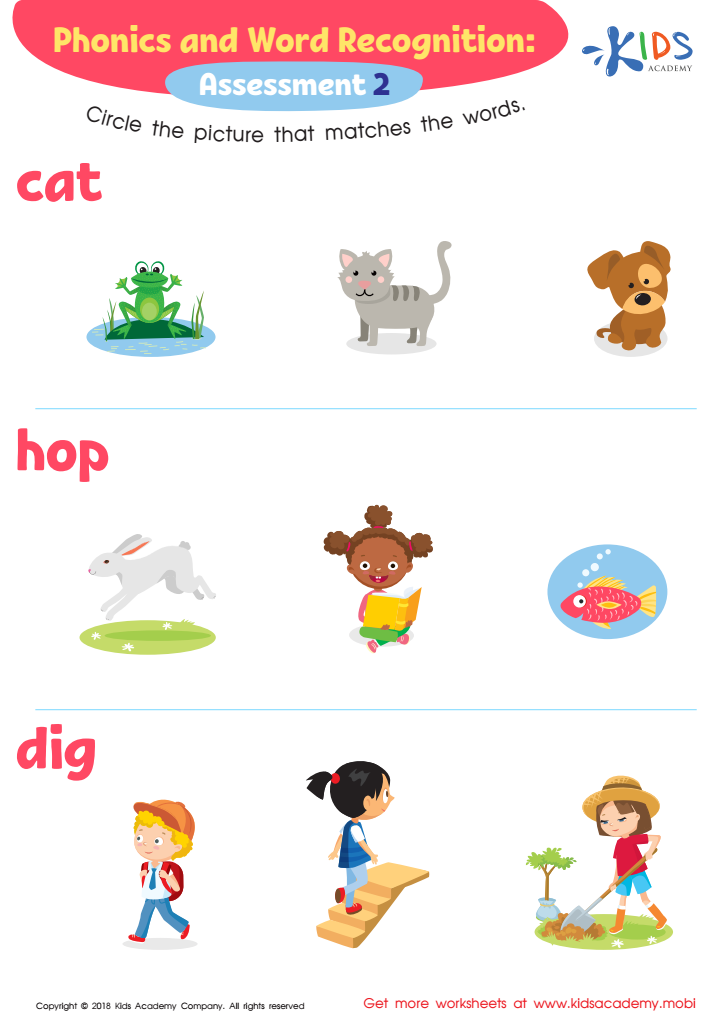
Phonological Awareness: Assessment 2 ELA Worksheet
This free worksheet assesses your emerging reader's ability to decode and match closed-syllable high-frequency words to the appropriate picture. The pictures are cheery and easy to identify, so your child will have fun and find success with decoding and matching.
 Assign to My Students
Phonological Awareness: Assessment 2 ELA Worksheet
Worksheet
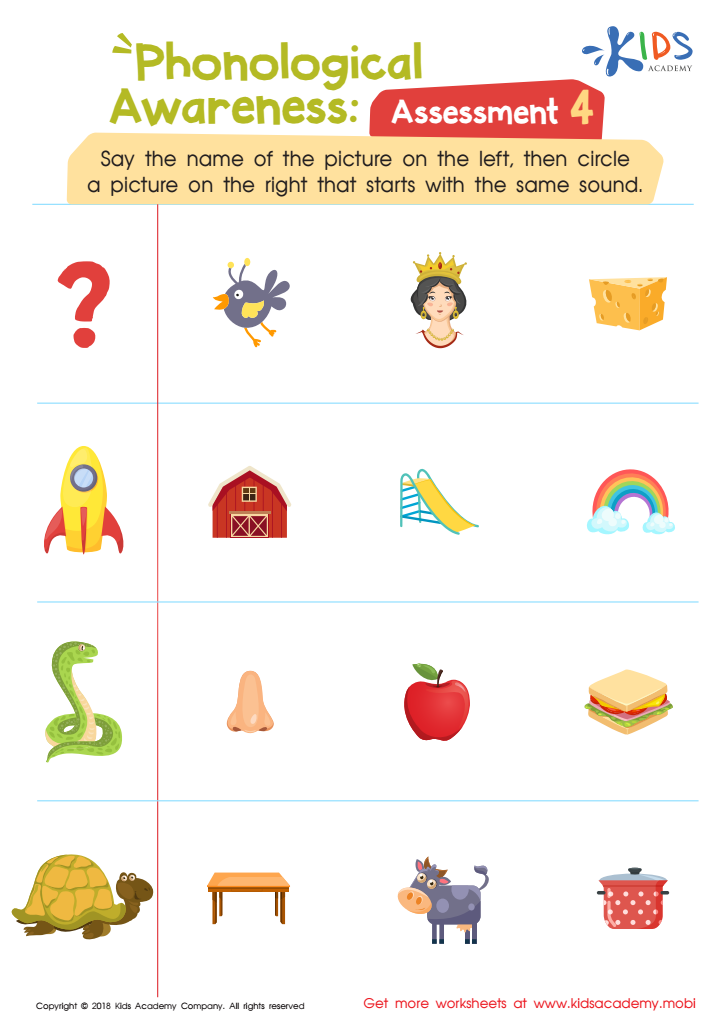
Phonological Awareness: Assessment 4 Worksheet
It can be tricky for young readers to differentiate between sounds in words. Make it fun with this downloadable worksheet! Ask your child to name each picture on the left and match the starting sound with an image on the right. This helps assess their phonics skills and make learning enjoyable.
Phonological Awareness: Assessment 4 Worksheet
Worksheet
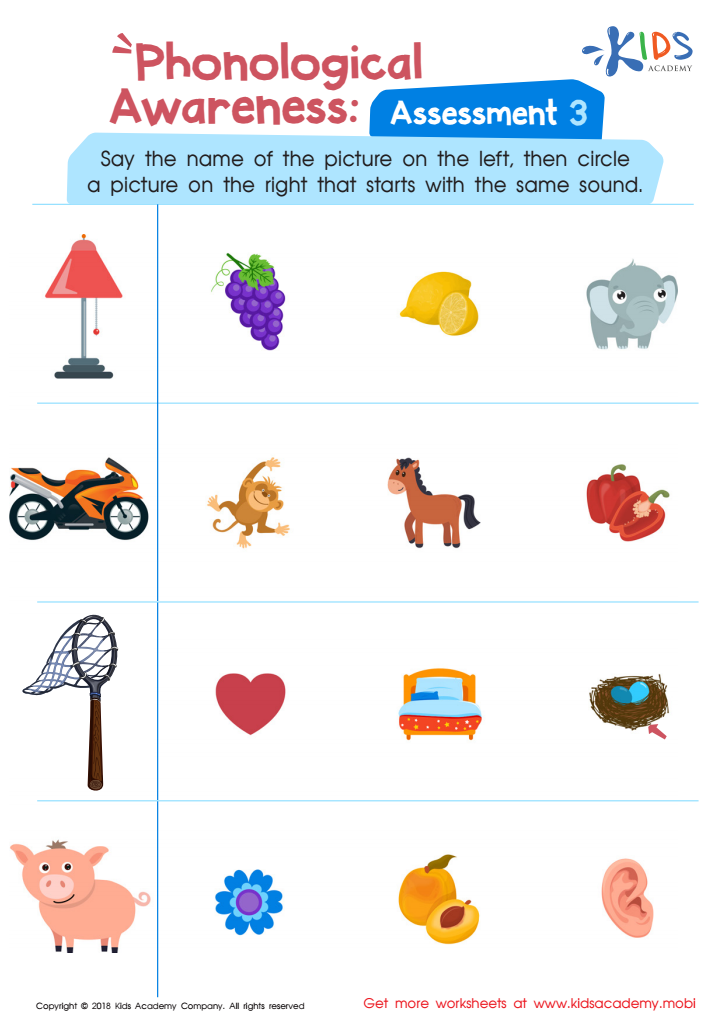
Phonological Awareness: Assessment 3 Worksheet
Test kids' reading readiness with a phonological awareness worksheet! With this PDF exercise, encourage children to name each picture aloud and match left to right. Help them learn to recognize word sounds at the start, middle and end of words. They'll be sure to remember that lamp doesn't sound like elephant!
Phonological Awareness: Assessment 3 Worksheet
Worksheet
Join Kids Academy for Free
Who is primarily going to use this learning content?



.jpg)



Extra Challenge Elementary Phonics Worksheets Activities with Answers are an invaluable resource for students at the elementary level to bolster their reading and writing skills. Phonics, the method of teaching reading by correlating sounds with symbols in an alphabetic writing system, is foundational in early education. These worksheets push the envelope beyond the basic curriculum, offering students a unique opportunity to engage with the material in a more challenging and rewarding manner.
Why are these Extra Challenge Elementary Phonics Worksheets Activities so useful? First and foremost, they cater to a wide range of learning styles. By incorporating activities that require critical thinking, problem-solving, and application of knowledge, these worksheets ensure that students are not merely memorizing but understanding and applying phonetic principles in versatile ways. The inclusion of answers further enhances the learning process by providing immediate feedback, allowing learners to self-correct and understand their mistakes in real-time.
Moreover, these worksheets are designed to challenge students, pushing them beyond their comfort zones. This is crucial for cognitive development and helps in fostering a growth mindset. When faced with more demanding tasks, students learn perseverance and resilience, qualities that are invaluable throughout their educational journey and beyond.
Additionally, the Extra Challenge Elementary Phonics Worksheets Activities with Answers are excellent tools for differentiation in the classroom. Teachers can use these resources to provide additional support to advanced learners who might not find the regular curriculum stimulating enough. This ensures that all students are engaged at a level that is most appropriate for them, promoting an inclusive learning environment where every child can thrive.
In essence, these extra challenge worksheets not only enhance phonetic skills but also equip students with the confidence and perseverance needed to tackle challenging tasks. They are a testament to the importance of challenging our young learners, preparing them not just academically but also for the complexities of the world beyond the classroom.








