Normal Area and Perimeter Word Problems Worksheets for Ages 8-9
1 filtered results
-
From - To
Discover the joy of mastering geometry with our Learning Interactive Worksheets focusing on Normal Area and Perimeter Word Problems, tailored specifically for children aged 8-9 years. These engaging worksheets are designed to reinforce understanding through practical problems, helping young learners to visualize and solve area and perimeter challenges in real-world contexts. Ideal for both classroom and home use, our worksheets make learning these fundamental math concepts both fun and accessible. Encourage your child's mathematical confidence and problem-solving skills with our expertly crafted activities that turn everyday learning into an exciting adventure.
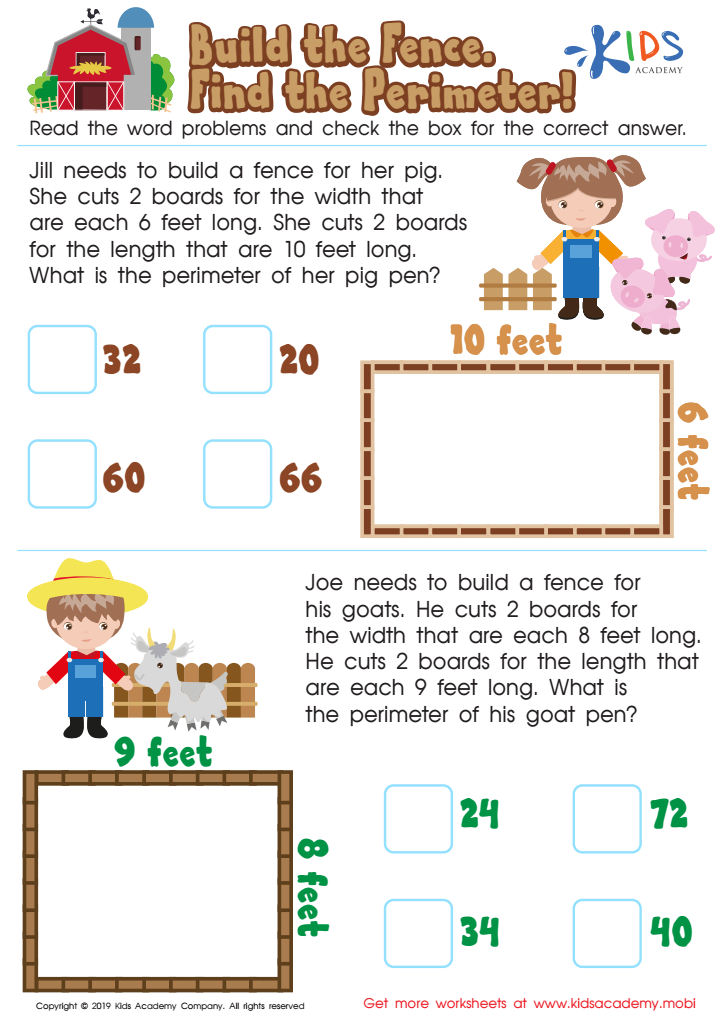
Build the Fence, Find the Perimeter Worksheet
 Assign to My Students



The Value of Normal Worksheets on Area and Perimeter Word Problems for Children Aged 8-9 Years
As children progress through their academic journey, the introduction of concepts like area and perimeter in mathematics can pose new and exciting challenges. Particularly for children aged 8-9, who are developing critical thinking and problem-solving skills, engaging educational tools are essential. This is where normal worksheets on area and perimeter word problems come in, especially those designed as learning interactive printables. These resources are not just useful; they are crucial stepping stones in elementary mathematical education.
Enhancing Comprehension through Contextual Learning
At the ages of 8 to 9, children are transitioning from concrete operational stages to more formal, logical thinking as per Piaget's theory of cognitive development. Normal worksheets on area and perimeter allow children to explore mathematical concepts in a context that makes sense to them. Word problems, in particular, provide real-world relevance, which helps students understand not just how to calculate, but why these calculations are important in everyday life.
Building Confidence with Incremental Challenges
Learning interactive printables are structured to introduce concepts in a gradual, understandable manner. They often begin with simple, straightforward problems and progressively incorporate more complex scenarios. This scaffolding approach is crucial because it builds confidence as children master the basics before moving on to more challenging problems. Confidence in their abilities encourages children to engage more deeply, enhancing their learning experience.
Promoting Interactive Learning
Worksheets designed as learning interactive printables are particularly beneficial because they provide opportunities for hands-on activities. These might include tasks where children need to measure real objects, draw shapes to specified dimensions, or even use digital tools to manipulate shapes and sizes. This type of interactivity not only makes learning more engaging but also helps solidify understanding as children learn by doing.
Supporting Development of Problem-Solving Skills
Problem-solving is a critical skill that goes beyond mathematics. Normal worksheets focused on area and perimeter word problems encourage children to develop these skills by posing various scenarios that require thoughtful solutions. Children learn to read carefully, identify the key pieces of information needed for solving the problem, and apply the appropriate mathematical formulas. These are invaluable skills in academic contexts and everyday life.
Facilitating Assessment and Feedback
For educators and parents, these worksheets provide a clear framework for assessing a child’s understanding and proficiency in area and perimeter. They can see where a child might be struggling and provide targeted feedback to help them improve. For children, completing these worksheets can offer a sense of accomplishment and a concrete demonstration of their learning progress. This feedback loop is essential for effective learning, helping children understand and correct their mistakes, further refining their skills over time.
Encouraging Collaboration and Discussion
Another significant benefit of learning interactive printables is their ability to be used in collaborative settings. Whether in the classroom or at home, children can work together on worksheets, discussing their approaches to solving problems and sharing strategies. This not only enhances their understanding but also improves their communication and social skills as they learn to express mathematical ideas and listen to others' perspectives.
Adapting to Individual Learning Styles
Normal worksheets on area and perimeter are also beneficial as they can be adapted to various learning styles. For visual learners, diagrams and color-coded sections can help in understanding the spatial aspects of area and perimeter. For kinesthetic learners, involving physical activities like cutting out shapes or using building blocks can make learning more effective. Auditory learners might benefit from discussions or explanations that accompany these worksheets. This adaptability makes worksheets a versatile tool in catering to diverse learning needs.
Long-Term Academic Benefits
Mastering area and perimeter through these worksheets lays a solid foundation for future mathematical concepts and skills. Geometry, algebra, and even calculus involve understanding and manipulating spaces and dimensions. Early exposure through practical and engaging worksheets ensures that children are well-prepared for these more advanced studies.
Conclusion
In conclusion, normal worksheets on area and perimeter word problems are immensely useful for children aged 8-9 years. They not only help in understanding fundamental mathematical concepts but do so in a way that is engaging through learning interactive printables. These worksheets build confidence, develop problem-solving skills, and cater to different learning styles, making them an indispensable tool in the educational toolkit for young learners. As children interact with these printables, they not only learn about mathematics but also about how to learn effectively, a skill that will benefit them throughout their academic and professional careers.