
Money management skills Easy Addition & Subtraction Worksheets for Ages 3-9
3 filtered results
Difficulty Level
Grade
Age
-
From - To
Subject
Activity
Standards
Enhance your child's money management skills with our Easy Addition & Subtraction Worksheets, designed for ages 3-9! These engaging, printable worksheets help young learners grasp basic math concepts while introducing them to essential money handling skills. Through fun and interactive exercises, kids will practice adding and subtracting real-life scenarios involving coins and bills, making learning both educational and enjoyable. Perfect for parents and educators looking to instill financial literacy from an early age, our worksheets foster confidence in math and encourage responsible money habits. Start your child's journey to smart money management today!
Favorites
With answer key
Interactive
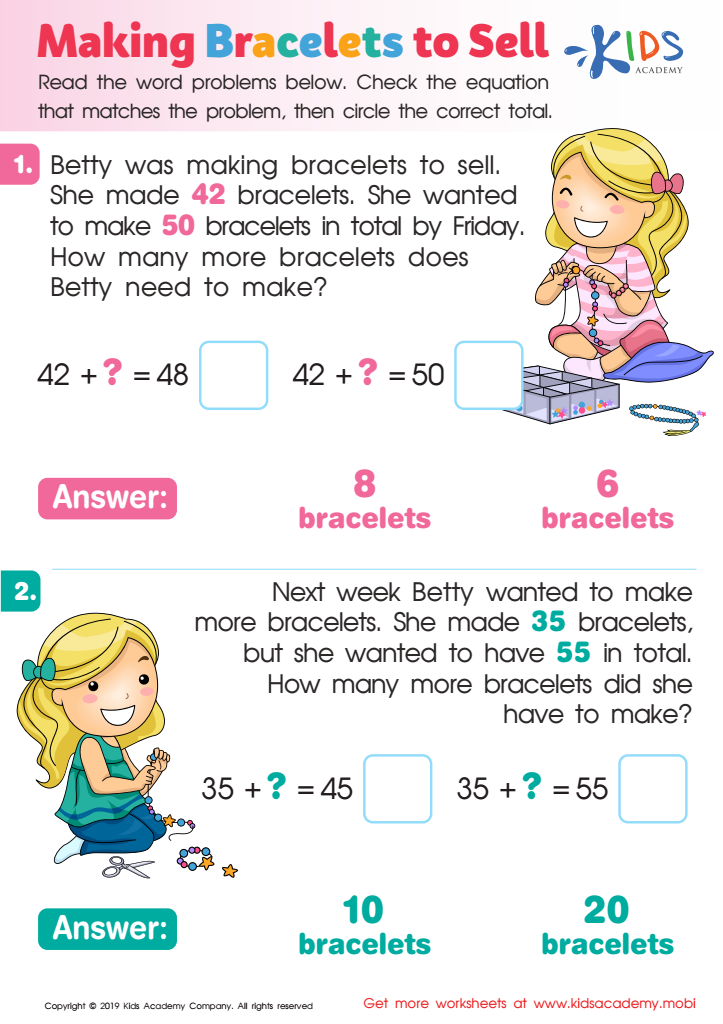
Making Bracelets to Sell Worksheet
Got kids who love crafting? This worksheet will be right up their alley! Let them use their creative and problem-solving skills to check equations and decide the correct total. It's just like making beads into a bracelet but on paper! Print out this downloadable PDF and get ready for a fun craft session.
 Assign to My Students
Making Bracelets to Sell Worksheet
Worksheet
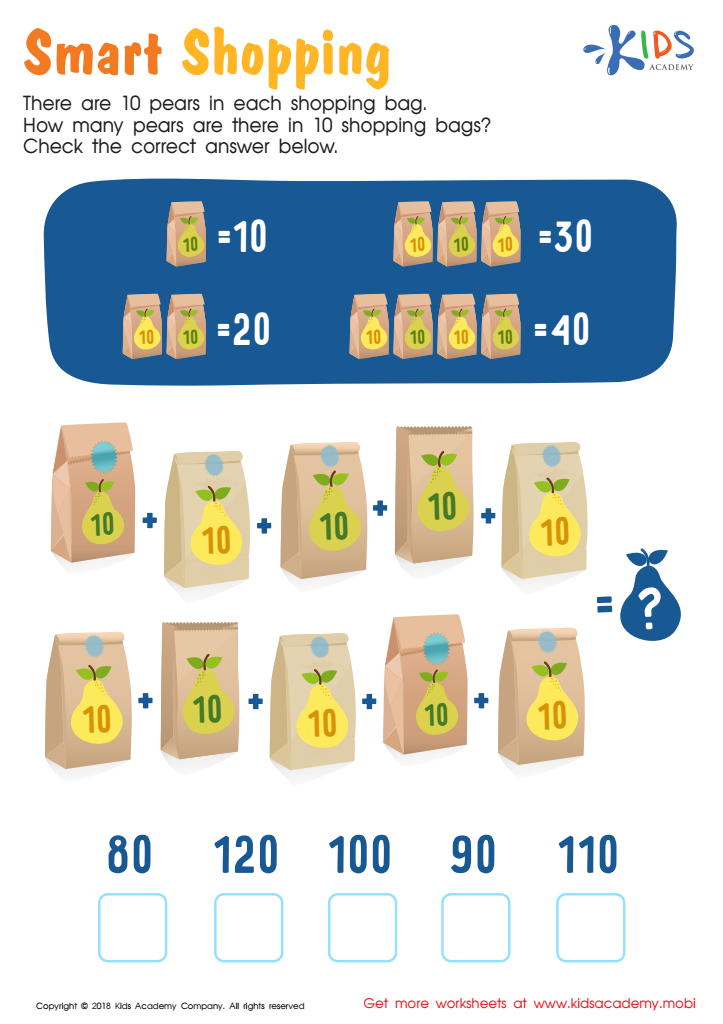
Smart Shopping: Trade Tens for a Hundred Worksheet
Use this worksheet to test counting skills: each bag has 10 pears. Ask your child how many pears are in 10 bags. Guide them as they count through the printout and check the answer below. See if they got it right!
Smart Shopping: Trade Tens for a Hundred Worksheet
Worksheet
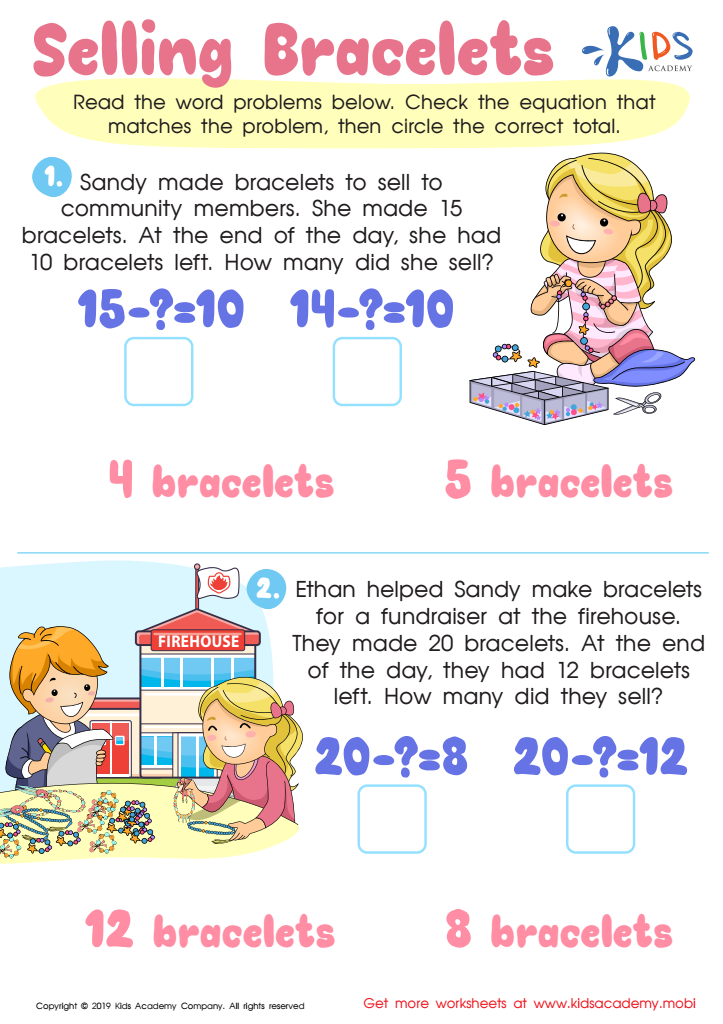
Selling the Bracelets Worksheet
Engage your kids with learning by making it fun! Try this creative worksheet: your kids can practice subtraction while making bracelets. Download the pdf; read the two word problems to them and help them choose the correct total. Have fun! (80 words)
Selling the Bracelets Worksheet
Worksheet
Join Kids Academy for Free
Who is primarily going to use this learning content?








Parents and teachers should care about money management skills for children ages 3-9 because these foundational skills set the stage for a lifetime of financial literacy. Early exposure to money concepts helps children understand value, savings, and making effective spending choices. Teaching easy addition and subtraction using real-life examples, like playing store or counting change, makes learning engaging and practical.
By nurturing these skills at a young age, children can develop a sense of responsibility and independence when it comes to handling money. Understanding basic arithmetic through money-related activities also reinforces mathematical skills, enhancing their overall academic performance in future subjects.
Moreover, money management promotes critical thinking and decision-making abilities. Children learn to evaluate options and consequences, which fosters their problem-solving skills. This knowledge is invaluable as they grow and eventually face real-world financial situations, such as managing allowances, saving for goals, or budgeting.
Ultimately, early education in money management helps children build a strong, positive relationship with money, equipping them with skills that contribute to their long-term success and well-being. Parents and teachers play a crucial role in guiding this journey, empowering children to become financially savvy adults.








