Filters

6 filtered results

Clear all filters
Favorites
With answer key
Interactive

6 filtered results

Difficulty Level

Grade


Unlock your child's counting potential with our Counting Skills Easy Word Problems Worksheets, specifically designed for ages 3 to 9. These engaging worksheets blend fun with learning, helping young learners master essential counting concepts through simple and relatable scenarios. Each activity encourages critical thinking and enhances problem-solving skills, making math enjoyable and accessible. Tailored to various skill levels, these worksheets promote confidence and independence as children count objects, solve basic problems, and reinforce their understanding of numbers in everyday situations. Explore our collection today and give your child a solid foundation in math that will last a lifetime!

Check out this FREE Trial Lesson on Word Problems for age 3-9!

Drawing it Out Addition

Favorites
With answer key
Interactive
  • 3-9
  • Counting skills
  • Word Problems
  • Easy
Butterfly Addition Worksheet

Butterfly Addition Worksheet

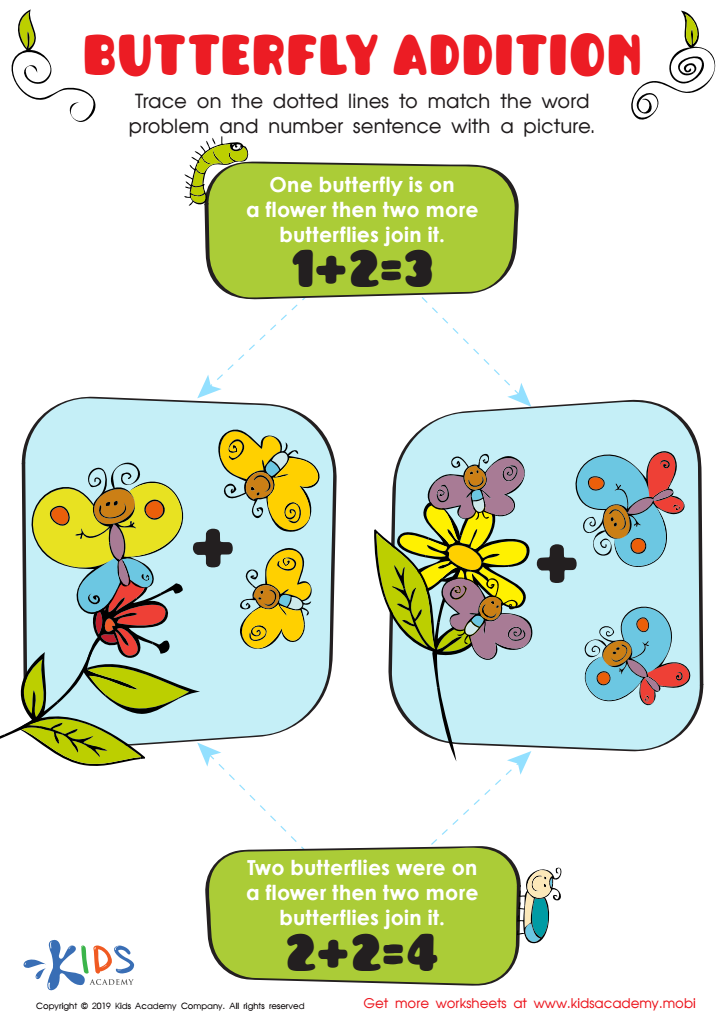
This tracing sheet is great for kids to work on math skills and have fun too. Read the word problems to them, then help them trace the dotted lines to match the problem and number sentence to a picture. Not only is it educational, it's beautiful too - your kids will love learning about butterflies!
Butterfly Addition Worksheet
Worksheet
Counting Seedlings Worksheet

Counting Seedlings Worksheet

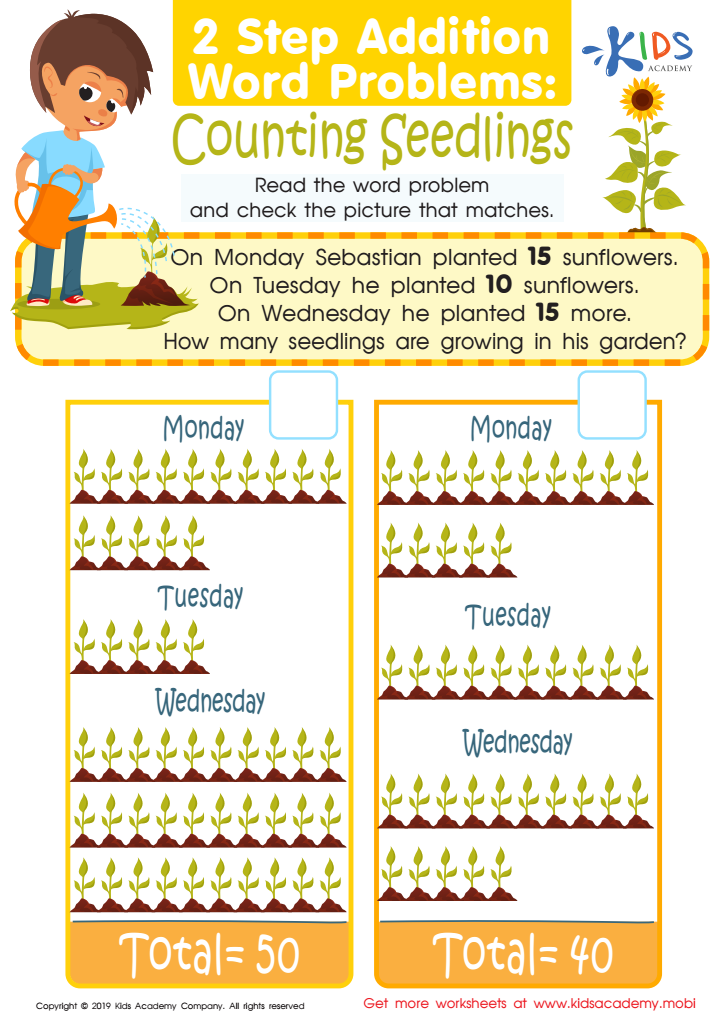
Understanding math word problems is key. Multiple steps can prove challenging - this free worksheet provides one-to-one picture representation to help kids solve multi-step addition word problems. Strengthen addition skills by choosing the matching picture to the answer.
Counting Seedlings Worksheet
Worksheet
Sea Math Worksheet
Sea Math Worksheet

Sea Math Worksheet

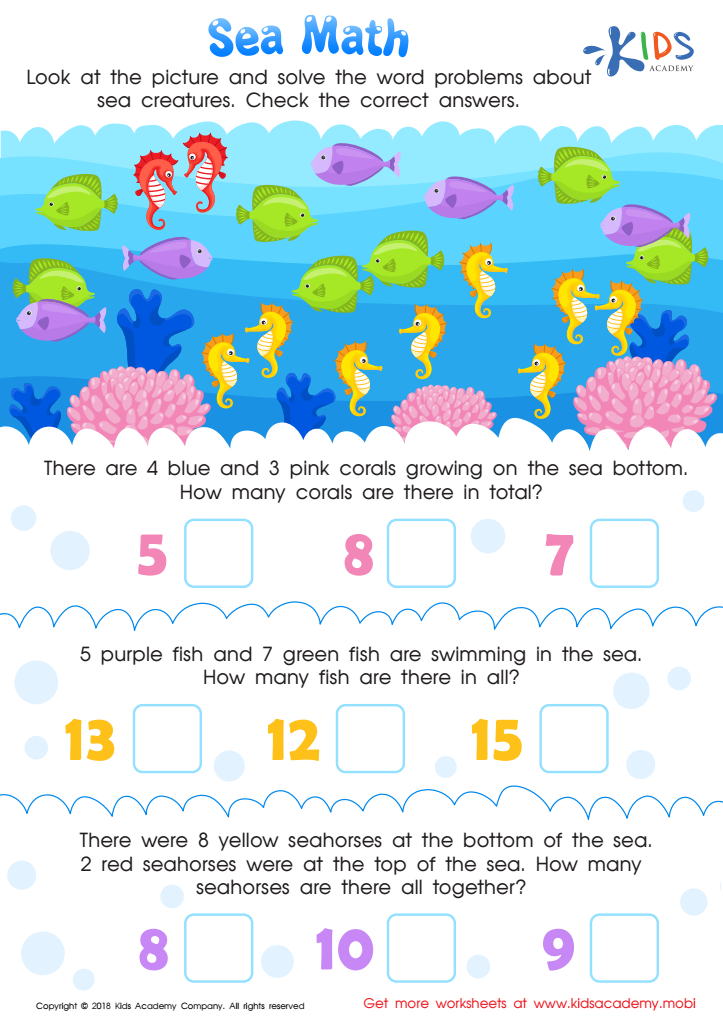
Dive into an ocean of addition with this fun math worksheet! Help your little mathematician count and add colorful coral and fish. Point out phrases like "in total" or "all together" as a reminder to use addition. Watch them add to find the answer and check the boxes to finish!
Sea Math Worksheet
Worksheet
Australian Animal Subtraction Worksheet

Australian Animal Subtraction Worksheet

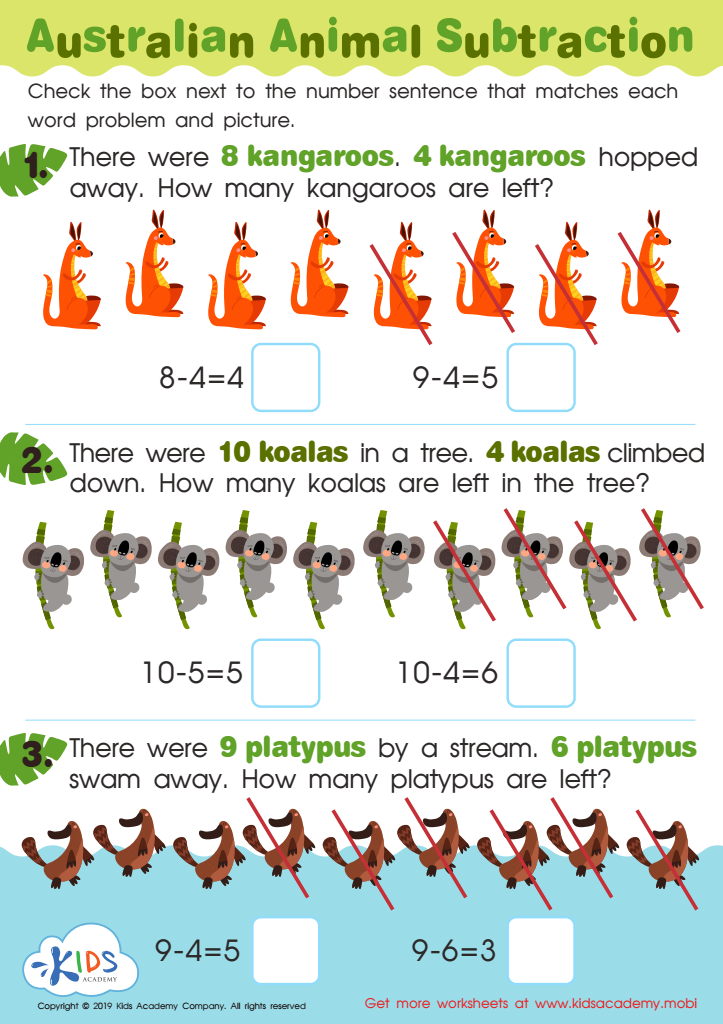
Test your child's wildlife knowledge. Ask them to name animals indigenous to Australia or other countries. Show them the animals in this worksheet and have them match each word problem and picture with the correct number sentence.
Australian Animal Subtraction Worksheet
Worksheet
Addition at the Zoo Worksheet

Addition at the Zoo Worksheet

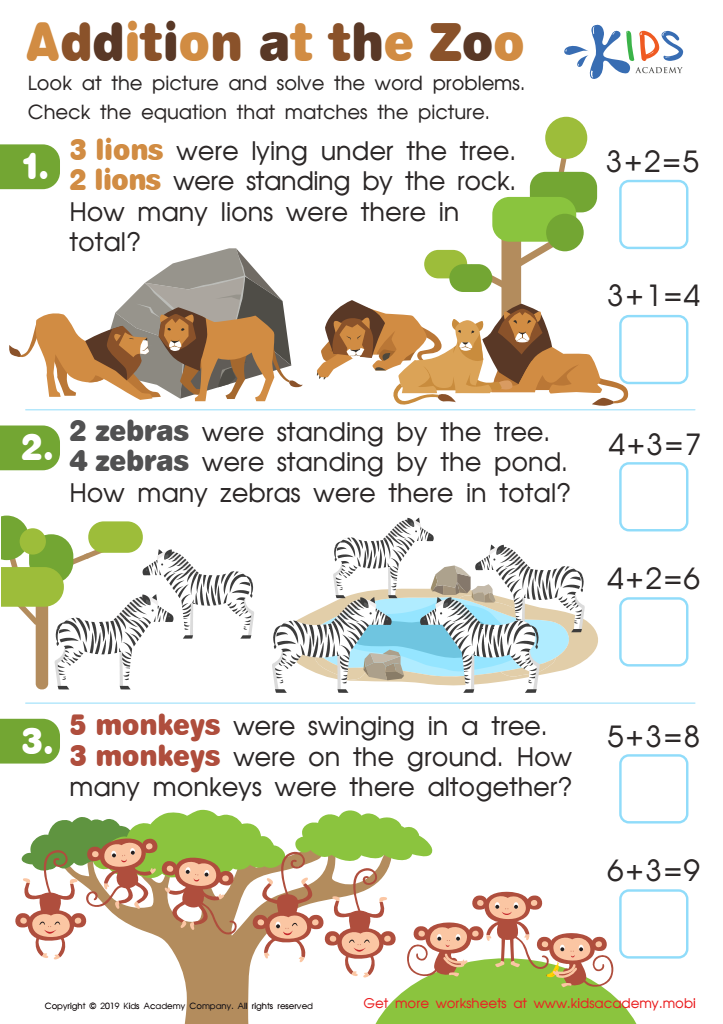
Visit the zoo with your kids and point out all the different animals. Ask them to name their favorites and identify animals on a worksheet. Challenge them to solve word problems related to the pictures. Ask them for the equation that fits the picture and check the answer.
Addition at the Zoo Worksheet
Worksheet
Animal Addition Worksheet


Animal Addition Worksheet

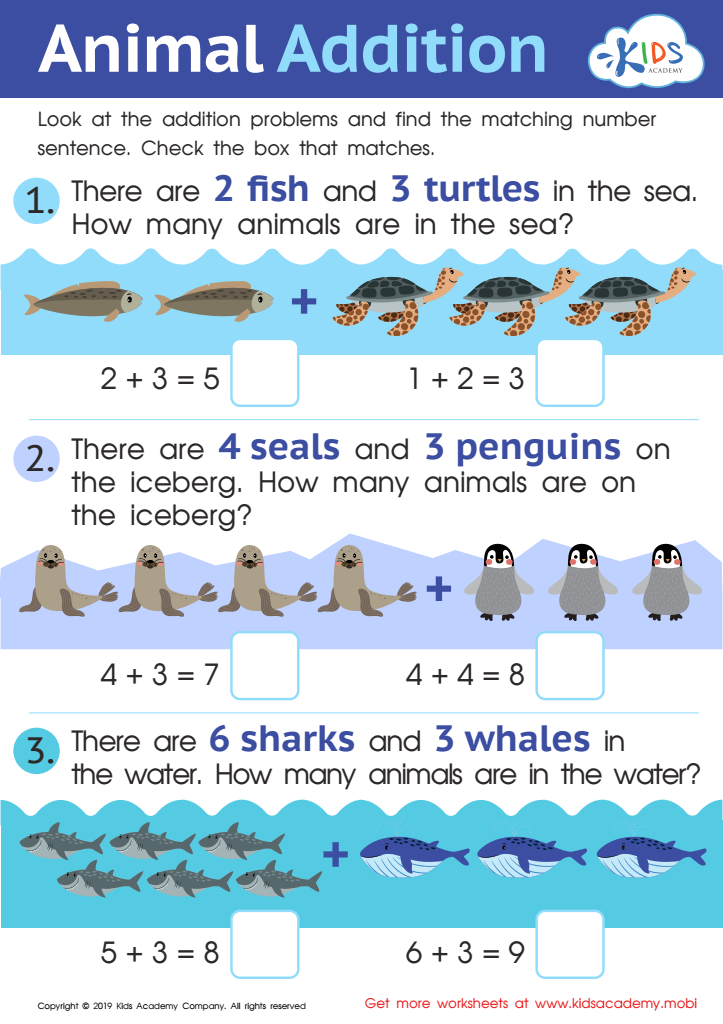
Get your kids learning addition and subtraction with this fun worksheet! Show them that solving equations can be enjoyable and help them match number sentences to the correct boxes. By doing this together, you'll create a positive learning experience that your kids won't forget.
Animal Addition Worksheet
Worksheet


Parents and teachers should prioritize counting skills and easy word problems for children aged 3-9 as they form the foundation for critical mathematical understanding. At this developmental stage, children are naturally curious and eager to learn, making it an ideal time to introduce basic counting and problem-solving concepts.

Counting skills help children develop number sense, enabling them to recognize quantities, understand the order of numbers, and build the ability to perform simple arithmetic operations. Engaging with easy word problems enhances their comprehension and critical thinking, fostering the ability to apply mathematical concepts to real-life situations.

Additionally, cultivating these skills in young children supports cognitive development and enhances confidence in their abilities. Mastering counting and basic problem-solving sets the stage for more complex mathematics later on, creating a smoother transition as they progress in their education.

By involving parents and teachers in this learning process, children benefit from a supportive environment that emphasizes the relevance of math in everyday life. Ultimately, nurturing counting skills and solving easy word problems ensures children are better prepared for academic challenges and develop a lifelong appreciation for mathematics.