Basic Math Skills Easy Fractions of Shapes Worksheets for Ages 4-8
4 filtered results
Difficulty Level
Grade
Age
-
From - To
Subject
Activity
Standards
Our "Basic Math Skills Easy Fractions of Shapes Worksheets" are designed to make learning fractions fun and accessible for kids aged 4-8. These colorful, engaging worksheets help children understand fractions by using simple shapes, promoting visual learning and practical application. Each worksheet is carefully crafted to teach basic fraction concepts, such as halves, thirds, and quarters, through interactive activities. Perfect for preschool and early elementary students, these worksheets build a solid foundation in fraction skills, enhance math confidence, and foster a love of learning. Ideal for classroom use or homeschooling, they bring math to life with playful ease.
Favorites
With answer key
Interactive
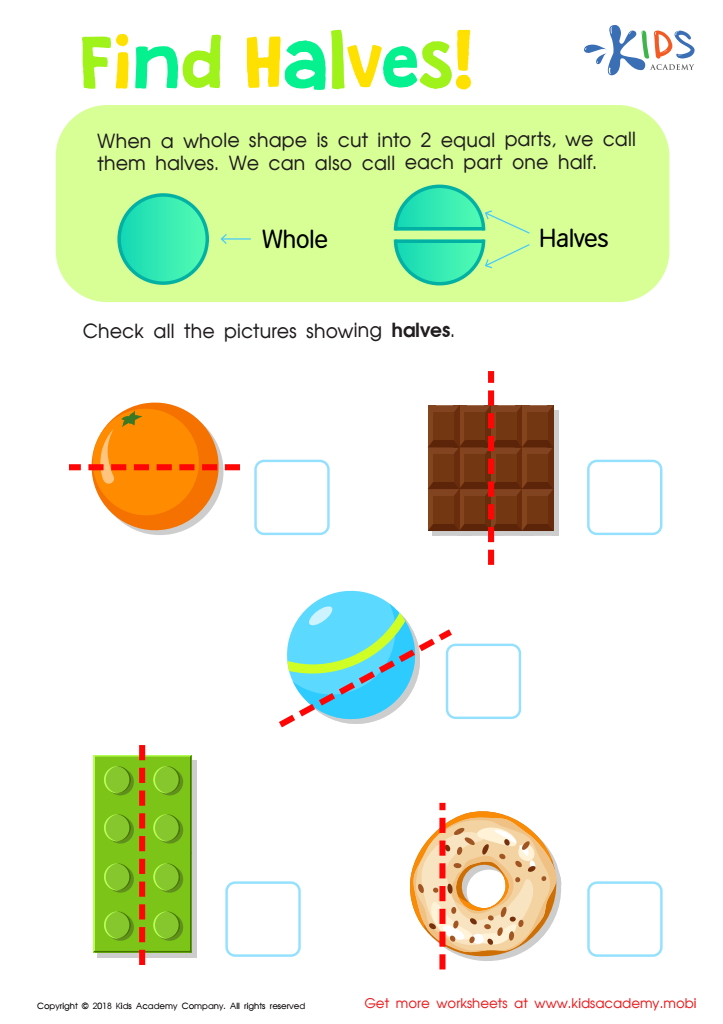
Find Halves Worksheet
If your child can tell you what two, three and four equal parts are called, give yourself a pat on the back! If not, this worksheet can help. Halves are two equal parts of a whole shape. Check the pictures in this printable pdf to help your child understand.
 Assign to My Students
Find Halves Worksheet
Worksheet
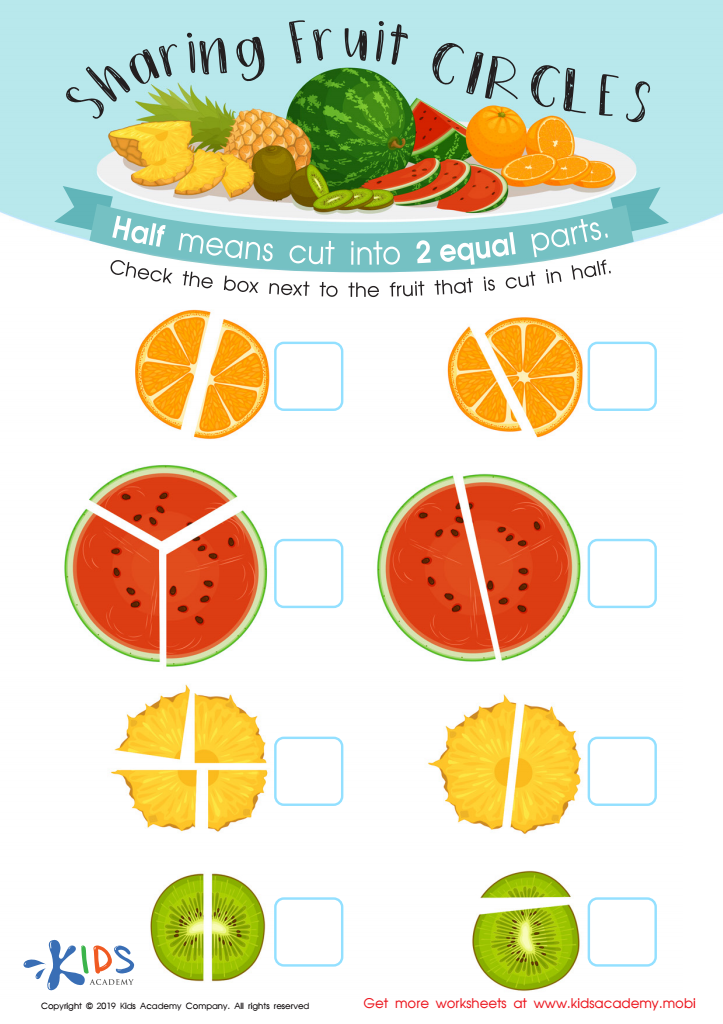
Sharing Fruit Circles Worksheet
Fruits are tasty and bright! Can your kids name some of their favorites? With this worksheet, you can use fruit to teach your kids geometry. Talk about how shapes can be cut into halves. Ask them to tick the box for the fruit halves in the printout.
Sharing Fruit Circles Worksheet
Worksheet
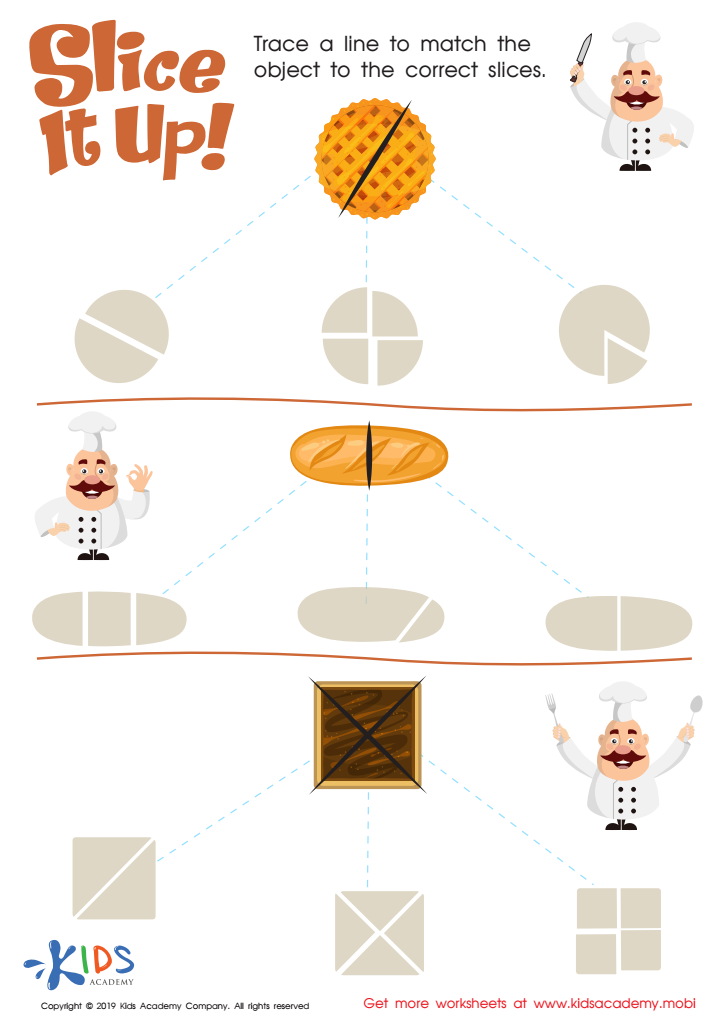
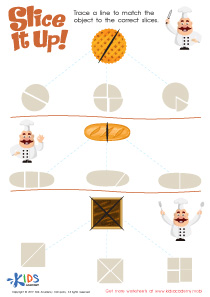
Slice It Up Worksheet
Try this fun math, reading and writing worksheet with your kids! They will love the colorful activities that perfect coordination and tracing. Engaging learning exercises help keep young minds sharp and boost skills. With these worksheets, your kids will be academically ahead of the curve!
Slice It Up Worksheet
Worksheet
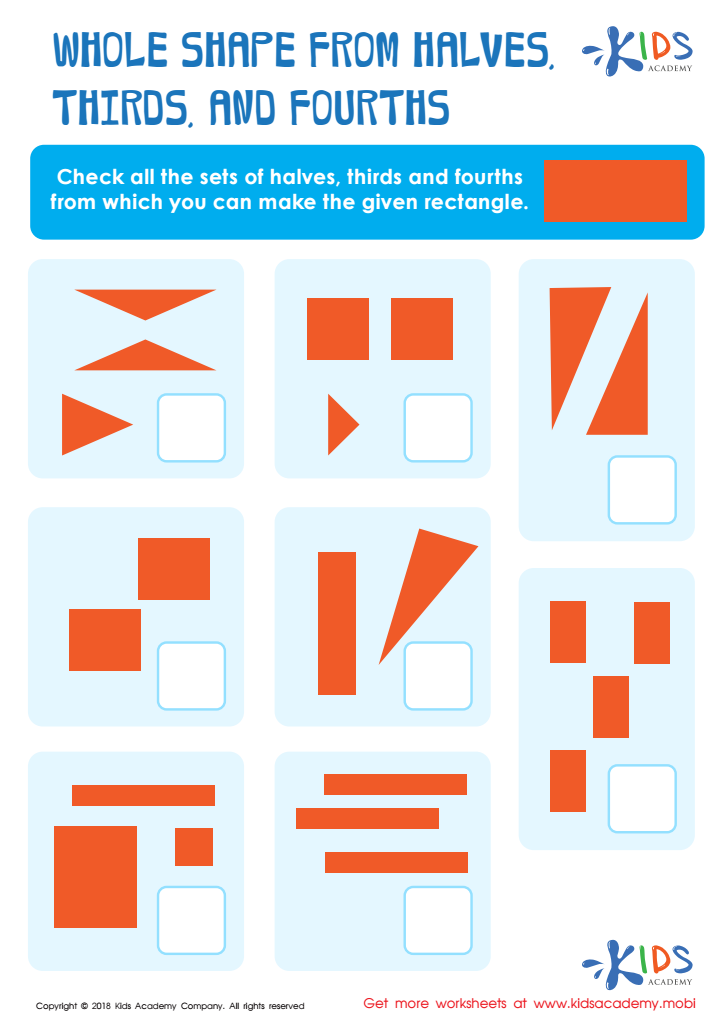
Whole Shape from Halves, Thirds and Fourths Worksheet
Explain to your students that they can make a new shape by combining halves, thirds, and fourths of a shape. Show them the worksheet with the rectangle at the top and ask them to find which sets of halves, thirds, and fourths make it. Have them check all the correct sets.
Whole Shape from Halves, Thirds and Fourths Worksheet
Worksheet
Join Kids Academy for Free
Who is primarily going to use this learning content?








Basic math skills, especially understanding fractions of shapes, form the cornerstone of a child’s future mathematical learning and overall cognitive development. It’s crucial for parents and teachers to prioritize these skills in children aged 4-8 for several compelling reasons.
First, basic math skills aid in developing logical thinking and problem-solving abilities. When children learn to divide shapes into fractions, they learn about division, symmetry, and proportionality, administering a solid foundation for more advanced mathematical concepts. This foundational knowledge fosters mental discipline, attention to detail, and perseverance.
Secondly, fraction concepts integral to daily life tasks. Whether it’s sharing a pizza, understanding portions, or following a recipe, fractions provide practical life skills. Children who grasp fractions early navigate everyday situations with confidence and competence.
Additionally, introducing math skills in early childhood enhances academic confidence. When children master basic math early, they build positive attitudes towards the subject, reducing math anxiety and setting the stage for lifelong learning enthusiasm.
Finally, engaging children with shapes and fractions promotes fine motor skills and spatial awareness critical to cognitive maturity and diverse learning endeavors. Play-based learning methods with visuals make this process enjoyable and effective.
In essence, nurturing these early skills equips children with essential tools for academic success, practical application, and a love for learning.