Comparing Fractions Easy Math Worksheets for Ages 5-6
3 filtered results
-
From - To
Welcome to our "Comparing Fractions Easy Math Worksheets for Ages 5-6" page! This engaging collection of worksheets is designed to help young learners grasp the concept of comparing fractions. Our carefully crafted activities use colorful visuals and relatable examples, making math fun and accessible. Children will practice identifying and comparing fractions with like and unlike denominators, fostering a solid mathematical foundation. Designed for early learners, these worksheets promote critical thinking and enhance problem-solving skills. Perfect for classroom or homeschool settings, our resources encourage independent learning while building confidence in young mathematicians. Explore our engaging worksheets today and make learning fractions a breeze!
Bubbling Over Worksheet
 Assign to My Students
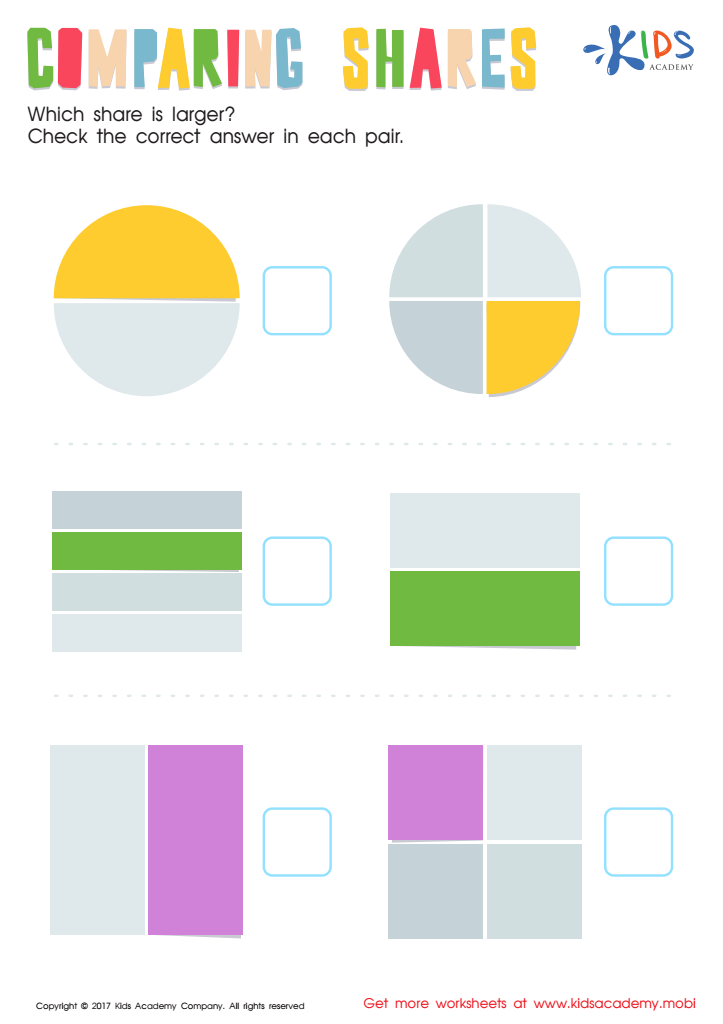
Comparing Shares Worksheet
Matching and Sorting for Preschool: Assessment 1 Worksheet




.jpg)


Understanding how to compare fractions is foundational for young learners, particularly for children aged 5-6. This early introduction not only enhances their mathematical skills but also promotes critical thinking. At this age, kids are developing essential cognitive abilities, and engaging them in comparative activities helps improve their problem-solving skills.
Comparing fractions lays the groundwork for a solid mathematical understanding. It encourages children to visualize numbers, reinforcing concepts of part-to-whole relationships. Through engaging visual aids like pie charts or fraction bars, children can more easily grasp how different fractions relate and what it means to be "greater," "less," or "equal."
For parents and teachers, fostering these skills is crucial as they prepare children for more advanced topics in mathematics. Additionally, the ability to compare fractions intersects with real-world applications, such as sharing food or understanding measurements, making mathematics relevant and exciting.
Moreover, focusing on comparison during these formative years instills confidence and a positive attitude toward math. When parents and teachers prioritize this learning, they not only enrich a child's educational experience but also promote a lifelong appreciation for mathematics and its practical applications. This foundation sets the stage for future success in a critical subject.








