
Animal recognition Easy Word Problems Worksheets for Ages 6-7
3 filtered results
Difficulty Level
Grade
Age
-
From - To
Subject
Activity
Standards
Enhance your child’s math and animal knowledge with our "Animal Recognition Easy Word Problems Worksheets for Ages 6-7." These engaging and educational worksheets blend the excitement of recognizing various animals with the challenge of solving simple word problems. Designed specifically for young students, they not only bolster basic math skills but also develop critical thinking and early literacy. Ideal for young learners, our fun and colorful sheets make it easy to practice addition, subtraction, and counting within an animal theme, capturing the curiosity and imagination of children while reinforcing key learning objectives.
Favorites
With answer key
Interactive
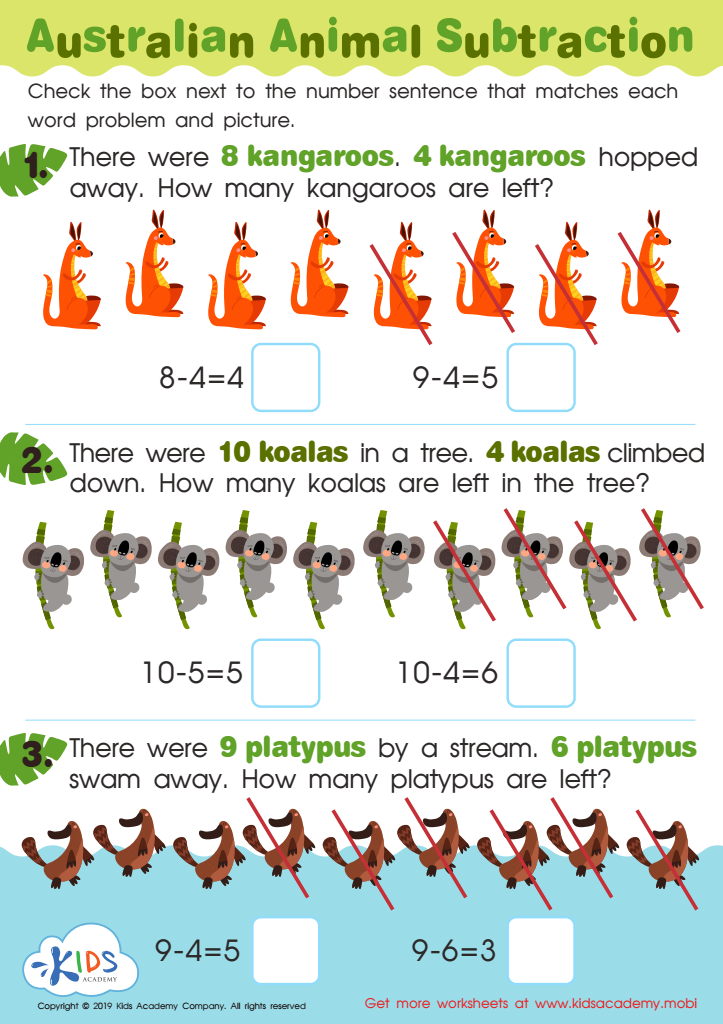
Australian Animal Subtraction Worksheet
Test your child's wildlife knowledge. Ask them to name animals indigenous to Australia or other countries. Show them the animals in this worksheet and have them match each word problem and picture with the correct number sentence.
 Assign to My Students
Australian Animal Subtraction Worksheet
Worksheet
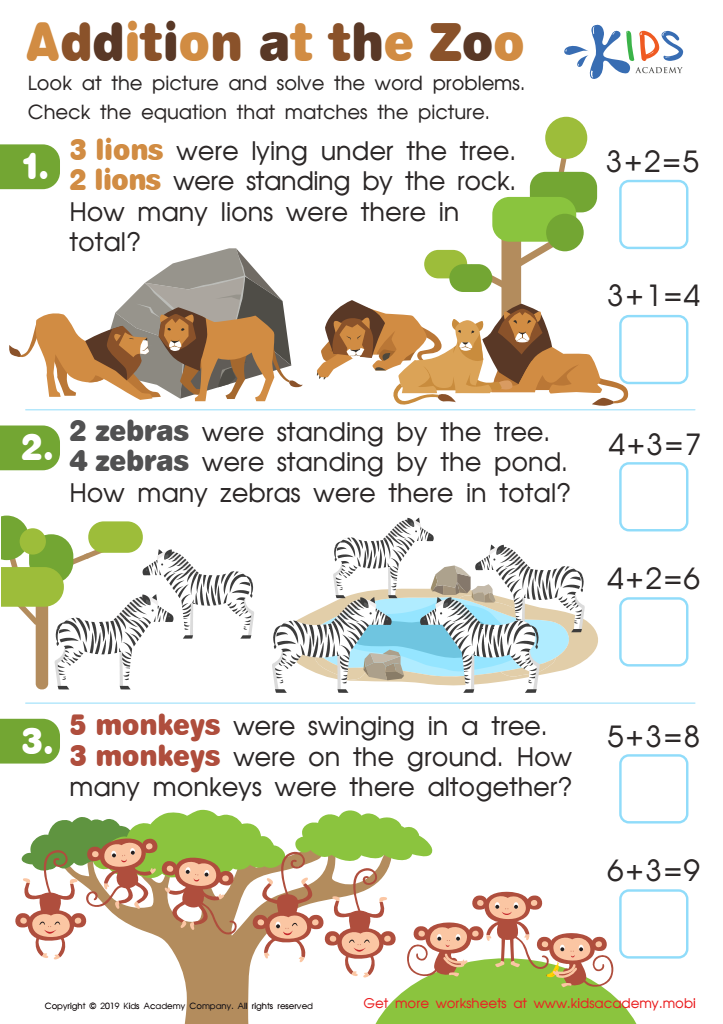
Addition at the Zoo Worksheet
Visit the zoo with your kids and point out all the different animals. Ask them to name their favorites and identify animals on a worksheet. Challenge them to solve word problems related to the pictures. Ask them for the equation that fits the picture and check the answer.
Addition at the Zoo Worksheet
Worksheet
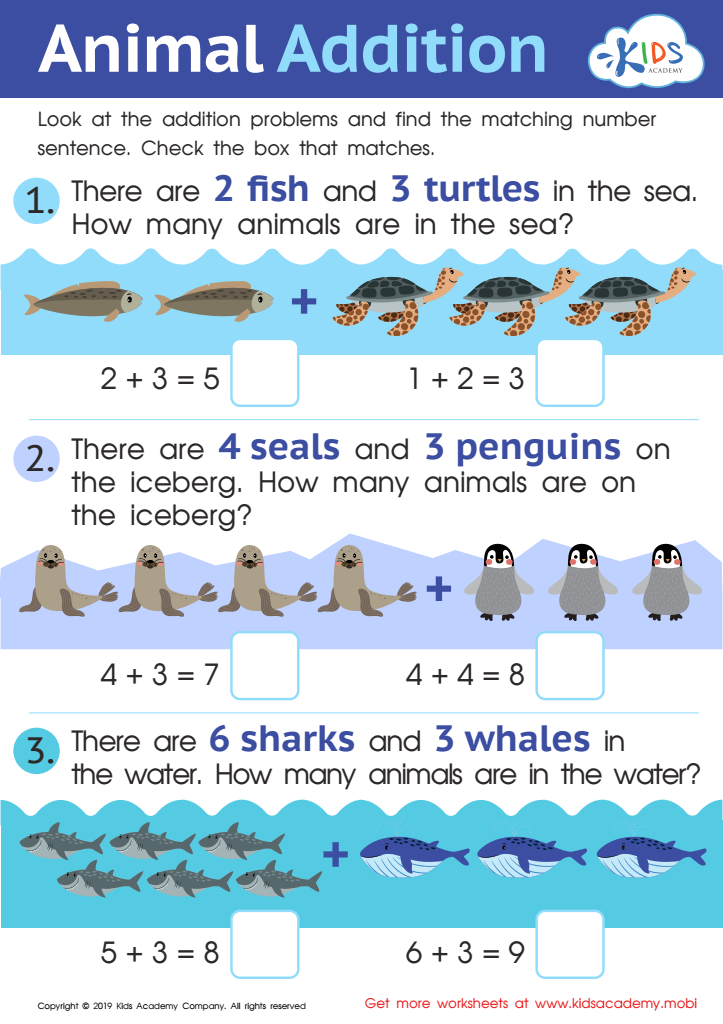
Animal Addition Worksheet
Get your kids learning addition and subtraction with this fun worksheet! Show them that solving equations can be enjoyable and help them match number sentences to the correct boxes. By doing this together, you'll create a positive learning experience that your kids won't forget.
Animal Addition Worksheet
Worksheet
Join Kids Academy for Free
Who is primarily going to use this learning content?








Parents and teachers should prioritize Animal Recognition Easy Word Problems for children aged 6-7 because these activities serve as essential building blocks in foundational learning. Firstly, they make mathematics engaging by incorporating familiar, interesting subjects like animals. This connection helps sustain a child's interest and encourages a positive attitude toward solving problems.
At this age, students are developing their basic arithmetic skills, like simple addition and subtraction. Animal-themed problems contextualize numbers in a fun, relatable setting, making abstract concepts more concrete. For instance, a problem asking, "If Jane has 3 rabbits and she gets 2 more, how many rabbits does she have now?" reinforces counting and numerical understanding effortlessly.
Additionally, these word problems enhance reading comprehension and critical thinking. Children must read the problem, recognize key information, and interpret the situation before solving it, thus engaging multiple cognitive processes simultaneously. This multi-faceted learning aids in developing both mathematical and language skills.
Furthermore, for young learners, familiarizing themselves with different animals cultivates curiosity about the natural world, broadening their general knowledge and fostering a sense of empathy and conservation awareness. Thus, Animal Recognition Easy Word Problems concurrently promote academic skills and a holistic approach to education, ultimately supporting a child's overall development.








