Number Recognition Easy Addition & Subtraction Worksheets for Ages 6-9 - Page 2
25 filtered results
-
From - To
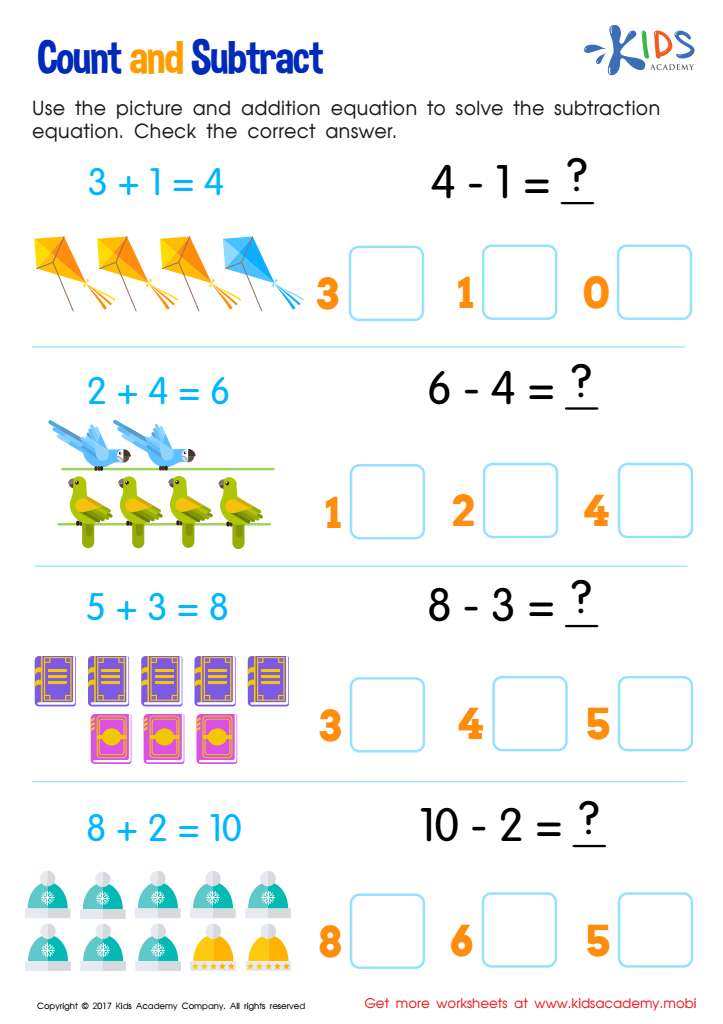
Count and Subtract Worksheet
 Assign to My Students








Parents and teachers should prioritize Number Recognition, Easy Addition, and Subtraction for children aged 6-9 because these fundamental skills form the cornerstone of mathematical understanding. Firstly, during these crucial early years, children's brains are highly receptive to learning basic numerical concepts. Proficient number recognition is essential as it enables children to confidently identify and understand numbers, laying the groundwork for more complex mathematical operations.
Easy addition and subtraction teach children the basic principles of arithmetic, which are vital for future learning. Mastery of these skills fosters a sense of achievement and confidence, motivating children to expand their mathematical knowledge. Additionally, early numerical proficiency contributes to logical thinking and problem-solving skills, abilities that are valuable beyond mathematics and useful in everyday life and other academic areas.
Moreover, engaging in these activities promotes cognitive development, enhancing memory and attention to detail. Activities such as counting games, visual aids, and interactive technologies can make learning enjoyable, thus maintaining the child’s interest and curiosity.
Investing time and effort in these early math skills not only supports academic success but also prepares children for a future where they can approach more complex mathematical challenges with confidence and enthusiasm. This support from parents and teachers is crucial during a child's formative learning years.








