
Basic Math Skills Easy Geometry Worksheets for 7-Year-Olds
5 filtered results
Difficulty Level
Grade
Age
-
From - To
Subject
Activity
Standards
Unlock your child's potential with our "Basic Math Skills Easy Geometry Worksheets for 7-Year-Olds"! Designed to make learning fun, these worksheets cover fundamental geometry concepts through engaging activities and colorful illustrations. They help kids grasp shapes, patterns, angles, and spatial awareness, fostering both confidence and competence. Each worksheet is skillfully crafted to suit young learners, blending education with enjoyment. Ideal for both classroom use and home practice, these resources are a fantastic way to bolster your child's math foundation and inspire a lifelong love for learning. Start your child’s mathematical journey with us today!
Favorites
With answer key
Interactive
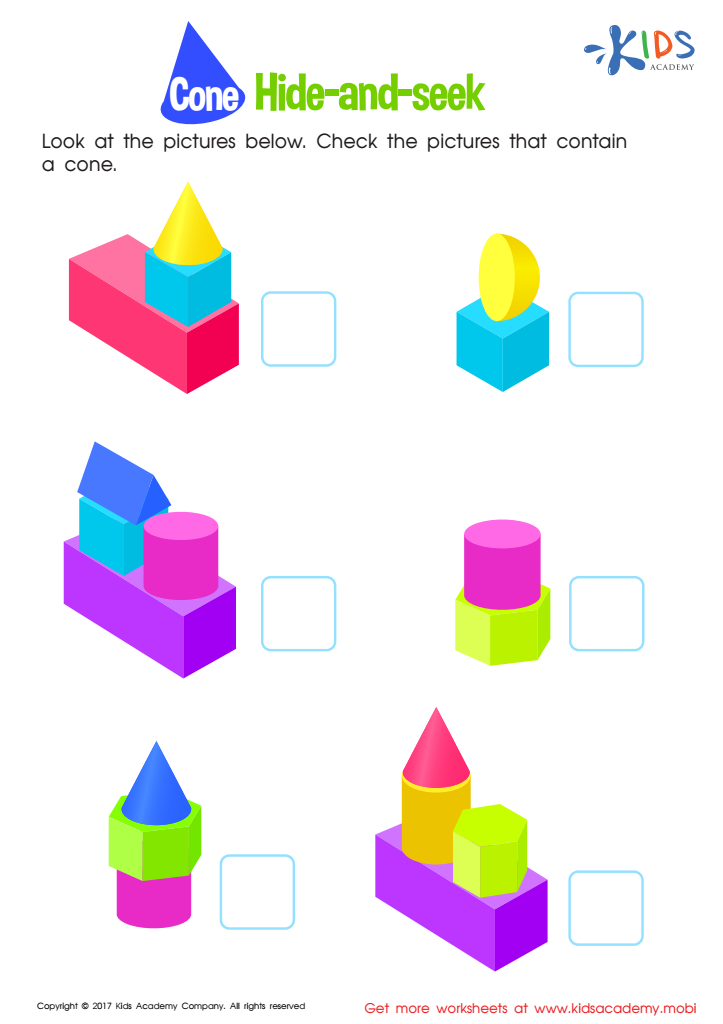
Cone Hide-and-Seek Worksheet
Prior to starting this worksheet, quiz your kid on shapes. If they gave quite a few, you've done well! This pdf will teach them more about cones; show them the pictures in the printout and have them identify which ones contain a cone.
 Assign to My Students
Cone Hide-and-Seek Worksheet
Worksheet











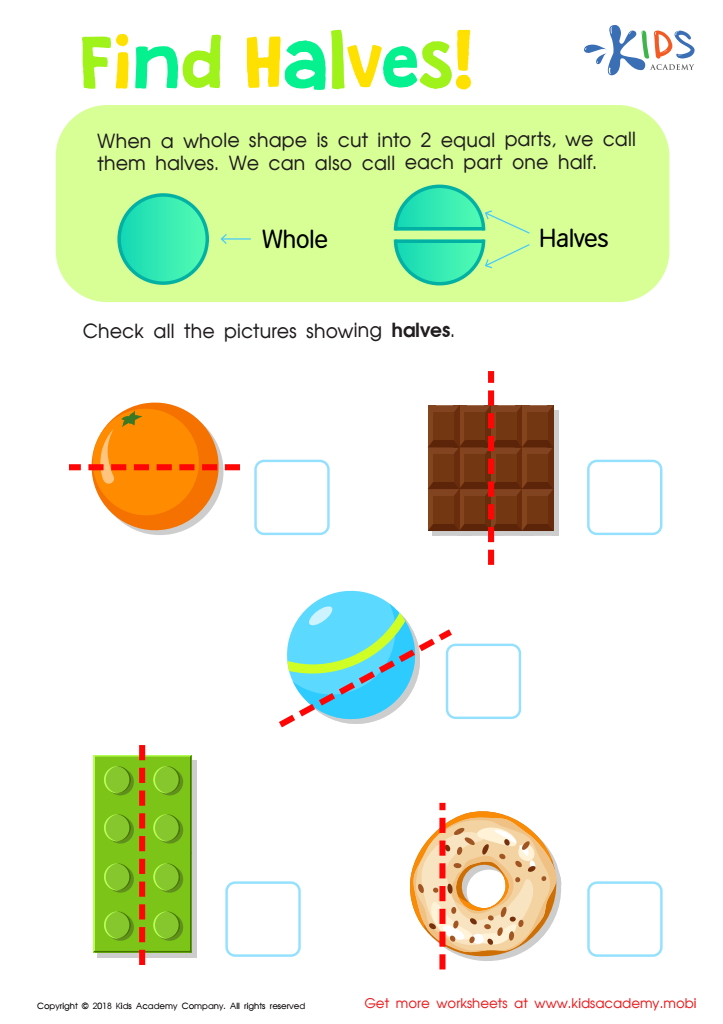
Find Halves Worksheet
If your child can tell you what two, three and four equal parts are called, give yourself a pat on the back! If not, this worksheet can help. Halves are two equal parts of a whole shape. Check the pictures in this printable pdf to help your child understand.
Find Halves Worksheet
Worksheet
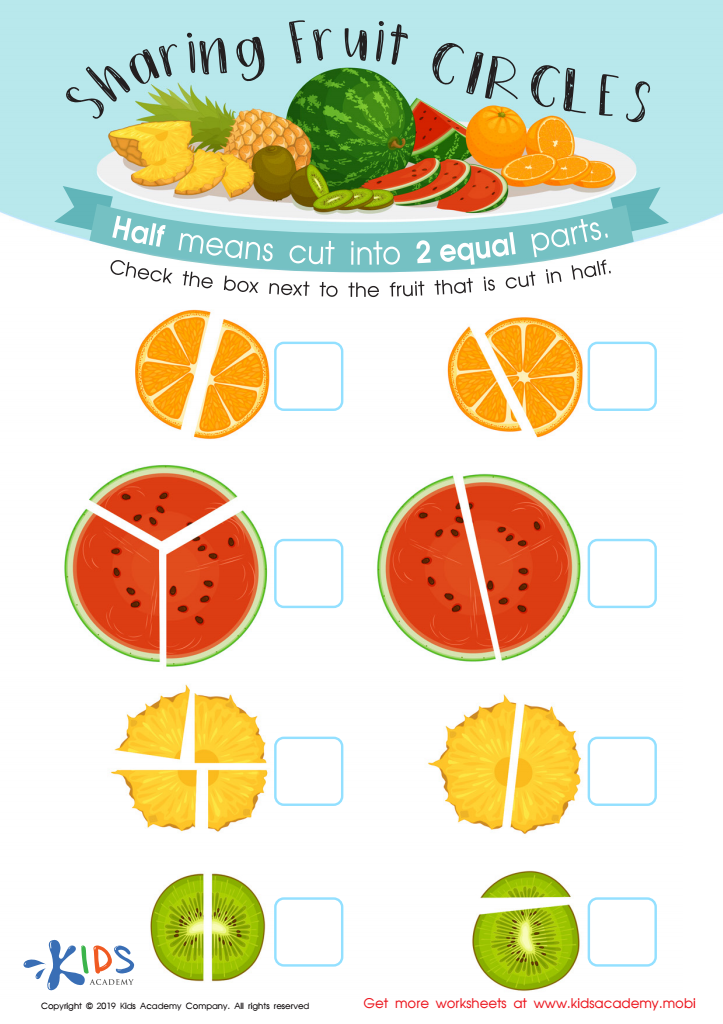
Sharing Fruit Circles Worksheet
Fruits are tasty and bright! Can your kids name some of their favorites? With this worksheet, you can use fruit to teach your kids geometry. Talk about how shapes can be cut into halves. Ask them to tick the box for the fruit halves in the printout.
Sharing Fruit Circles Worksheet
Worksheet
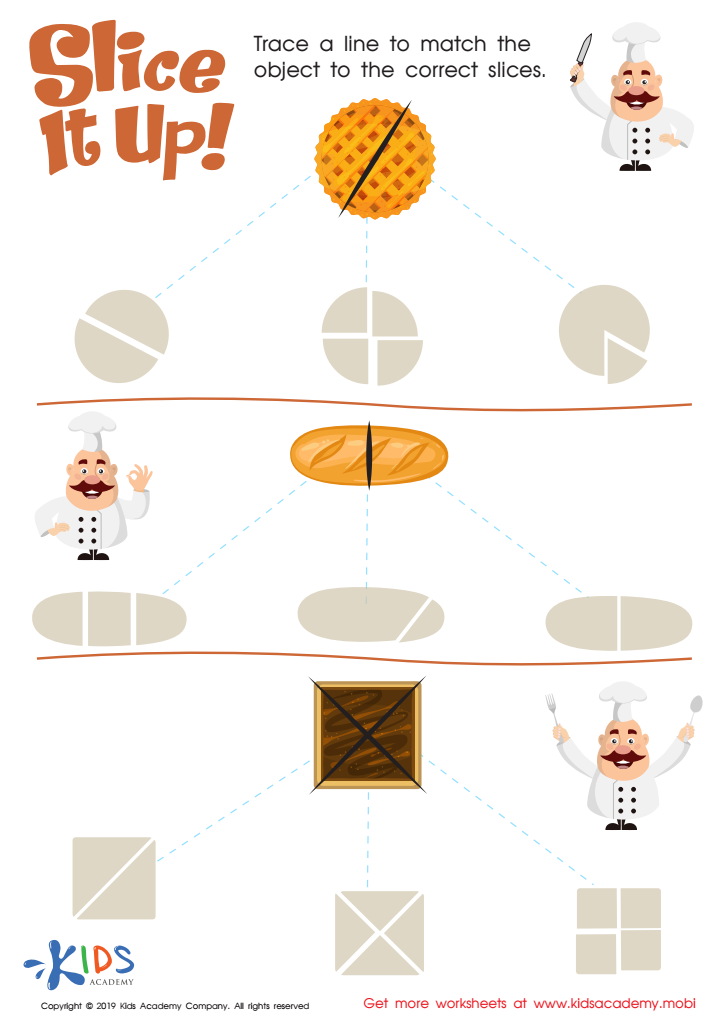
Slice It Up Worksheet
Try this fun math, reading and writing worksheet with your kids! They will love the colorful activities that perfect coordination and tracing. Engaging learning exercises help keep young minds sharp and boost skills. With these worksheets, your kids will be academically ahead of the curve!
Slice It Up Worksheet
Worksheet
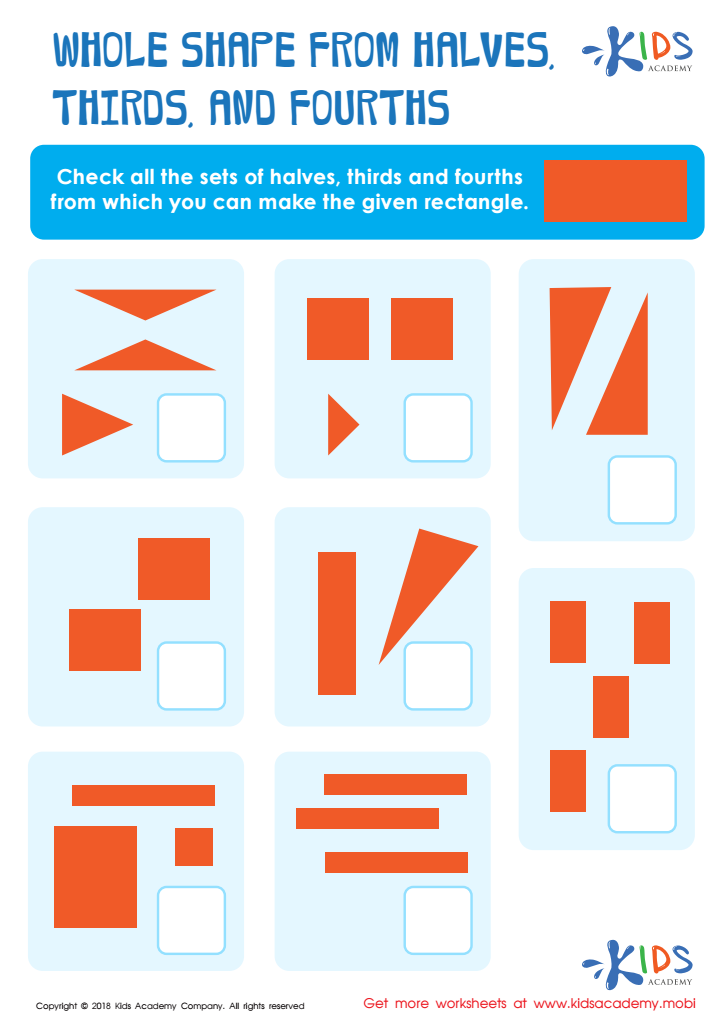
Whole Shape from Halves, Thirds and Fourths Worksheet
Explain to your students that they can make a new shape by combining halves, thirds, and fourths of a shape. Show them the worksheet with the rectangle at the top and ask them to find which sets of halves, thirds, and fourths make it. Have them check all the correct sets.
Whole Shape from Halves, Thirds and Fourths Worksheet
Worksheet
Join Kids Academy for Free
Who is primarily going to use this learning content?








Basic math skills and early geometry for 7-year-olds are crucial for their overall development and future academic success. At this age, children are in a pivotal stage of cognitive development where they begin to understand and interpret the world around them in new ways. Introducing basic math and geometry aids in building a strong foundation for later, more complex mathematical concepts.
First, math skills enhance logical thinking and problem-solving abilities. When children learn to recognize shapes, identify patterns, and understand spatial relationships, they develop critical thinking skills that are applicable beyond math classes. For example, knowing the difference between a square and a rectangle or understanding symmetry helps children make sense of things they perceive in their environment.
Second, early proficiency in math and geometry boosts confidence. Mastery in these subjects at a young age can lead to a positive attitude toward learning and prevent math anxiety later on. Children who feel competent in math are more likely to participate in STEM-related activities and understand analytical aspects in other subjects.
Lastly, these skills are often part of standardized testing, ensuring that students are prepared not just for academic performance but for practical, everyday tasks such as measuring ingredients for a recipe or following directions on a map. Therefore, parents and educators should prioritize teaching basic math and geometry to provide children with the tools they need for future mastery and practical application.








