
Observational skills Easy Math Worksheets for 7-Year-Olds
3 filtered results
Difficulty Level
Grade
Age
-
From - To
Subject
Activity
Standards
Enhance your child’s learning experience with our "Observational Skills Easy Math Worksheets" designed specifically for 7-year-olds. These engaging worksheets help young learners develop crucial observational skills while mastering basic math concepts. By incorporating fun activities that promote observation and analysis, children will enhance their ability to recognize patterns, shapes, and numbers in their environment. Our carefully crafted exercises encourage critical thinking and problem-solving, making math enjoyable and interactive. Perfect for parents and educators, these worksheets serve as valuable tools to support early math education and foster a love for learning. Explore our collection now and watch your child's skills flourish!
Favorites
With answer key
Interactive
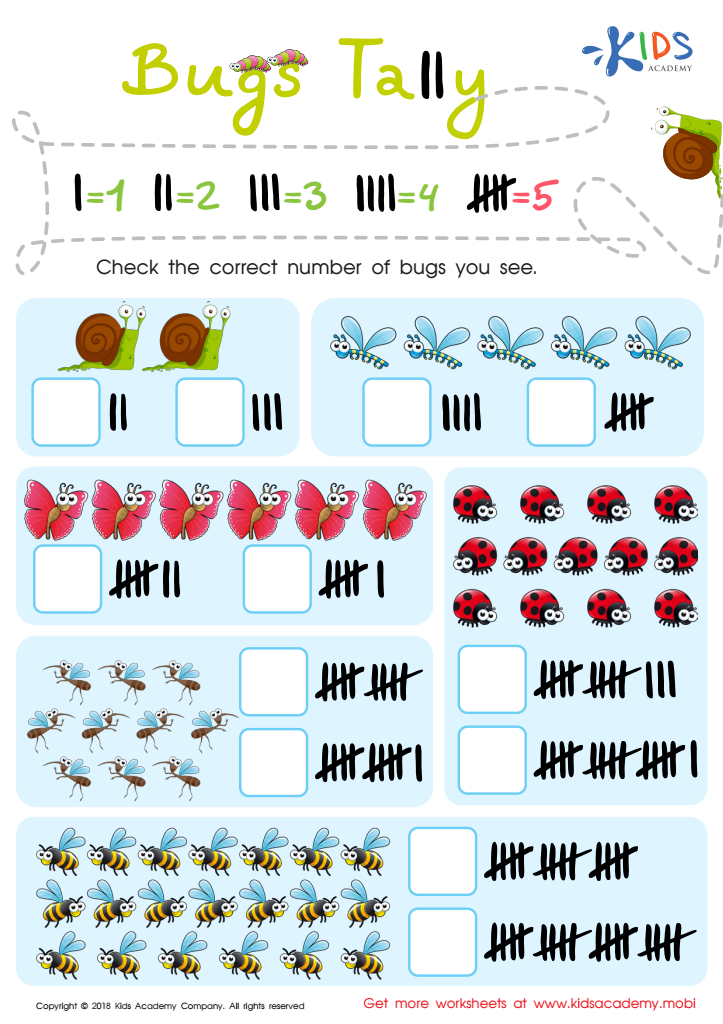
Bugs Tally Worksheet
This fun worksheet uses friendly bugs to help young mathematicians learn numbers and tally marks. They'll gain real-world skills to help with adding, subtracting and counting. Representations will solidify number reasoning, aiding with game playing and more.
 Assign to My Students
Bugs Tally Worksheet
Worksheet
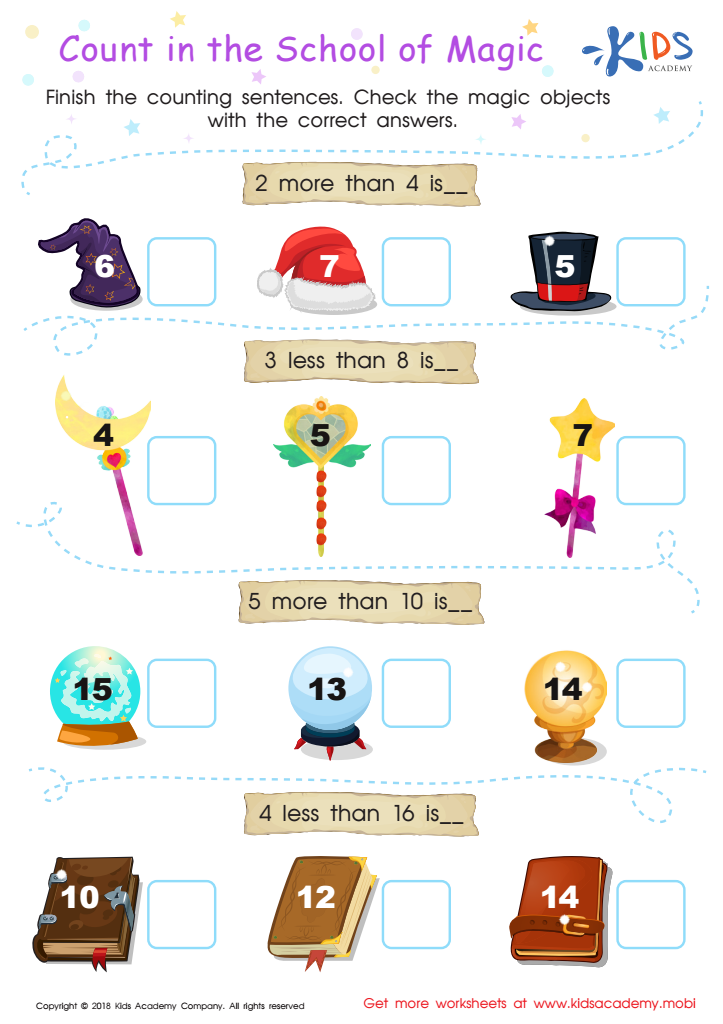
Count in the School of Magic Worksheet
Your math learners can explore the School of Magic with this worksheet. They'll read equations with addition and subtraction numbers under 20, count back and forth to find the answer, then complete the counting sentences. Fun pictures and easy accuracy make it an enjoyable and successful learning experience.
Count in the School of Magic Worksheet
Worksheet
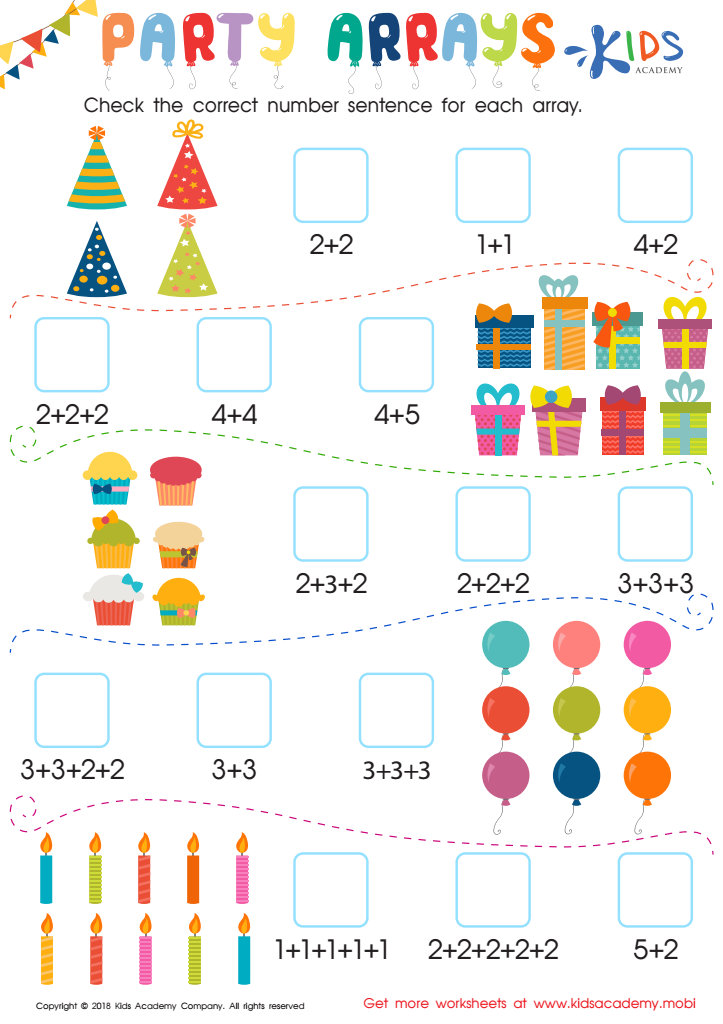
Party Arrays Worksheet
Help your child count the objects in each of the five arrays, then check the correct number sentence for each. This exercise will test their math skills and understanding of number sentences. Guide them to select the appropriate boxes.
Party Arrays Worksheet
Worksheet
Join Kids Academy for Free
Who is primarily going to use this learning content?








Parents and teachers should prioritize Observational Skills in Easy Math for 7-year-olds because these skills serve as foundational building blocks for a child's cognitive development. At this age, children are naturally curious, and honing their observational abilities can enhance their mathematical thinking and problem-solving skills. Observational skills encourage students to notice patterns, make connections, and recognize relationships among numbers, shapes, and spatial dimensions.
By focusing on observational skills in math, educators can help children develop critical thinking aptitude that extends beyond simple calculations. For instance, when children observe and discuss characteristics of objects, numbers, or geometric shapes, they learn to analyze data and recognize trends, which is crucial not only in math but in everyday decision-making.
Moreover, observational skills foster a deeper understanding of mathematical concepts, leading to increased confidence. Children who can observe and articulate what they see are better equipped to understand more complex ideas later on. Additionally, enhancing these skills together with their parents or carers creates an engaging learning atmosphere, strengthening the parent-child relationship and promoting cooperative learning. Ultimately, by nurturing observational skills in math, educators equip children with the essential tools they need for future academic success and life skills.








