Understanding life cycles Easy Grade 2 Reading Comprehension Worksheets
3 filtered results
Difficulty Level
Grade
Age
-
From - To
Subject
Activity
Standards
Explore our "Understanding Life Cycles" Easy Grade 2 Reading Comprehension Worksheets! Designed for young learners, these worksheets provide engaging content that simplifies the concept of life cycles in nature. Through age-appropriate texts and interactive activities, students will learn about various life cycles, such as those of butterflies, frogs, and plants. Each worksheet encourages critical thinking and comprehension skills while fostering a love for science. Perfect for classroom use or at-home practice, these resources will help second graders grasp important concepts in an enjoyable way. Start enhancing your child's reading and understanding of life cycles today!
Favorites
With answer key
Interactive
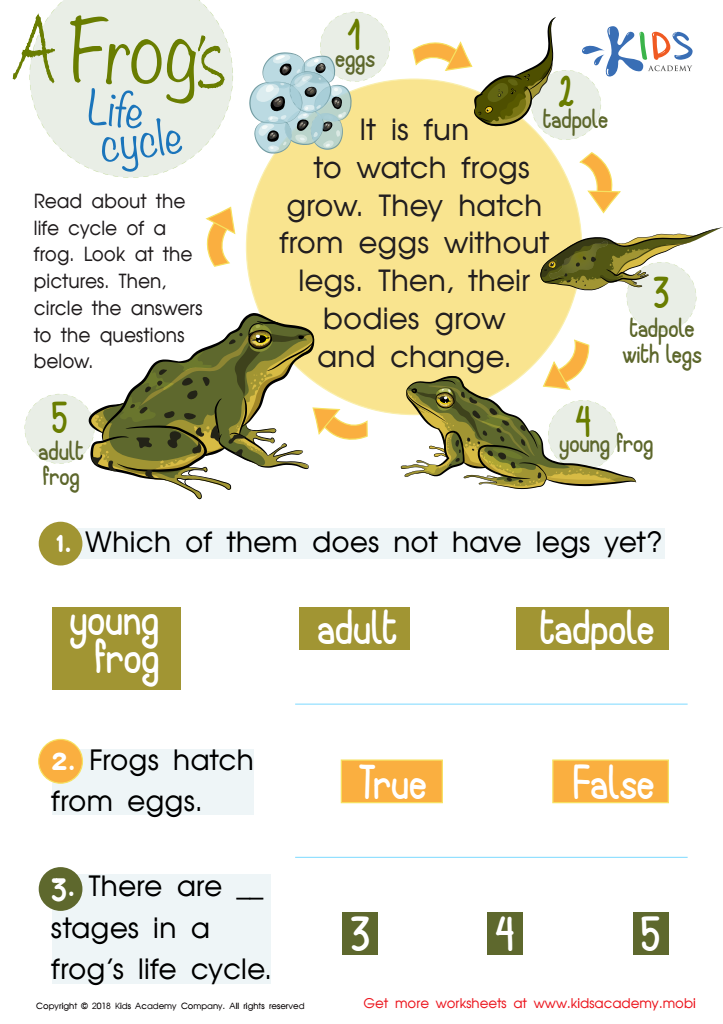
A Frog’s Life Cycle Worksheet
Encourage your kids to learn about frogs! Ask them to tell you some features, then read and discuss the text that explains the frog's life cycle. Show them the pictures to help them visualize it. Finish by helping them answer the questions at the bottom of the worksheet.
 Assign to My Students
A Frog’s Life Cycle Worksheet
Worksheet
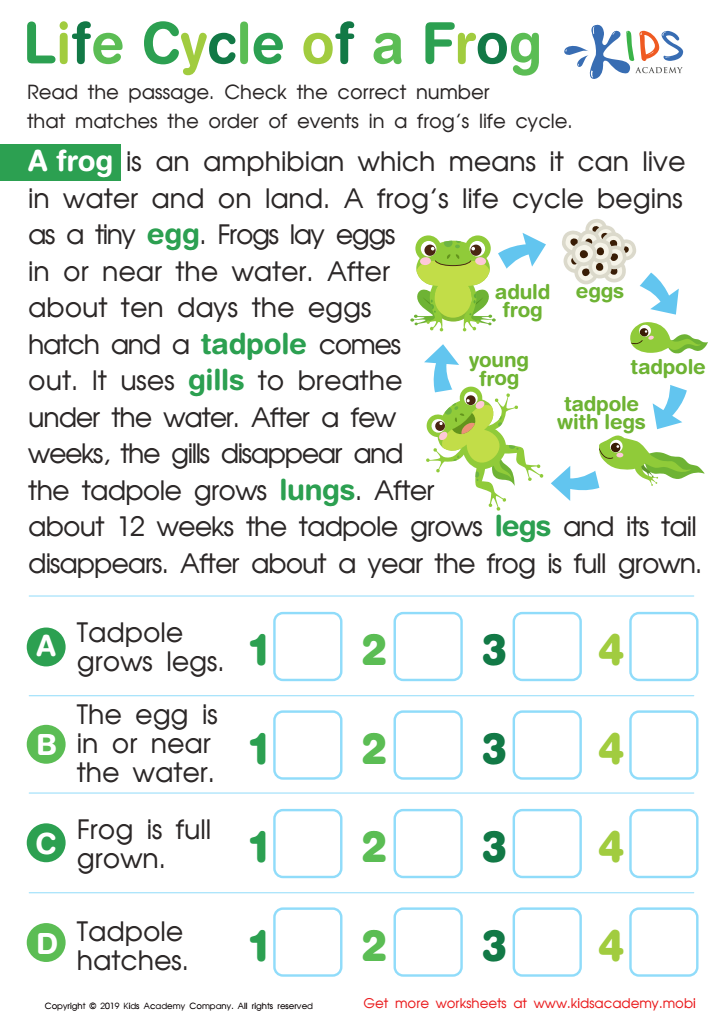
Life Cycle of a Frog Worksheet
Teach your kids to read and open their eyes to new knowledge. Frogs have fascinating life cycles. Show them the worksheet with pictures and guide them as they read the passage about it. Encourage them to check the number that matches the frog's life cycle order.
Life Cycle of a Frog Worksheet
Worksheet
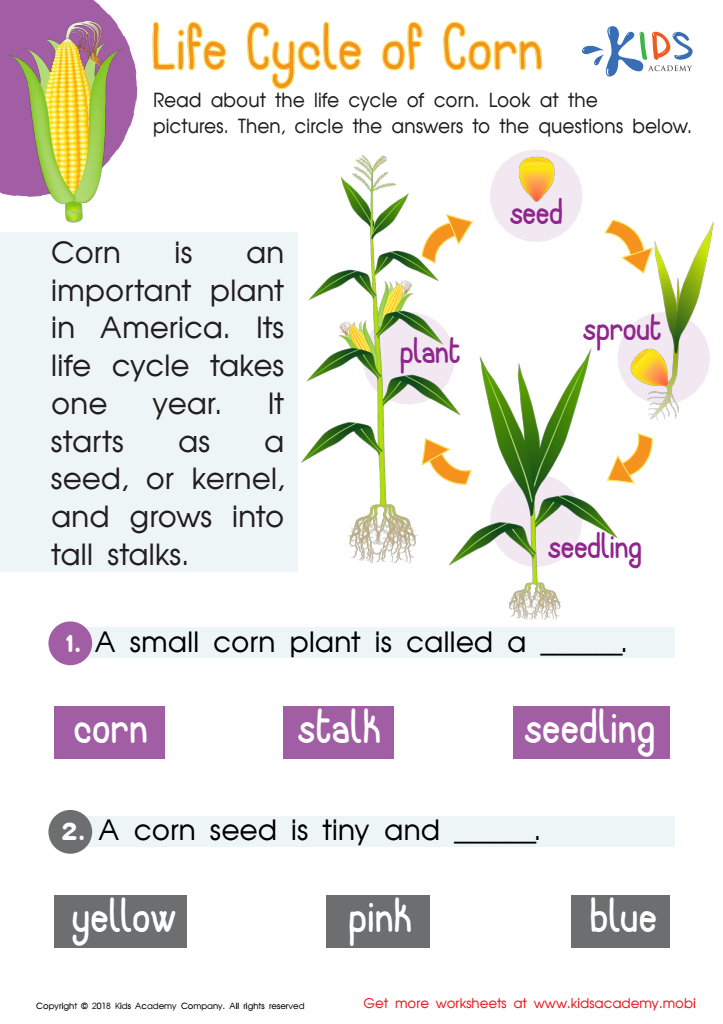
Life Cycle of Corn Worksheet
Help your kids learn about corn! Ask them what foods it's used to make. Read this worksheet and look at the pictures to learn the life cycle of corn. Then, have them circle the answers to the questions at the bottom. Corn is an important crop for farmers, used to make many foods we eat today.
Life Cycle of Corn Worksheet
Worksheet
Join Kids Academy for Free
Who is primarily going to use this learning content?






Understanding life cycles is crucial for young learners and their caregivers because it fosters a deeper appreciation for nature and all living things. In grade 2, children are at a stage where they are curious about the world around them. Teaching them about life cycles—such as those of butterflies, frogs, and plants—helps them grasp essential concepts in biology and ecology. It illustrates how living organisms grow, reproduce, and interact with their environment.
Parents and teachers should care because knowledge of life cycles promotes critical thinking and observation skills. Children learn to ask questions, make predictions, and draw conclusions. This foundational knowledge can ignite a lifelong interest in science and nature, encouraging STEM (Science, Technology, Engineering, and Mathematics) learning.
Additionally, understanding life cycles can instill values such as respect for living beings and awareness of environmental issues, such as conservation. It also provides opportunities for hands-on activities, like planting seeds or observing caterpillars transforming into butterflies, which enhance learning through experience.
By investing in the comprehension of life cycles, parents and teachers enrich children's educational journey, promoting cognitive growth and fostering a sense of responsibility towards the planet.