Understanding patterns Easy Grade 3 Math Worksheets
4 filtered results
-
From - To
Unlock the joy of learning with our "Understanding Patterns Easy Grade 3 Math Worksheets"! These engaging and thoughtfully designed resources help third graders master the crucial skill of recognizing and interpreting patterns. Through a variety of fun and diverse exercises, students will enhance their mathematical reasoning and problem-solving abilities. Tailored for young learners, these worksheets ensure that mastering patterns is both easy and enjoyable, boosting their confidence in math. Ideal for classroom use or at home, our worksheets make learning patterns a breeze. Make math fun and accessible with Kids Academy’s kid-friendly pattern worksheets for third grade!
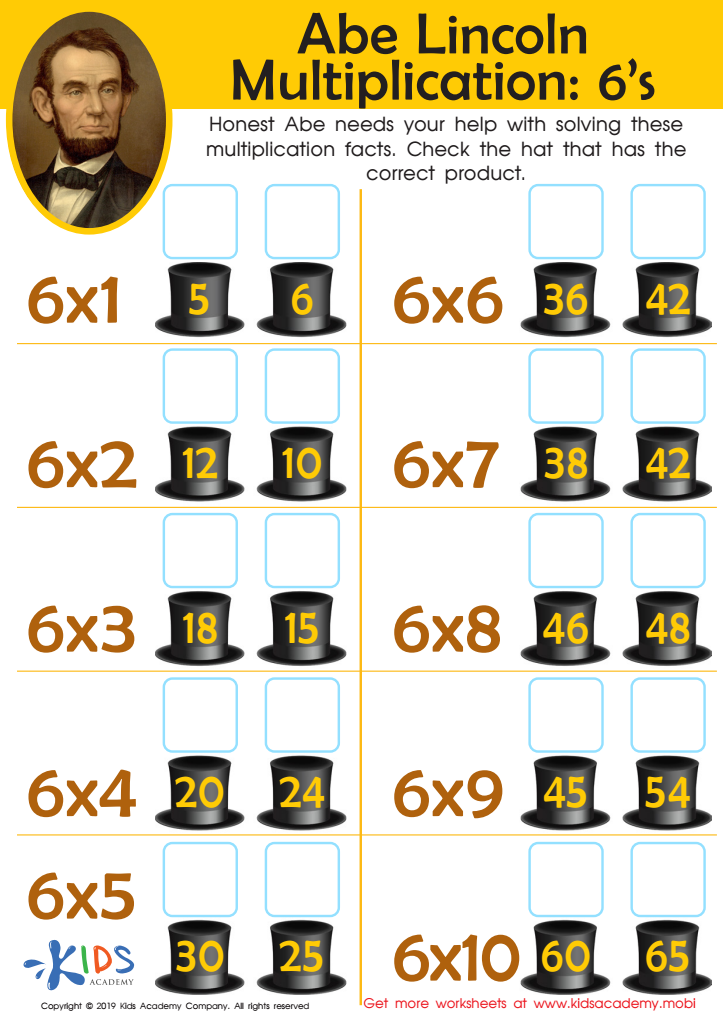
Abe Lincoln Multiplication: 6’s Worksheet
 Assign to My Students








Understanding patterns is crucial for Grade 3 students as it lays the groundwork for higher-level mathematical concepts and critical thinking. Patterns help children recognize order in their environment, enhancing their ability to predict, analyze, and solve problems.
Firstly, patterns are a fundamental aspect of math that underpin more complex topics such as arithmetic, geometry, and algebra. When children learn to identify and extend patterns, they are better prepared to understand multiplication, division, and fractions in later grades. For example, recognizing a sequence of numbers can simplify understanding multiplication tables and other repetitive structures.
Additionally, understanding patterns fosters cognitive development. It trains young minds to categorize information and discern relationships between objects or numbers, promoting logical thinking and problem-solving skills. These skills are transferable to other academic areas and real-life situations, aiding overall intellectual growth.
Furthermore, patterns feature prominently in many areas beyond math, including reading, art, and music. Recognizing and creating patterns can help children develop comprehension skills, appreciate rhythm and symmetry, and enhance creativity.
Overall, grasping the concept of patterns offers a multiplicity of benefits that support a child's academic journey and intellectual development. For these reasons, parents and teachers should prioritize teaching and reinforcing the understanding of patterns in early-grade math.