Developing math skills Grade 1 Worksheets
3 filtered results
Difficulty Level
Grade
Age
-
From - To
Subject
Activity
Standards
Welcome to our "Developing Math Skills Grade 1 Worksheets" page! Designed for young learners, these worksheets provide engaging and interactive activities that foster essential math skills. Covering key concepts such as addition, subtraction, number recognition, and basic problem-solving, our resources help children build a strong foundation in mathematics. Each worksheet is crafted to be age-appropriate, ensuring that your first grader stays motivated while learning. Teachers and parents alike will find these printables useful for reinforcing classroom concepts at home. Empower your child’s math journey today with our thoughtfully designed worksheets that make learning fun and effective!
Favorites
With answer key
Interactive
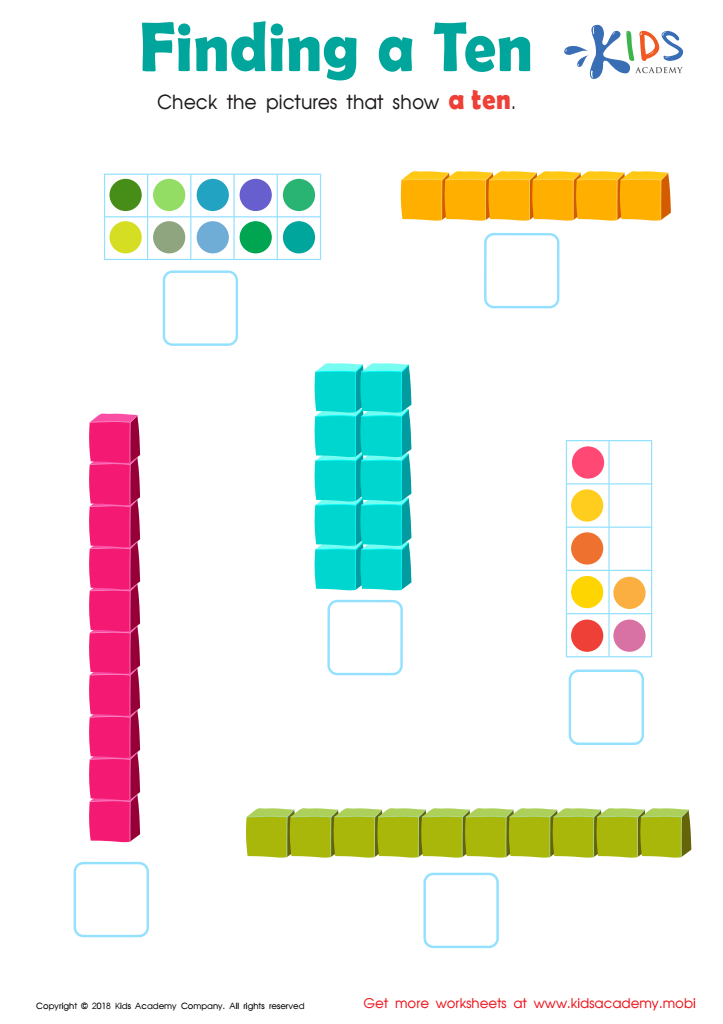
Finding a Ten Worksheet
Can your child count to ten? Distinguish groups of ten? This free printable worksheet uses shapes and colors to help first graders learn to count and understand what groups of numbers look like. It's fun and easy to comprehend, helping kids master the fundamentals of math.
 Assign to My Students
Finding a Ten Worksheet
Worksheet
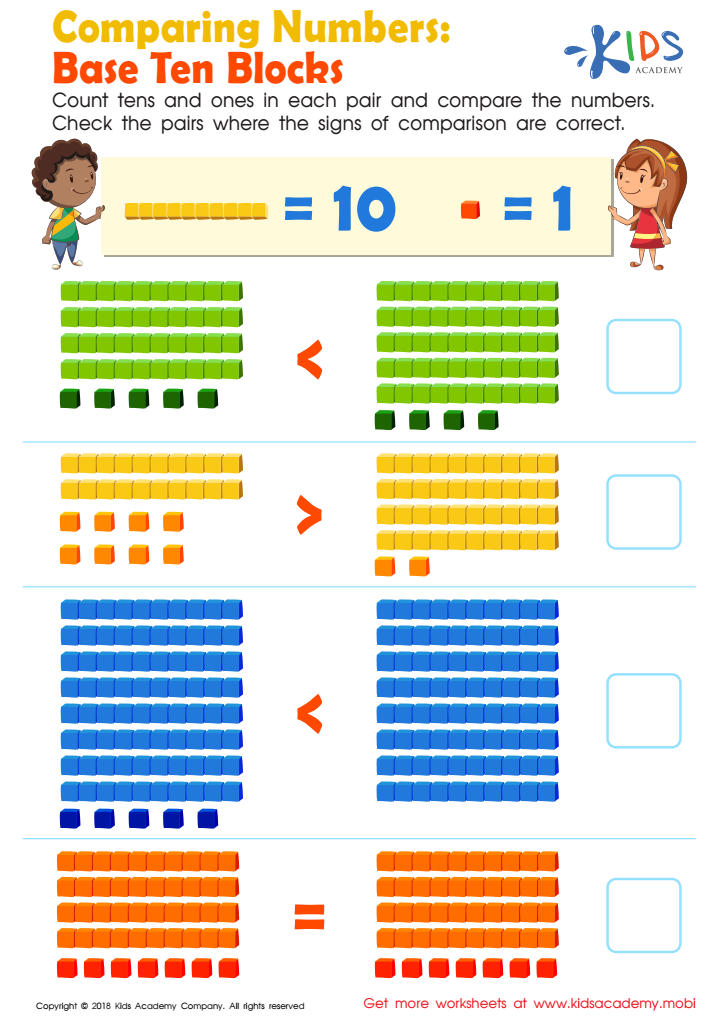
Comparing Numbers: Base Ten Blocks Worksheet
Make math fun for your child with a colorful worksheet. They'll need to compare signs by counting blocks on each side and signifying whether it's correct or not. This is one way to help your child beat the unhappiness that comes with math.
Comparing Numbers: Base Ten Blocks Worksheet
Worksheet
Join Kids Academy for Free
Who is primarily going to use this learning content?







Developing math skills in Grade 1 is crucial because it lays the foundation for a child’s future academic success. At this stage, children begin to grasp core concepts such as counting, addition, and subtraction. Mastering these basic skills enhances their confidence and encourages a positive attitude toward learning.
Moreover, math is not just about numbers; it fosters critical thinking, problem-solving abilities, and logical reasoning. By nurturing these skills early, we prepare children for more complex mathematical concepts that they will encounter in later grades. Engaging in math also stimulates cognitive development, enhancing a child’s ability to understand patterns and relationships.
Parents and teachers play a vital role in this developmental stage. Their support fosters a safe environment for experimenting and exploring mathematical ideas. Encouraging activities like games and practical applications in daily life, such as shopping or cooking, makes learning enjoyable and relevant.
Finally, strong math skills correlate with success in multiple subjects, establishing a well-rounded education. By actively participating, parents and teachers can inspire a lifelong love of learning, teach the importance of perseverance, and help children comprehend the value of mathematics in real-world situations.