Understanding clocks Grade 1 Worksheets
3 filtered results
Difficulty Level
Grade
Age
-
From - To
Subject
Activity
Standards
Welcome to our "Understanding Clocks" worksheets for Grade 1! These engaging resources are designed to help young learners grasp the fundamentals of reading clocks and telling time. With a variety of interactive activities, students will practice identifying times on analog and digital clocks, comparing different times, and understanding time concepts such as "morning," "afternoon," and "evening." Our worksheets are perfect for reinforcing classroom learning or for at-home practice. With colorful illustrations and easy-to-follow instructions, kids will build confidence and essential skills in time-telling. Dive into our fun and educational materials to make learning about clocks an enjoyable experience!
Favorites
With answer key
Interactive
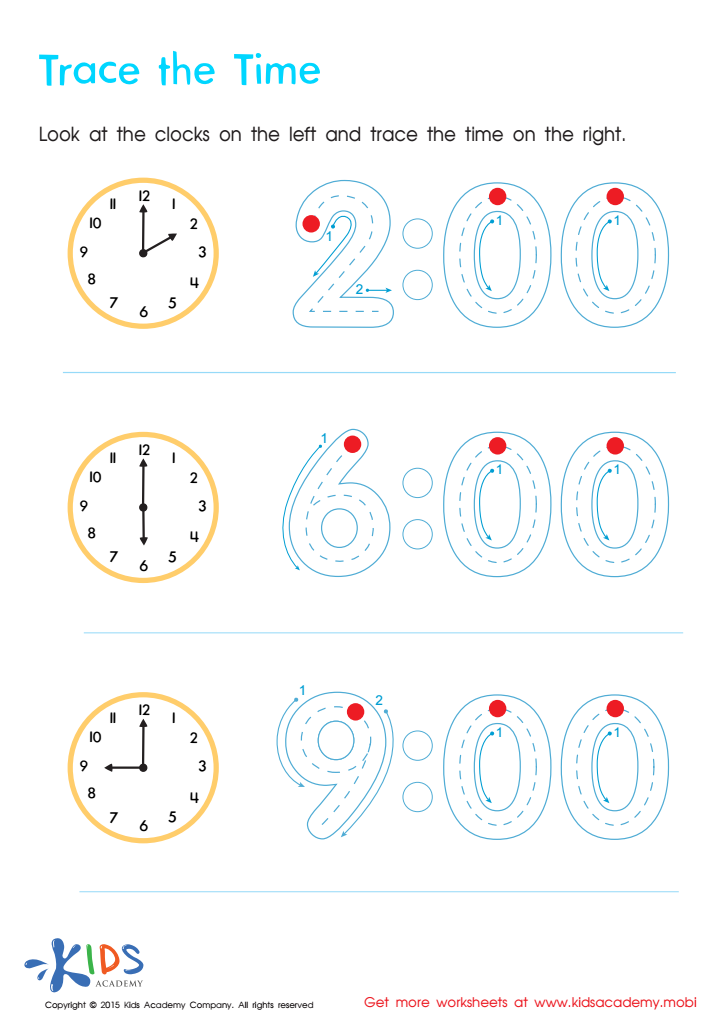
Telling The Time Worksheet: Part 2
Help your kids learn to tell the time with this free math worksheet from Kids Academy. Have them look at the clock faces and trace the time on the right - is it a full hour or half an hour? Get more practice with our wide selection of math worksheets for kindergarten.
 Assign to My Students
Telling The Time Worksheet: Part 2
Worksheet
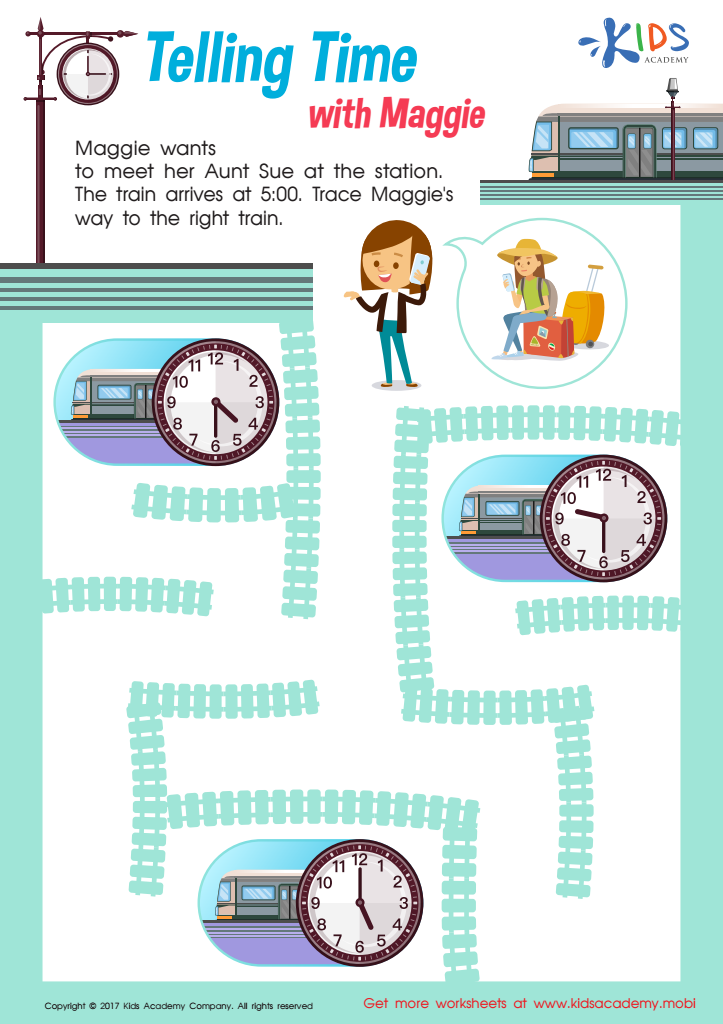
Telling Time With Maggie Time Worksheet
Help Maggie catch her train! Navigate the maze and read clocks to get her to her destination. Join her on a fun time-telling adventure with this puzzling worksheet. Your child will love it!
Telling Time With Maggie Time Worksheet
Worksheet
Join Kids Academy for Free
Who is primarily going to use this learning content?





Understanding clocks is a foundational skill for Grade 1 students, making it essential for parents and teachers to prioritize. Knowing how to tell time not only boosts a child's independence but also enhances their ability to manage daily routines. As children learn to read a clock, they gain important skills in numeracy and critical thinking, linking mathematical concepts to real-life situations.
Time management is a vital skill that extends beyond the classroom. By grasping how clocks work, children develop a sense of responsibility and punctuality, helping them prepare for future academic challenges and social interactions. Moreover, learning to tell time lays the groundwork for understanding concepts like schedules, time intervals, and duration, which they will encounter as they progress in their education.
Furthermore, the process of learning to read a clock encourages perseverance and problem-solving. It allows students to make connections between numerical values and physical time measurements. This cognitive growth is crucial at an early age, setting the stage for more complex mathematical concepts in later grades. By engaging with clocks, parents and teachers foster an environment rich in learning opportunities—emphasizing practical skills that equip children for everyday life and future academic success.