Cognitive Development Grade 1 2D Shapes Worksheets
3 filtered results
Difficulty Level
Grade
Age
-
From - To
Subject
Activity
Standards
Enhance your child’s cognitive development with our Grade 1 2D Shapes Worksheets! Designed to engage young learners, these worksheets promote critical thinking and problem-solving skills while introducing essential concepts of geometry. From identifying and classifying shapes to hands-on activities that reinforce learning, our resources make mastering 2D shapes both fun and educational. Each worksheet caters to diverse learning styles, providing enjoyable and interactive experiences that foster a love for math. Perfect for classroom use or at-home learning, our cognitive development worksheets help set a solid foundation for future math success. Explore our collection and watch your child's understanding of shapes grow!
Favorites
With answer key
Interactive
Match It up Worksheet
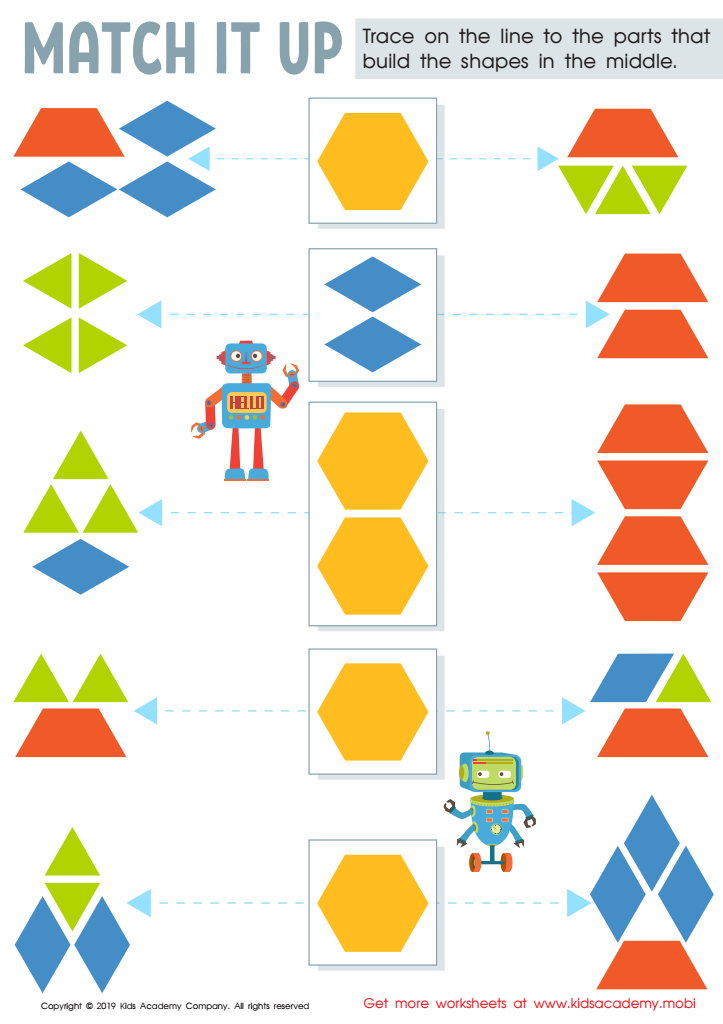
If your kids are into robots, they'll be thrilled to work on this worksheet. Ask them to name shapes they know, and help them draw and identify these shapes. Look at the shapes in the middle, and the sides. Finally, help your kids trace the lines to build the shapes in the middle.
 Assign to My Students
Match It up Worksheet
Worksheet
Twin Shapes Worksheet
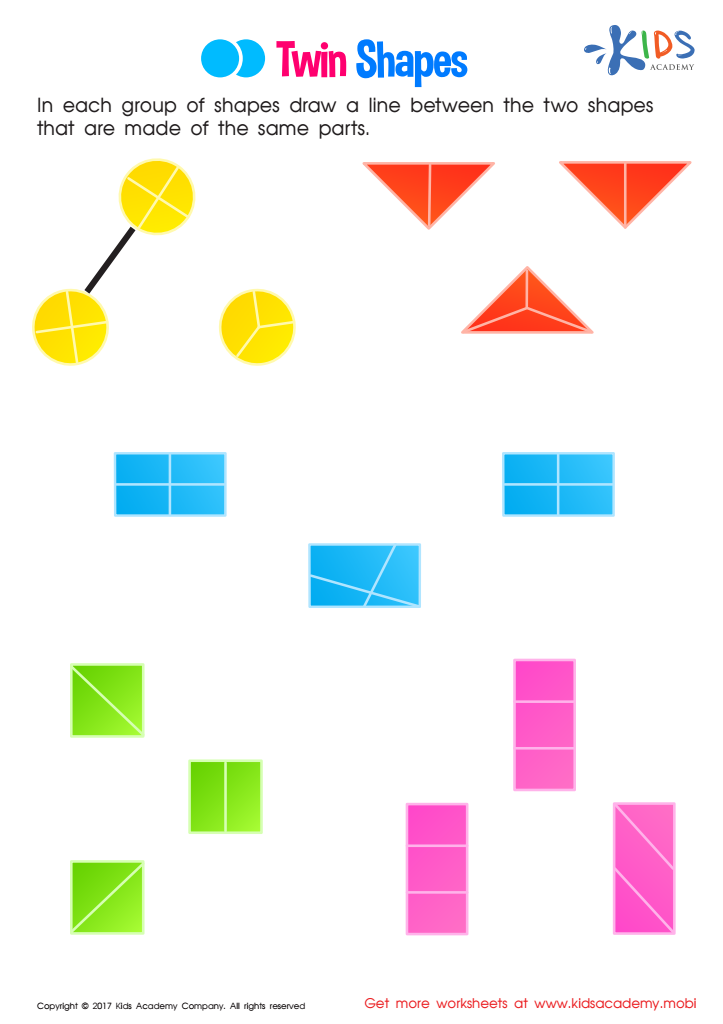
Your students' goal in this worksheet is to find the twin shapes: drawing a line between two shapes made of the same parts. Likely, the first shapes encountered were circles, triangles, rectangles and squares - examples of which are seen frequently in everyday life. Encourage them to apply what they know and work out which is the twin shape!
Twin Shapes Worksheet
Worksheet
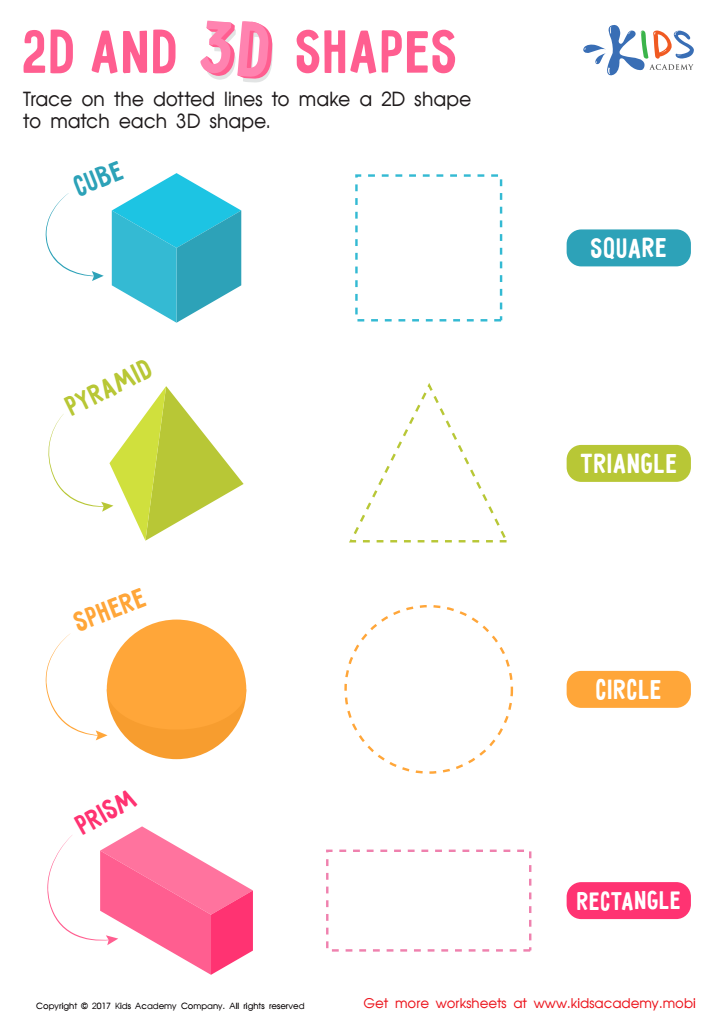
2D and 3D Shapes Worksheet
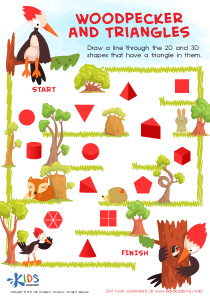
Introduce your child to 3D and 2D with this traceable worksheet. With dotted lines, help them trace and make a 2D shape for each 3D shape: square, triangle, rectangle, and circle. Show them there's more than one way to draw! You may have taken them to a 3D movie, or they've seen some fantastic 3D art. Now they can wonder no more.
2D and 3D Shapes Worksheet
Worksheet
Join Kids Academy for Free
Who is primarily going to use this learning content?





Understanding 2D shapes is a vital aspect of cognitive development in Grade 1 students. Parents and teachers should prioritize this area for several reasons. First, mastering 2D shapes lays the groundwork for future mathematical concepts, including geometry and spatial awareness. Recognizing, naming, and categorizing shapes, such as circles, squares, triangles, and rectangles, fosters critical thinking skills.
Additionally, engaging with shapes enhances a child’s observational skills. When kids explore their environment to identify shapes, they develop a deeper understanding of the world around them. This type of exploration promotes curiosity, encouraging children to ask questions and find answers through investigation, which is integral to cognitive growth.
Moreover, learning about shapes can be integrated into various activities outside the classroom, including art, construction, and even real-world context, making learning enjoyable and relatable. Parents can reinforce this knowledge by pointing out shapes in everyday materials or structures, bridging the gap between classroom learning and daily life.
In conclusion, focusing on 2D shapes in Grade 1 strengthens foundational skills in mathematics and enhances cognitive development, encouraging children to think critically and explore their world creatively. Educators and parents are integral in nurturing these essential skills to foster lifelong learning.