Counting practice Grade 1 Coins Worksheets
5 filtered results
Difficulty Level
Grade
Age
-
From - To
Subject
Activity
Standards
Introduce your first graders to the fundamentals of money management with our engaging "Counting Practice Grade 1 Coins Worksheets". These fun, visually appealing worksheets help young learners master counting coins, from pennies to quarters. Students will develop essential math skills as they add up coins, interpret their values, and solve real-world problems. Designed to boost confidence, these interactive activities support curriculum standards and encourage practical understanding. Perfect for classroom use or extra practice at home, our counting coins worksheets provide a solid foundation for future financial literacy. Empower your child with crucial counting skills today!
Favorites
With answer key
Interactive
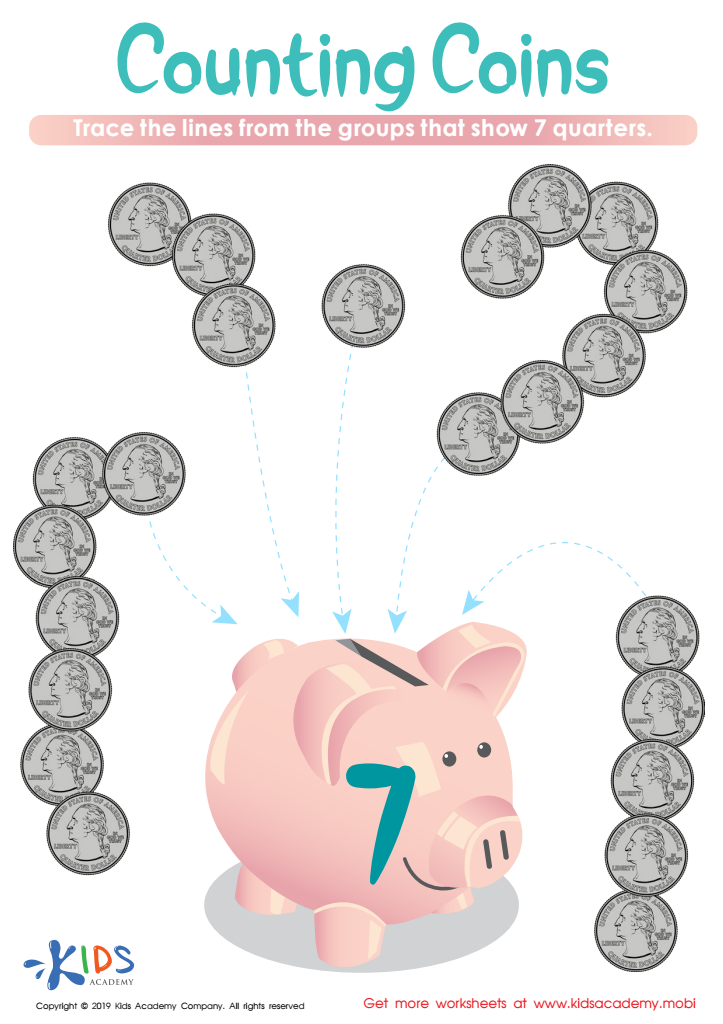
Counting Coins Worksheet
Help your students overcome their fear or aversion of counting and learning numbers with this fun worksheet! It features colorful pictures with four groups of coins. Ask the students to count each group, then trace the lines to the piggy bank. Show them it's easy to count and learn numbers!
 Assign to My Students
Counting Coins Worksheet
Worksheet
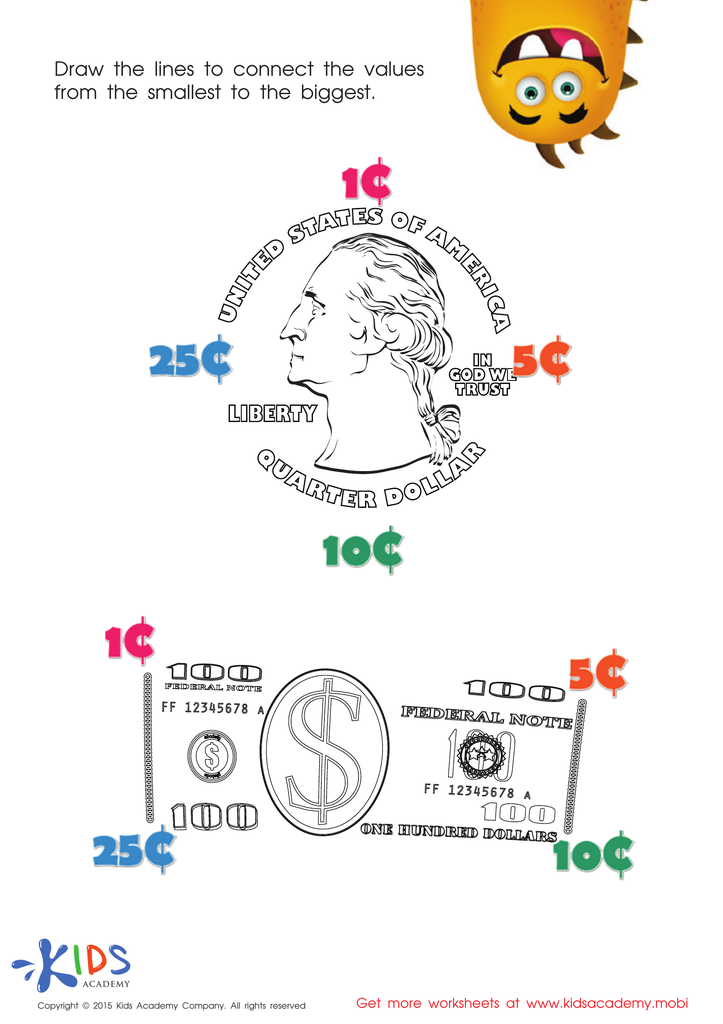
Connecting the Values Money Worksheet
Counting games are a fun way to teach kids about money and counting money. We've learnt the penny, nickel, dime and quarter - can you identify them from the pictures? Draw a line from the smallest to the biggest value and remember the order. Kids Academy has more fun and informative worksheets on counting money.
Connecting the Values Money Worksheet
Worksheet
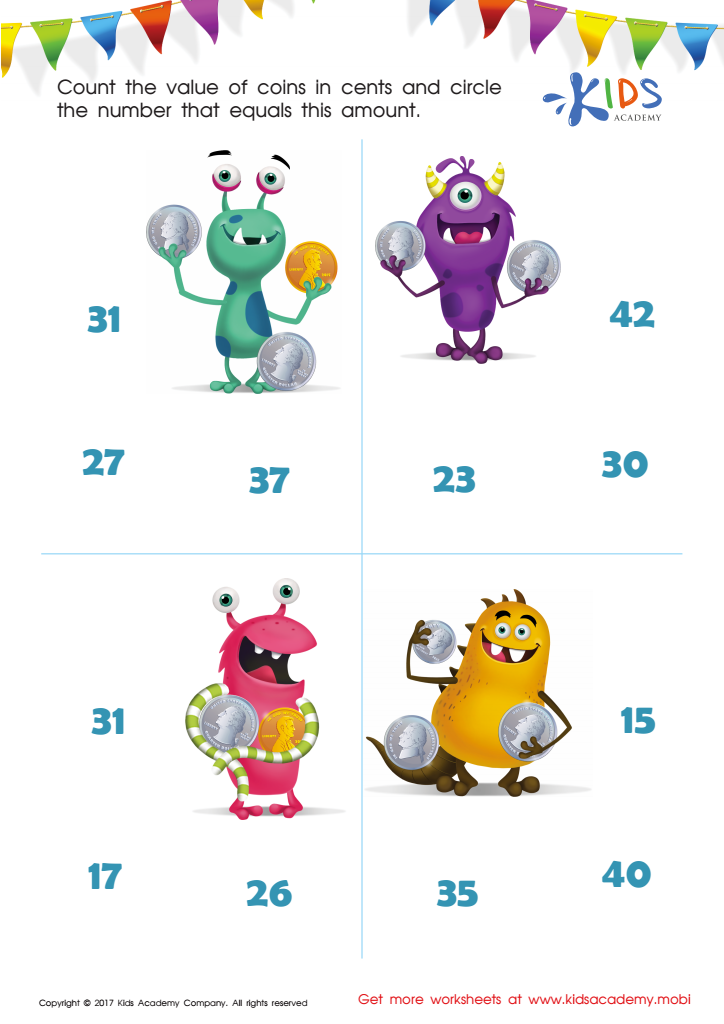
How Many Coins Money Worksheet
Have fun while counting coins: look at the monsters and count the coins in their hands. Challenge your little learners to count and write down the number of coins each one has. Enjoy the time together!
How Many Coins Money Worksheet
Worksheet
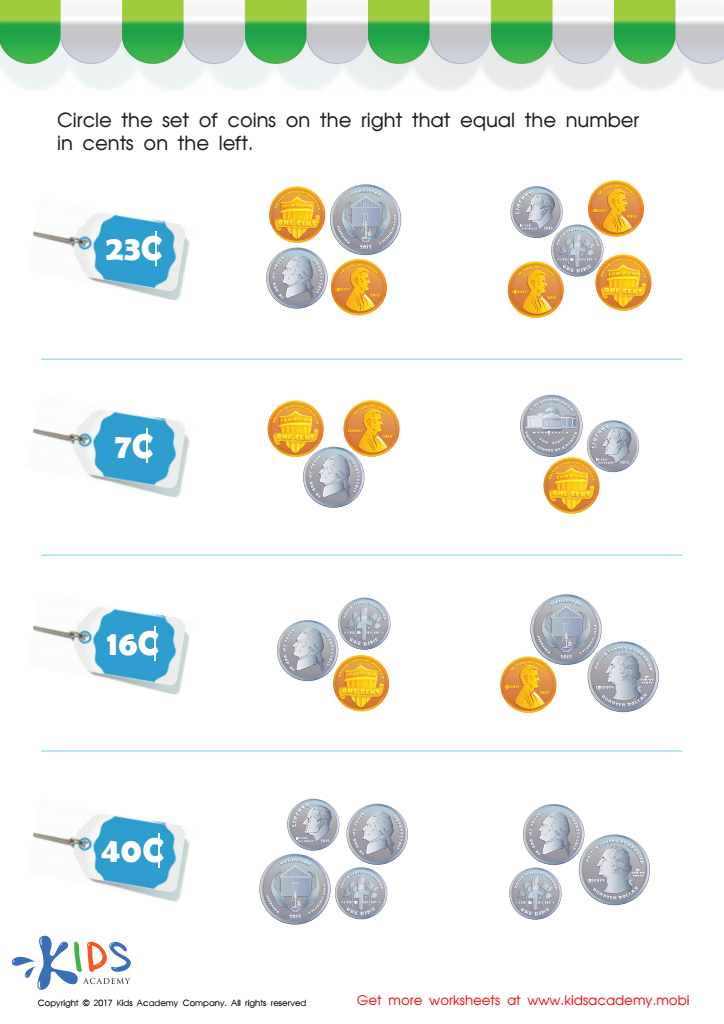
Picking the Coins You Need Money Worksheet
Let's learn to count money with Parents and Kids Academy! Investigate a real shop together: buy a globe, pencils, books, and a school bag using coins. Then, circle the coins you'll need. Visit our website for more free and fun money games for kids!
Picking the Coins You Need Money Worksheet
Worksheet
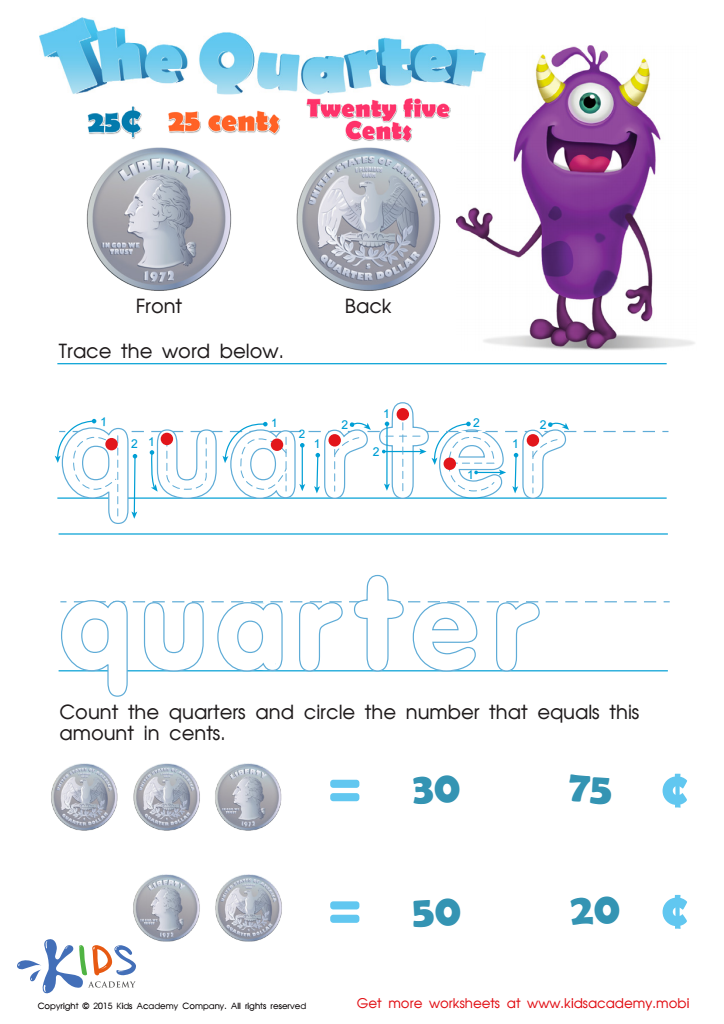
Twenty Five Cents or the Quarter Money Worksheet
Check out our new printable money games - learn to count money easily! With quarters, trace the word, count them and calculate the amount in cents. More worksheets at our website. Give it a try!
Twenty Five Cents or the Quarter Money Worksheet
Worksheet
Join Kids Academy for Free
Who is primarily going to use this learning content?





Counting practice with coins for Grade 1 students is foundational for several key developmental reasons. Firstly, it introduces basic financial literacy, a crucial life skill. Kids learn to recognize different coin values and understand money's practical use, setting the stage for more complex financial concepts later.
Also, handling coins helps improve fine motor skills as children manipulate small objects with precision. Such physical dexterity is important for everyday tasks and handwriting. Moreover, counting coins inherently reinforces basic math skills. It promotes abilities such as adding, subtracting, and understanding equivalence, all essential for higher-level math.
Additionally, this practice enhances cognitive development. It stimulates critical thinking as students figure out which combinations of coins equal a given amount. The practice also encourages problem-solving and decision-making abilities.
From a social perspective, understanding and using money equips children to participate more fully in society. Simple activities like buying items help them grasp the value of goods and services and the concept of trade.
In summary, incorporating coin counting in early education supports financial literacy, fine motor skills, and foundational math competencies, preparing children not only for more complex academic challenges but also for daily real-world interactions.