Shape Recognition Grade 1 Geometry Worksheets - Page 2
25 filtered results
-
From - To
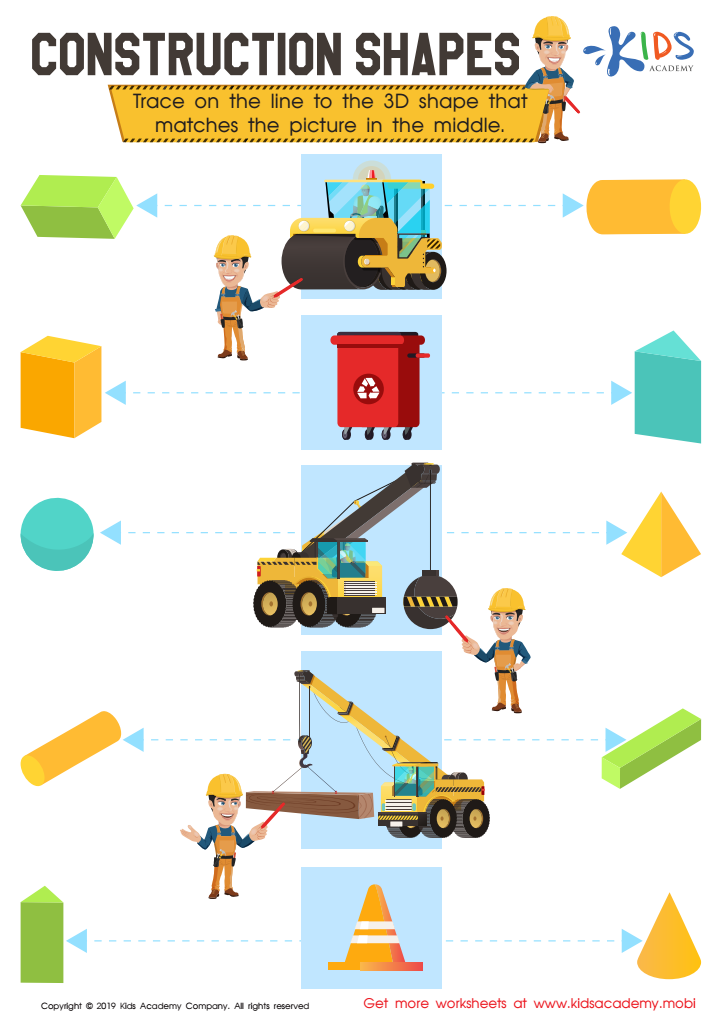
Construction Shapes Worksheet
 Assign to My Students








Shape recognition is a foundational skill in early childhood education, especially important in the context of geometry for first graders. Parents and teachers should care about shape recognition because it fosters vital cognitive and motor skills. By learning to identify and differentiate shapes, children enhance their visual-spatial awareness, a critical component in areas ranging from reading comprehension to problem-solving.
Understanding shapes helps children as they progress in mathematics. Recognizing patterns, which often include geometric shapes, underpins many math concepts. Additionally, shape recognition plays a role in developing logical thinking skills necessary for solving both simple and complex problems, building a solid foundation for future education in subjects such as science, technology, engineering, and mathematics (STEM).
Moreover, shape recognition aligns with important life skills beyond academics. When children distinguish shapes correctly, they can better navigate their physical environment, improving their spatial orientation and safety. This skill is also integral to developing fine motor skills, as children draw shapes and manipulate objects.
Simultaneously, working with shapes encourages creativity and artistic expression, allowing children to see and create patterns in the world around them. By supporting shape recognition, parents and teachers set the stage for a more comprehensive and enriching educational experience, fostering a child's growth on multiple fronts.