Cognitive Development Grade 1 Math Worksheets - Page 2
25 filtered results
-
From - To
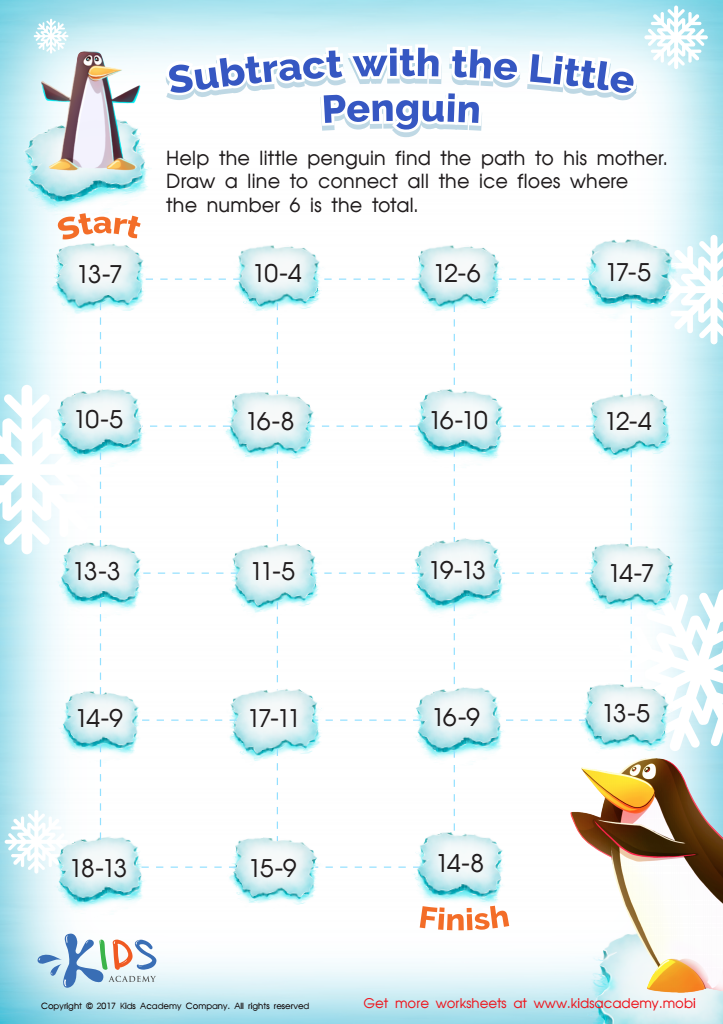
Subtract With The Little Penguin Substraction Worksheet
 Assign to My Students








Cognitive development in early childhood, particularly in Grade 1 math, is crucial for a child's overall growth and future academic success. At this age, children are developing foundational skills that inform their understanding of mathematical concepts, including number sense, counting, and problem-solving. Parents and teachers should care about this stage as it sets a precedent for children’s ability to engage with more complex subjects later on.
By fostering cognitive development in math, caregivers can help children enhance critical thinking skills, logical reasoning, and the ability to make connections between abstract concepts and real-world applications. Early math experiences significantly contribute to a child's confidence and attitude towards learning. A solid understanding of basic math in Grade 1 reflects higher achievement in later grades, as early exposure creates a pathway to mastering operations such as addition and subtraction while reinforcing cognitive abilities.
Moreover, strong math skills empower students to face challenges with resilience, promoting a growth mindset. When parents and teachers support cognitive development in math, they are investing in their children’s long-term educational journey, encouraging lifelong learning and the capacity to adapt to an increasingly complex world. Emphasizing math at this formative stage fuels not only academic success but also fruitful future opportunities.