Counting skills Extra Challenge Worksheets for Ages 3-6 - Page 3
50 filtered results
-
From - To
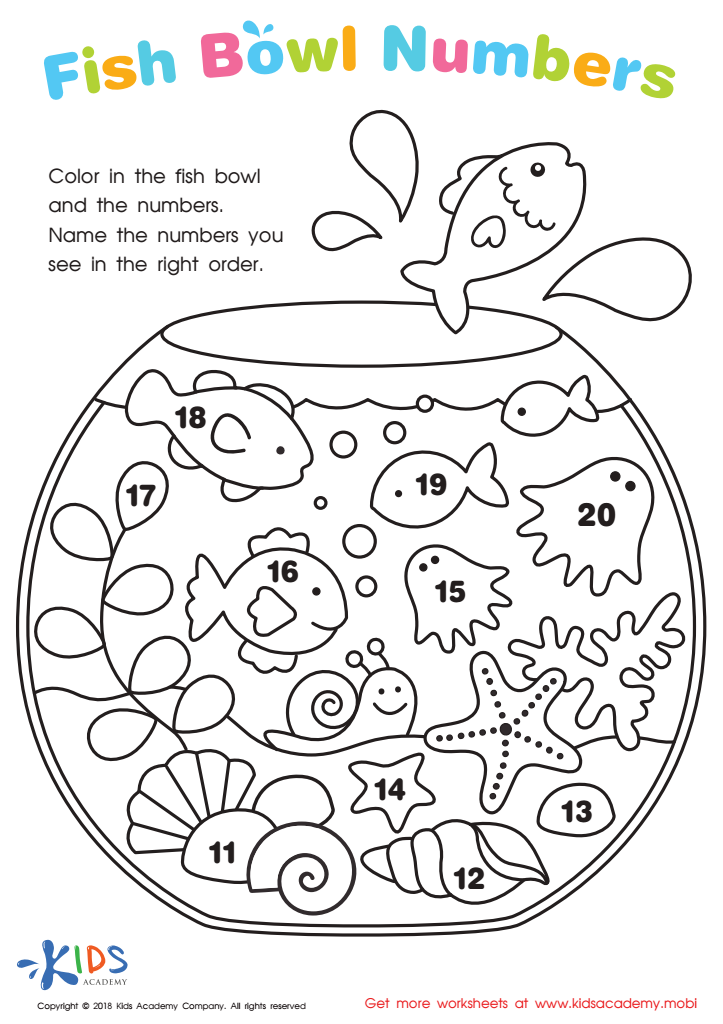
Fish Bowl Numbers Worksheet
 Assign to My Students






.jpg)

Counting skills are foundational to a child's cognitive development, making it crucial for parents and teachers to focus on enhancing these abilities in children aged 3-6. Early counting experiences foster number recognition, improve problem-solving abilities, and lay the groundwork for future mathematical understanding. Children who engage in counting games and challenges develop their numerical fluency, enabling them to grasp more complex concepts later in life.
Moreover, early counting activities promote language development, as children learn to articulate numbers and quantities. These experiences can strengthen fine motor skills through hands-on activities like using counters, blocks, or fingers. Implementing extra challenges encourages children to experiment, think critically, and build perseverance when faced with difficulties.
Additionally, counting skills are not just academic; they are integral to daily life—such as understanding time, measuring ingredients while cooking, and financial literacy. Parents and teachers who prioritize counting skills contribute to a child’s confidence, encouraging a positive attitude towards learning and exploration. Engaging children in counting challenges not only enriches their educational experience but also fosters a love for mathematics that can inspire lifelong learning. Overall, investing time in counting skills at this early stage offers a wealth of developmental benefits.








