Fraction visualization Extra Challenge Fractions of Shapes Worksheets for Ages 3-7
3 filtered results
Difficulty Level
Grade
Age
-
From - To
Subject
Activity
Standards
Boost your child's fraction skills with our "Fraction Visualization Extra Challenge: Fractions of Shapes Worksheets" for ages 3-7! These engaging printable worksheets from Kids Academy are designed to make learning fractions fun and interactive. Ideal for early learners, the exercises help children visualize and understand fractions through colorful shapes and hands-on practice. They'll enhance their mathematical skills, spatial awareness, and problem-solving abilities. Whether used at home or in the classroom, these worksheets offer a challenging yet enjoyable way to master fractions, building a strong foundation for future math success. Download now and watch your young learner flourish!
Favorites
With answer key
Interactive
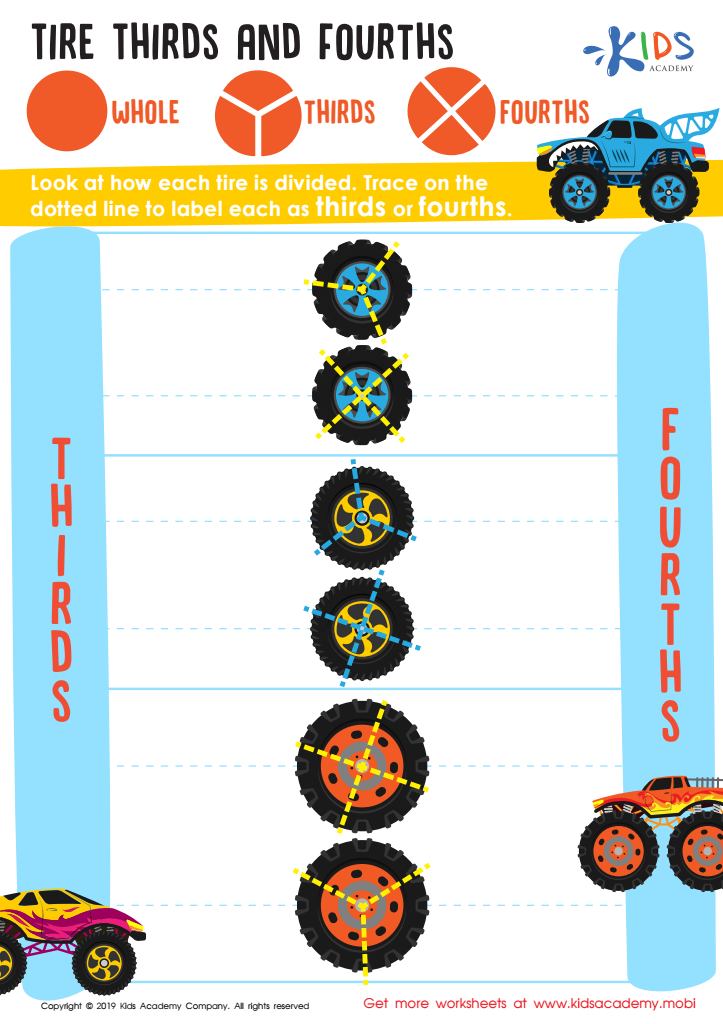
Tire Thirds and Fourths Worksheet
Learning geometry is key in your child's education. Have them identify and name shapes cut into 2, 3 and 4 parts. Test their knowledge with this worksheet - trace the dotted line to label each as third or fourth. Encourage them to keep learning!
 Assign to My Students
Tire Thirds and Fourths Worksheet
Worksheet
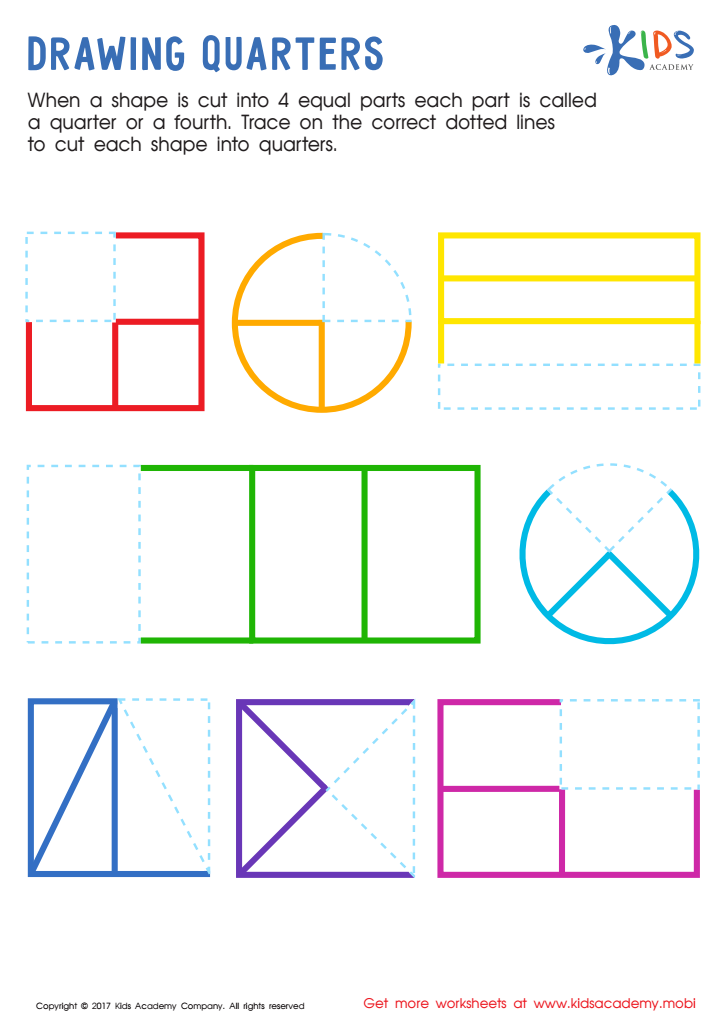
Drawing Quarters Worksheet
Help your kids divide shapes into quarters! Have them trace dotted lines to cut each shape into 4 equal parts. Each of the 4 parts is called a quarter or a fourth. This worksheet will help kids learn more about dividing shapes into four equal parts.
Drawing Quarters Worksheet
Worksheet
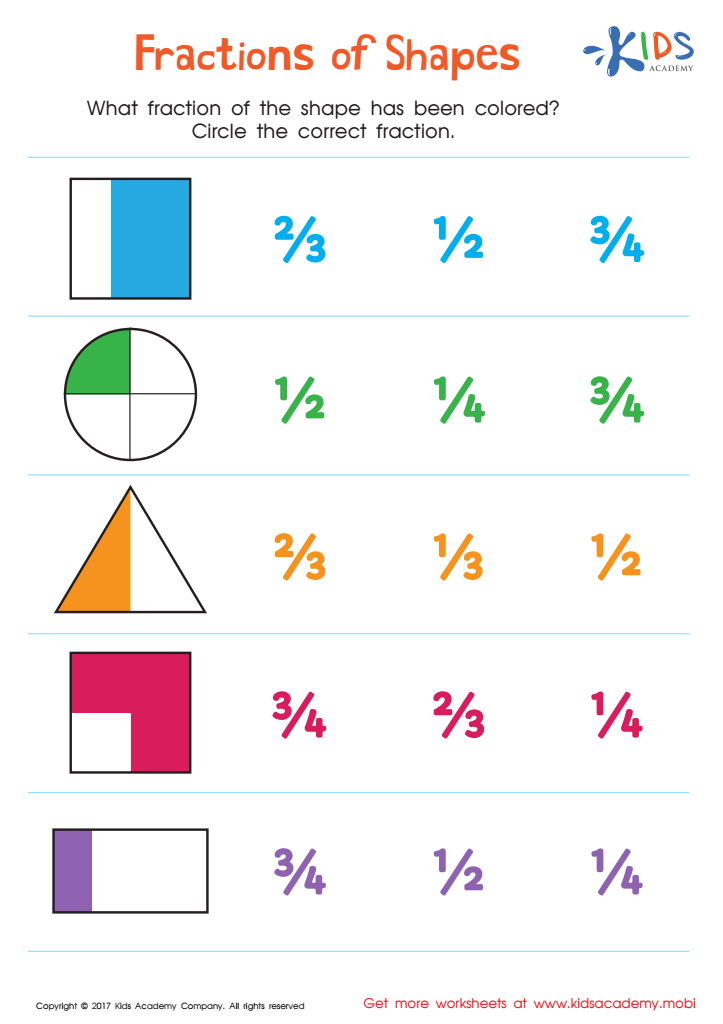
Fractions of Shapes: Math Concept Worksheet
Fractions can be tricky, but with pictures to illustrate them, they become much easier to understand. Our fractions of shapes worksheet is a great way to help children visualize fractions and gain a better understanding of them.
Fractions of Shapes: Math Concept Worksheet
Worksheet
Join Kids Academy for Free
Who is primarily going to use this learning content?








Fraction visualization is a critical foundational skill for young learners, and the Extra Challenge Fractions of Shapes is an excellent tool for boosting their understanding in a playful yet effective way. Children aged 3-7 are at a prime age for developing their cognitive and visual learning abilities. By introducing fractions through visual representation of shapes, parents and teachers can seamlessly integrate complex mathematical concepts into a child's learning process.
Understanding fractions is essential for later mathematical success; it underpins more advanced topics like ratio, proportion, and algebra. Visualization helps make abstract ideas tangible—dividing a shape into parts makes the concept of fractions less intimidating and more concrete. When children manipulate fraction shapes, they grasp that fractions represent parts of a whole, enhancing their comprehension and retention.
Moreover, visualization activities foster problem-solving skills and promote interactive learning, which is crucial for young minds. For example, asking children to color one-half or one-third of a picture not only reinforces fraction concepts but also improves fine motor skills and attention to detail. Parents and teachers who engage children in these activities are helping to lay a solid mathematical foundation, making future learning experiences less challenging and more intuitive. Thus, prioritizing fraction visualization at a young age is an investment in their long-term academic success.