Counting skills Extra Challenge Money Worksheets for 3-Year-Olds
3 filtered results
Difficulty Level
Grade
Age
-
From - To
Subject
Activity
Standards
Introducing Counting Skills Extra Challenge Money Worksheets for 3-Year-Olds! At Kids Academy, we've crafted engaging and educational worksheets specially designed to enhance your child's counting skills using simple money examples. These worksheets not only make counting fun but also help young learners understand the value of money and basic arithmetic. Each worksheet features brightly colored graphics and age-appropriate challenges that keep 3-year-olds excited about learning. Whether it's identifying coins or adding up small amounts, our worksheets provide the perfect extra challenge to develop your child's mathematical thinking. Boost your child's early math skills with Kids Academy today!
Favorites
With answer key
Interactive
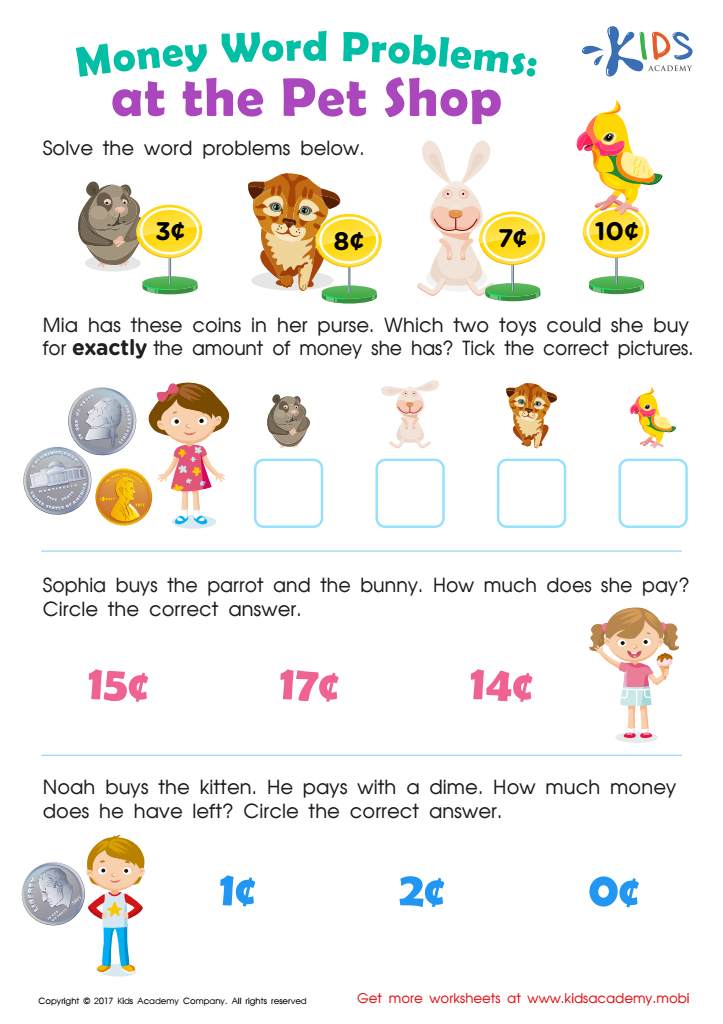
Pet Shop Worksheet
Teach your child a key life skill: counting and managing money. With this worksheet, they'll learn to count coins and calculate purchases at the pet shop. Give them colorful, fun math practice!
 Assign to My Students
Pet Shop Worksheet
Worksheet
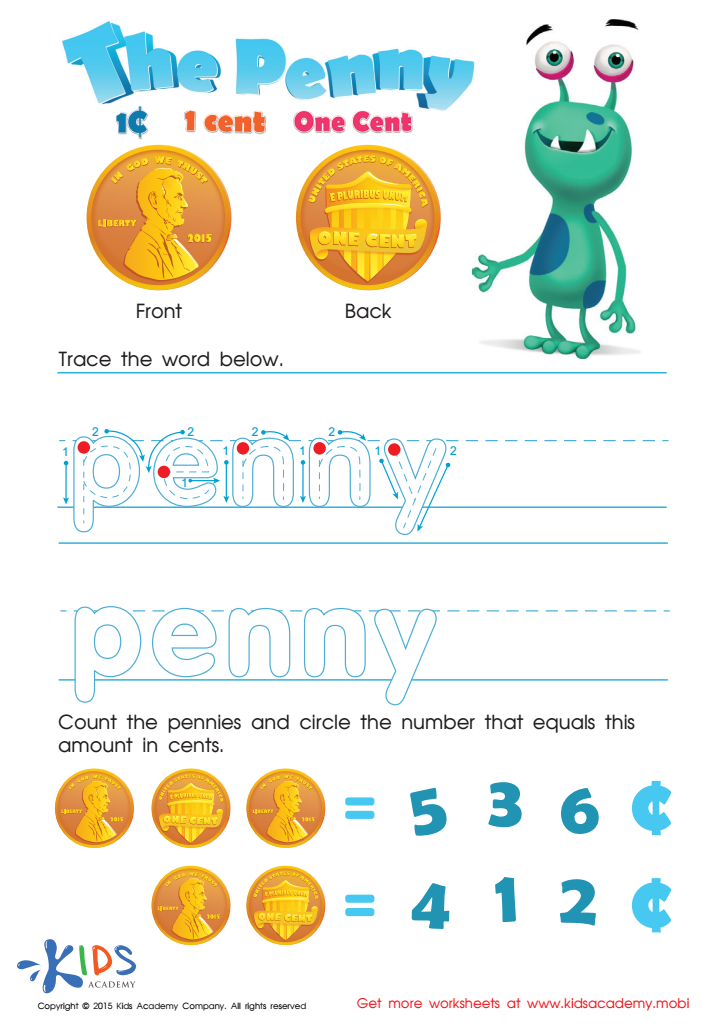
One Cent or the Penny Money Worksheet
Counting money made easy with Kids Academy's new collection of worksheets! Start with the one cent coin, or "Penny": trace it and count the pennies to work out the total. Visit our site for more free, printable money worksheets.
One Cent or the Penny Money Worksheet
Worksheet
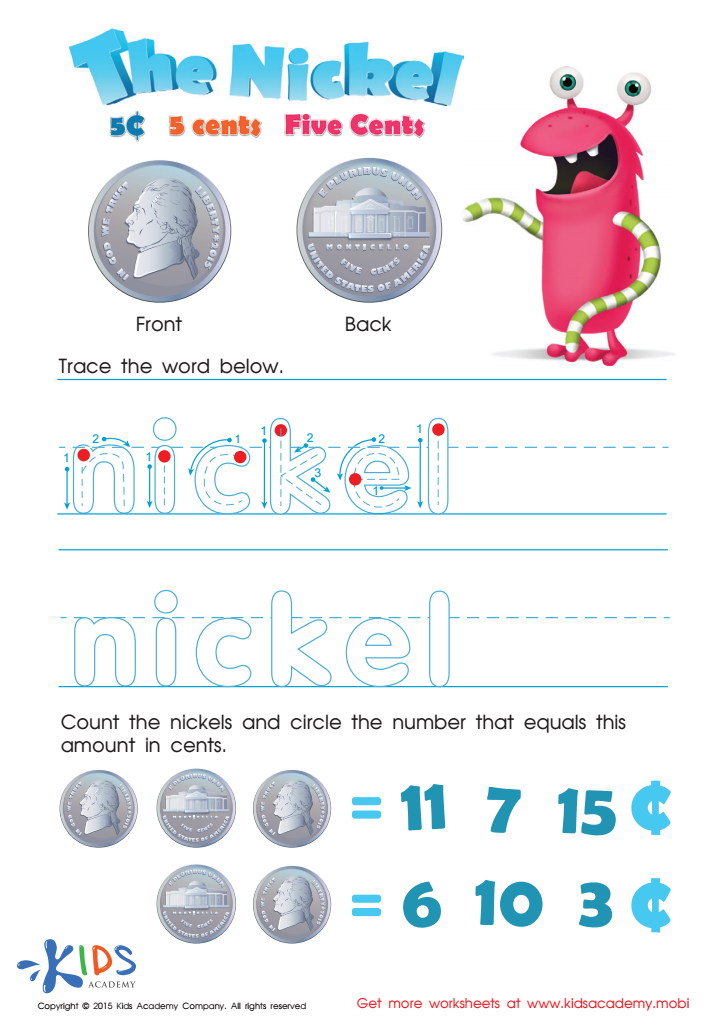
Five Cents or the Nickel Money Worksheet
Counting money games help kids make learning money fun and easy. Next up: the 5 cent coin, or nickel. Look at both sides and remember them. Then, trace the word "nickel" to help you remember. Finally, count the nickels and work out amounts in cents. Let's do this! Kids Academy helps make money learning easy and fun!
Five Cents or the Nickel Money Worksheet
Worksheet
Join Kids Academy for Free
Who is primarily going to use this learning content?





.jpg)


Fostering counting skills in 3-year-olds through activities like “Counting Skills Extra Challenge Money” can be incredibly beneficial for early childhood development. For starters, engaging children with counting and money-related activities introduces them to basic mathematical concepts in a fun and practical way. This early exposure helps build a strong numerical foundation, making future mathematics classes and problem-solving tasks easier to grasp.
Moreover, these activities are not only about counting numbers; they also involve recognizing different coin sizes, shapes, and values, which enhances a child's cognitive development. Handling pretend money can improve fine motor skills, such as picking up and sorting coins, which are essential for writing and other hand-related tasks.
Additionally, incorporating counting exercises that use money can instill important life skills like understanding the value of savings, making simple purchases, and grasping the concept of exchange. These are foundational skills for financial literacy, and introducing them at an early age can foster responsible money-handling habits in the future.
Meanwhile, these activities also provide opportunities for social interaction and communication as children play store with family members or peers, thereby boosting their social and language skills. In short, parents and teachers should care because these practices offer comprehensive developmental benefits, preparing children for both academic success and real-world challenges.