Listening skills Extra Challenge Phonics Worksheets for Ages 4-6
3 filtered results
Difficulty Level
Grade
Age
-
From - To
Subject
Activity
Standards
Enhance your child's phonics journey with our "Listening Skills Extra Challenge Phonics Worksheets" specially designed for ages 4-6. These engaging worksheets focus on honing auditory skills, helping young learners distinguish sounds, recognize letters, and improve comprehension through fun-filled activities. Kids will enjoy a variety of tasks that encourage active listening, such as sound identification and word matching, all while building a strong foundation in phonics. Our worksheets promote language development and cognitive skills, ensuring a holistic learning experience. Perfect for both classroom and at-home practice, these challenges foster an interactive learning environment where children can thrive in their literacy journey.
Favorites
With answer key
Interactive
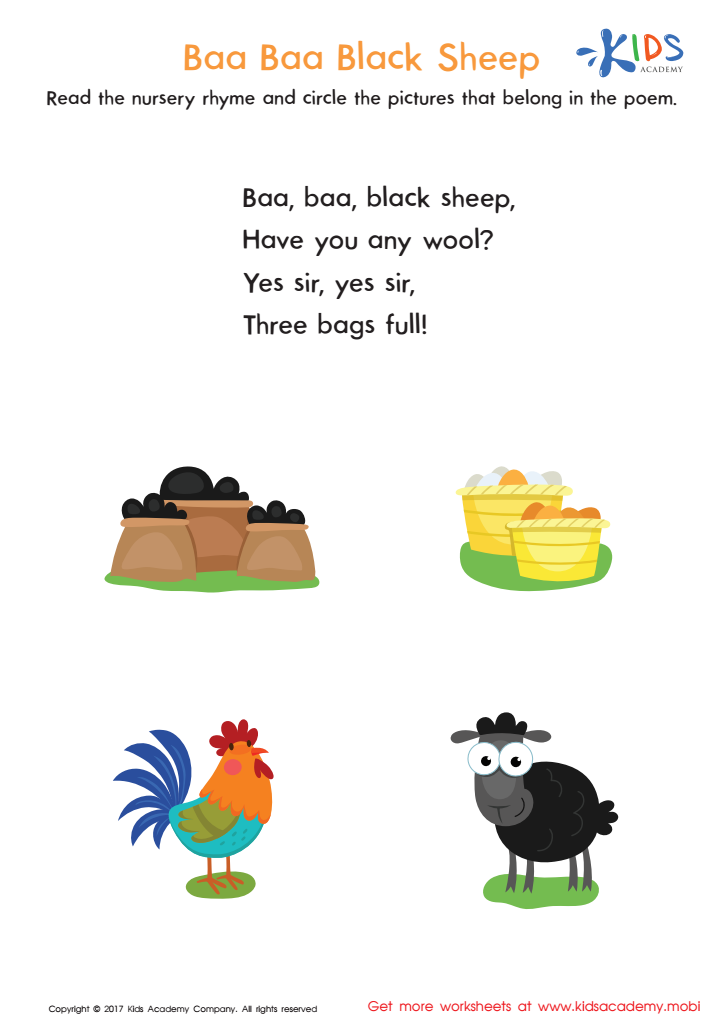
Baa Baa Black Sheep Printable
Jumpstart your child's reading skills with this printable Baa Baa Black Sheep worksheet! Recite the lines with them, then have them select the pictures associated with the poem to test comprehension. Fun and educational!
 Assign to My Students
Baa Baa Black Sheep Printable
Worksheet
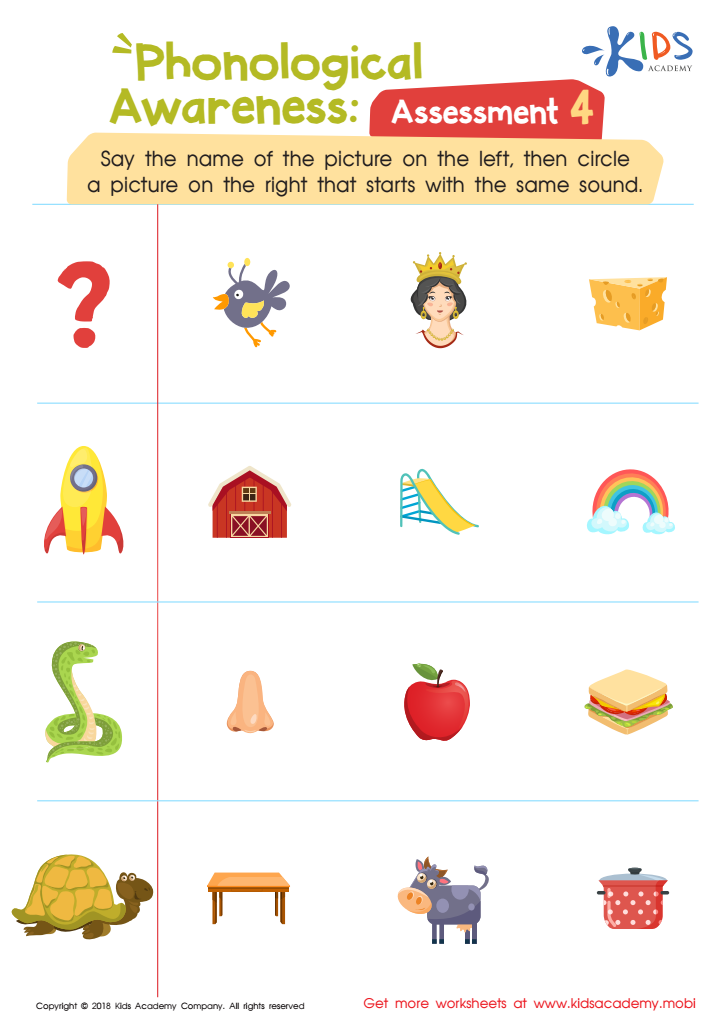
Phonological Awareness: Assessment 4 Worksheet
It can be tricky for young readers to differentiate between sounds in words. Make it fun with this downloadable worksheet! Ask your child to name each picture on the left and match the starting sound with an image on the right. This helps assess their phonics skills and make learning enjoyable.
Phonological Awareness: Assessment 4 Worksheet
Worksheet
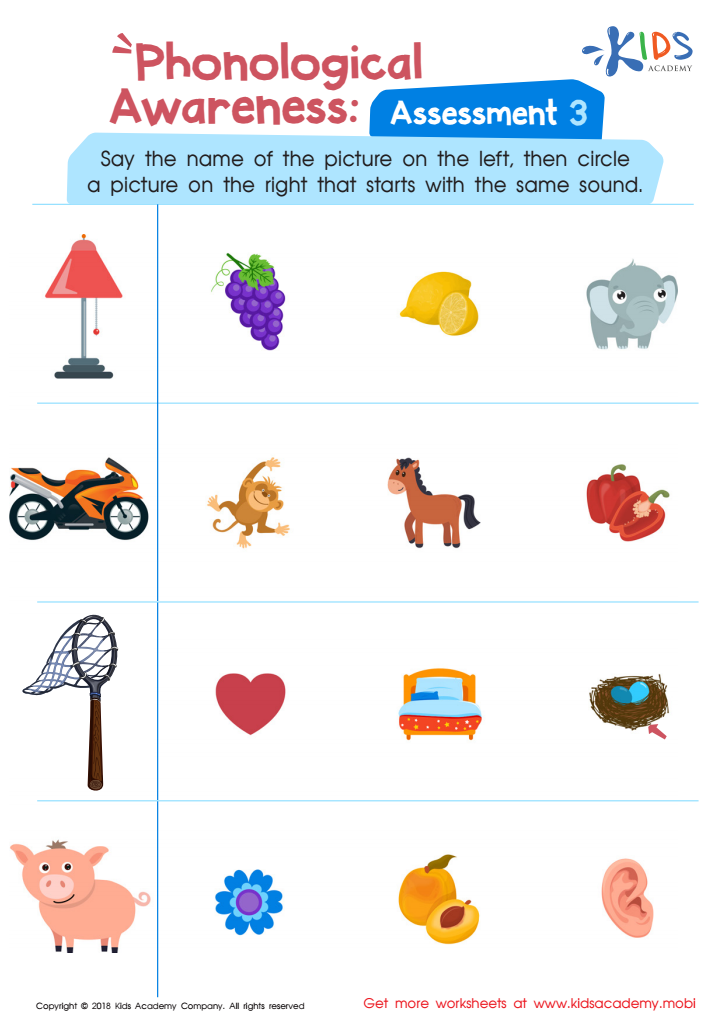
Phonological Awareness: Assessment 3 Worksheet
Test kids' reading readiness with a phonological awareness worksheet! With this PDF exercise, encourage children to name each picture aloud and match left to right. Help them learn to recognize word sounds at the start, middle and end of words. They'll be sure to remember that lamp doesn't sound like elephant!
Phonological Awareness: Assessment 3 Worksheet
Worksheet
Join Kids Academy for Free
Who is primarily going to use this learning content?








Listening skills are foundational to early literacy and overall communication, making programs like Listening Skills Extra Challenge Phonics for Ages 4-6 essential for parents and teachers. At this developmental stage, children are learning to decode language; strong listening skills enable them to discern sounds and rhythms, which are crucial for phonics and reading development.
Parents and teachers should care about these skills because children who excel in listening are more likely to follow instructions, engage in classroom discussions, and participate in social interactions. This enhances their confidence and fosters a conducive learning environment, allowing them to absorb new information and replicate sounds accurately.
Moreover, quality phonics programs not only improve a child's reading and writing skills but also nurture critical cognitive skills such as memory and attention. Early interventions help mitigate future academic struggles, setting the foundation for lifelong learning.
Investing in listening skills equips children with effective tools for communication and collaboration, promoting emotional intelligence and teamwork. Additionally, as children develop these abilities, they create a supportive bond with their educators and caregivers, ultimately fostering a positive attitude towards learning. Thus, prioritizing listening skills in young learners forms a pivotal influence in their educational journey.