Understanding plurals Extra Challenge Grammar Worksheets for Ages 4-6
3 filtered results
Difficulty Level
Grade
Age
-
From - To
Subject
Activity
Standards
Introducing our "Understanding Plurals Extra Challenge Grammar Worksheets" designed specifically for children aged 4-6! These engaging and interactive worksheets provide an additional level of challenge for young learners, helping them develop a solid grasp of pluralization. With colorful illustrations and fun activities, children will enhance their vocabulary skills while mastering the concept of turning singular nouns into plural forms. Ideal for both classroom and home learning, these worksheets encourage creativity and reinforce essential grammar foundations. Give your child the opportunity to excel in their language skills with our comprehensive range of thoughtfully designed translucent worksheets for extra practice and discovery!
Favorites
With answer key
Interactive
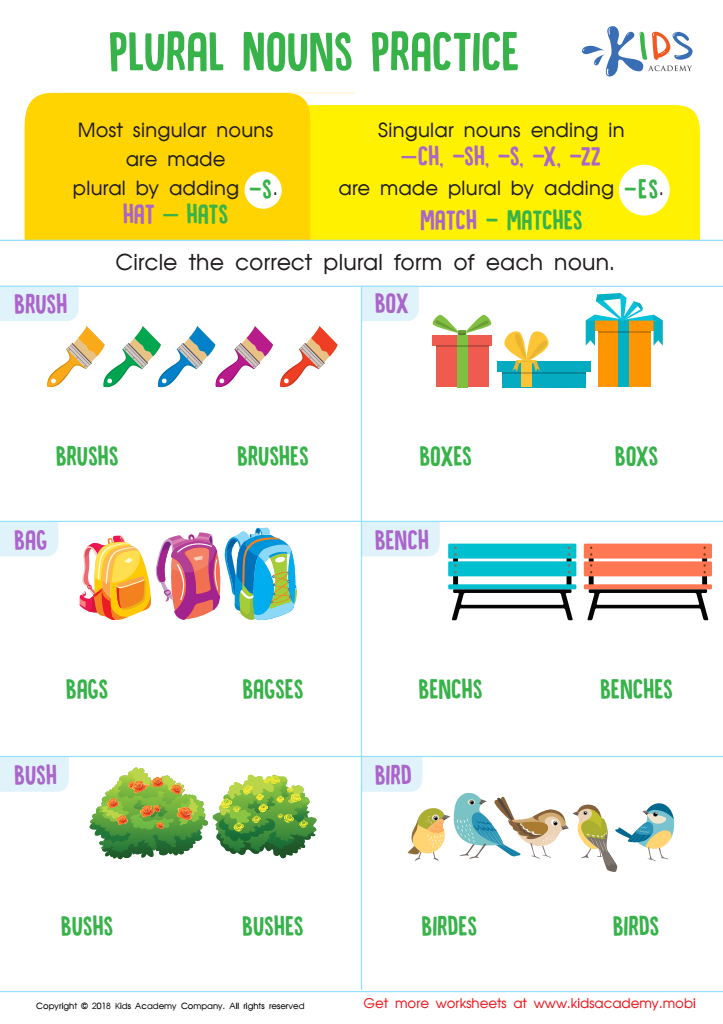
Plural Nouns Practice Worksheet
Explain to your child that most singular nouns become plural by adding "-s". E.g. "cat"->"cats". For words ending in "-ch", "-sh", "-s", "-x", or "-zz", add "-es". E.g. "buzz"->"buzzes". Then, get them to circle the right plural form of each noun on the worksheet.
 Assign to My Students
Plural Nouns Practice Worksheet
Worksheet
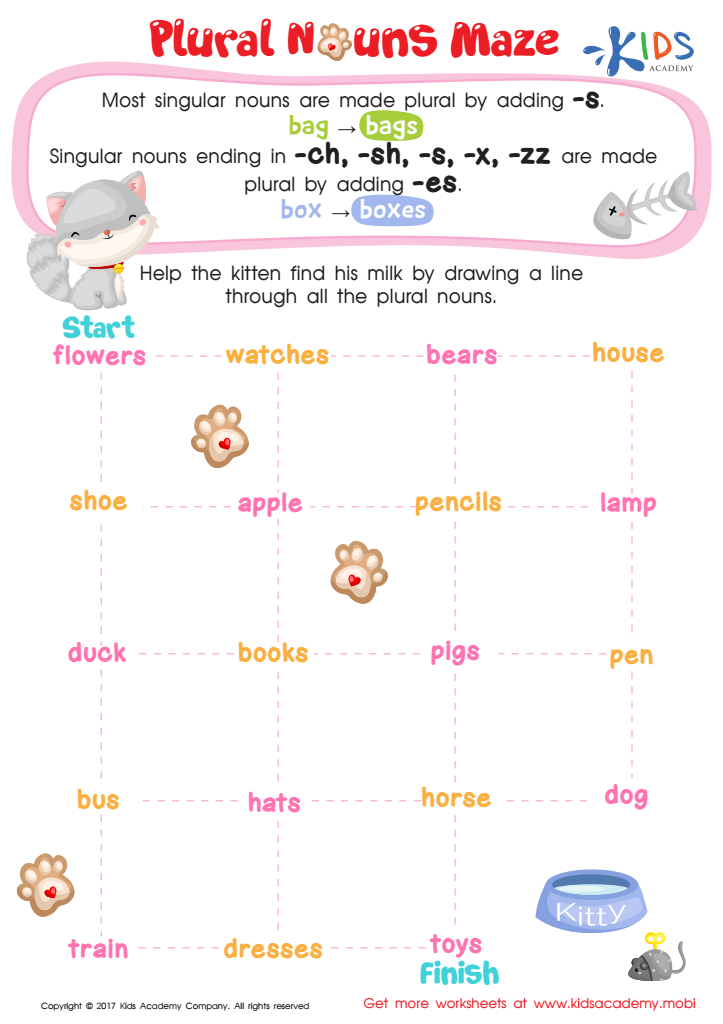
Plural Nouns Maze Worksheet
Oh no, the kitty needs her milk! Help your learner navigate the maze by drawing a line through the plural words. Review the grammar rules on -s and -es endings, then get to work to guide the kitten to her bowl! Download this PDF worksheet to start.
Plural Nouns Maze Worksheet
Worksheet
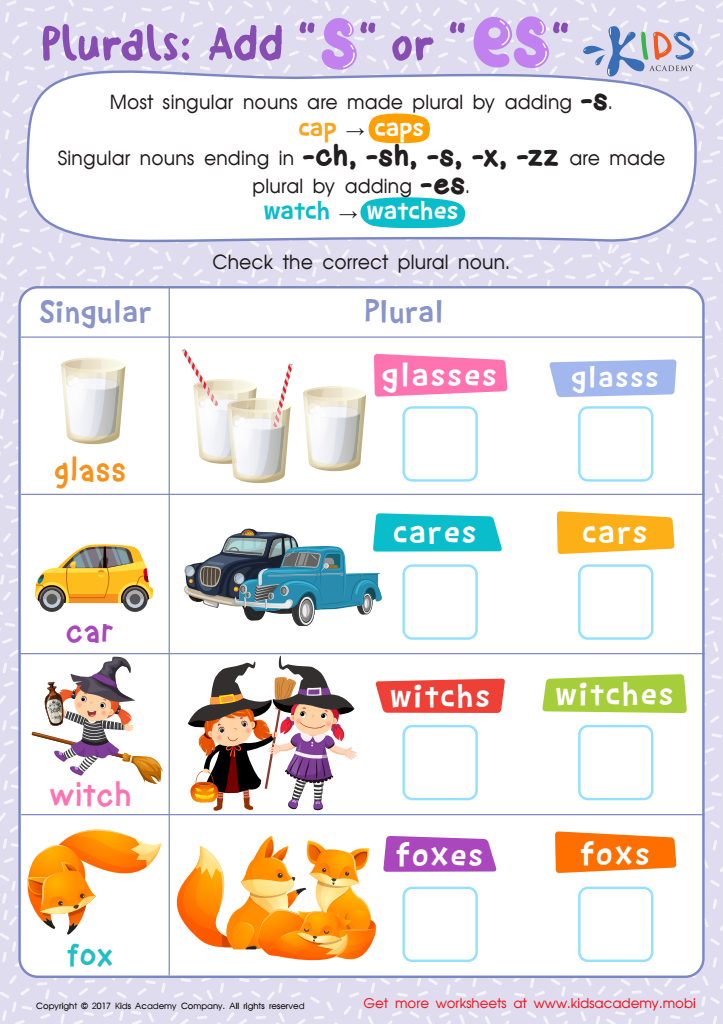
Plurals: "–es" or "–es"? Worksheet
Learning plural nouns can be tough for young readers. This worksheet shows them the difference between singular and plural spelling with cute images. Read each word and check the correct version. Remind them why the other ending can't be used.
Plurals: "–es" or "–es"? Worksheet
Worksheet
Join Kids Academy for Free
Who is primarily going to use this learning content?




Understanding plurals is a fundamental aspect of language development for children aged 4-6, and it plays a critical role in their overall communication skills. For parents and teachers, fostering plural understanding enhances children’s vocabulary development, allowing them to express themselves more accurately and comprehensively. By grasping the concept of plurals, young learners can differentiate between singular and multiple items, which lays the groundwork for more complex grammar rules in the future.
Additionally, recognizing and forming plurals supports early literacy skills. It helps children read and comprehend texts more fluently, as they better understand descriptions that involve counting or comparing items. Moreover, learning plurals introduces them to the subtleties of language, sparking curiosity about words and stimulating their critical thinking.
Another reason to prioritize plural understanding is its relevance to social interactions. Children frequently encounter different contexts where they must describe groups, whether in play settings, sharing experiences at school, or discussing interests with peers. Developing this skill helps build confidence in their communication abilities.
In essence, by emphasizing plurals, parents and teachers can significantly contribute to a child’s linguistic foundation, preparing them for academic success and social engagement.