Understanding plurals Extra Challenge Grammar Worksheets for Ages 4-7
5 filtered results
Difficulty Level
Grade
Age
-
From - To
Subject
Activity
Standards
Enhance your child’s grasp on grammar with our “Understanding Plurals Extra Challenge Worksheets” designed for ages 4-7. Perfect for young learners, these worksheets make mastering plurals engaging and fun through activities tailored to their developmental stage. With a variety of exercises such as matching, fill-in-the-blank, and short writing prompts, kids will enjoy learning to form and use plural nouns correctly. Our carefully curated content helps develop necessary language skills while also nurturing a love for learning. Set your young scholars on the path to grammar excellence with these effective, enjoyable worksheets.
Favorites
With answer key
Interactive
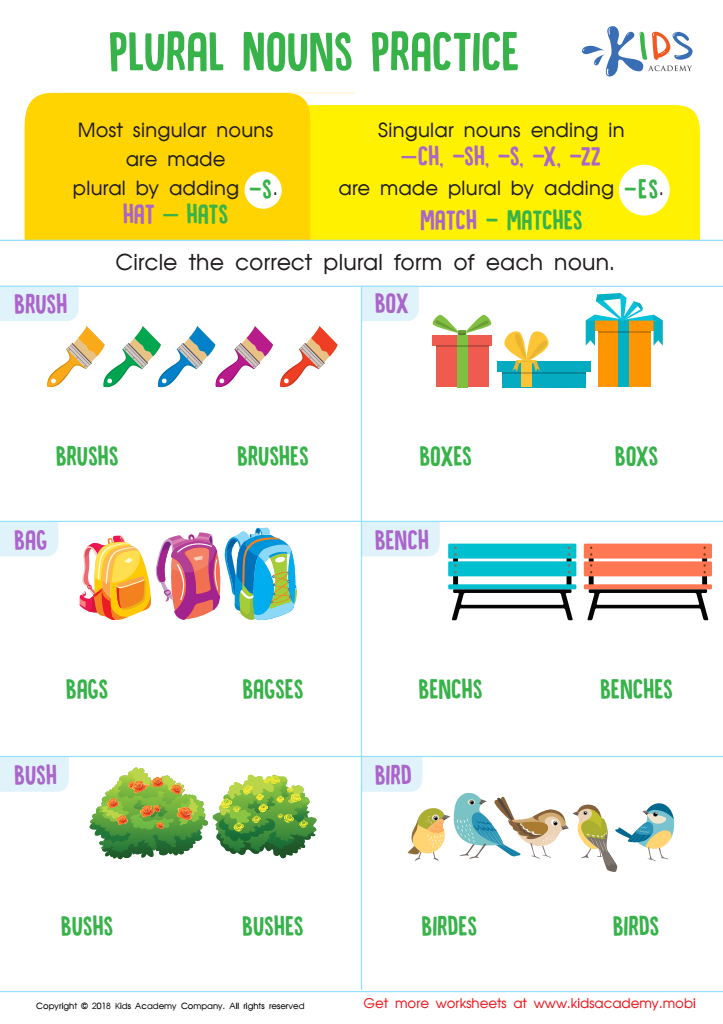
Plural Nouns Practice Worksheet
Explain to your child that most singular nouns become plural by adding "-s". E.g. "cat"->"cats". For words ending in "-ch", "-sh", "-s", "-x", or "-zz", add "-es". E.g. "buzz"->"buzzes". Then, get them to circle the right plural form of each noun on the worksheet.
 Assign to My Students
Plural Nouns Practice Worksheet
Worksheet
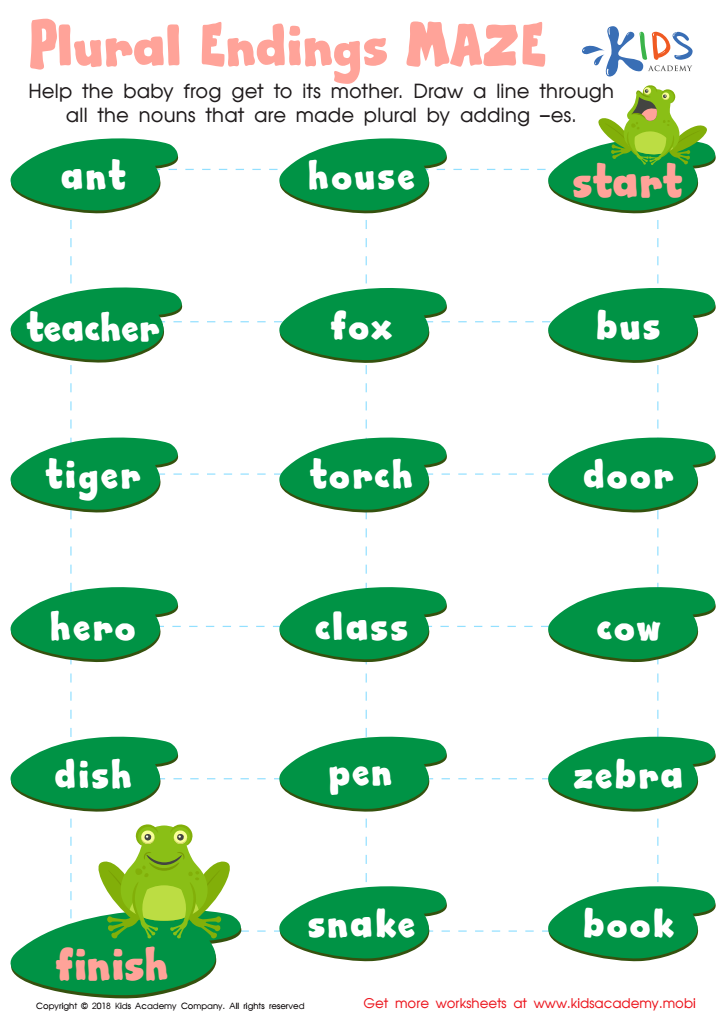
Plural Endings Maze Worksheet
Help your child have fun while learning new things with this worksheet. Does your child know that some nouns require '-es' to make them plural? Use this pdf to teach them the rule and get the little frog to its mother – draw a line through the words with '-es' plural forms.
Plural Endings Maze Worksheet
Worksheet
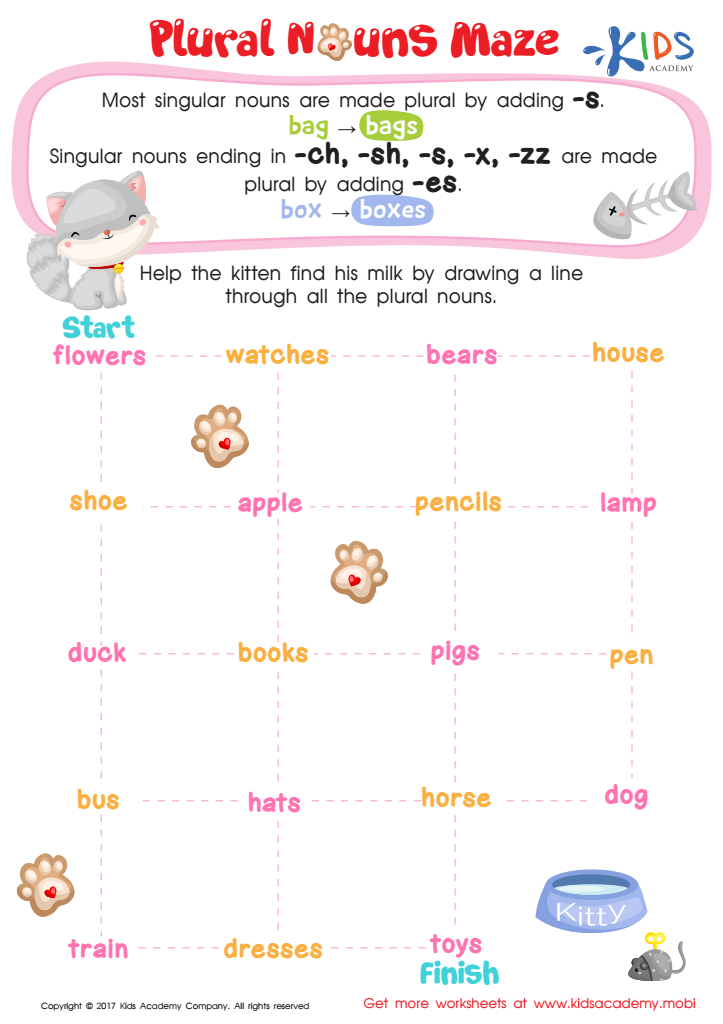
Plural Nouns Maze Worksheet
Oh no, the kitty needs her milk! Help your learner navigate the maze by drawing a line through the plural words. Review the grammar rules on -s and -es endings, then get to work to guide the kitten to her bowl! Download this PDF worksheet to start.
Plural Nouns Maze Worksheet
Worksheet
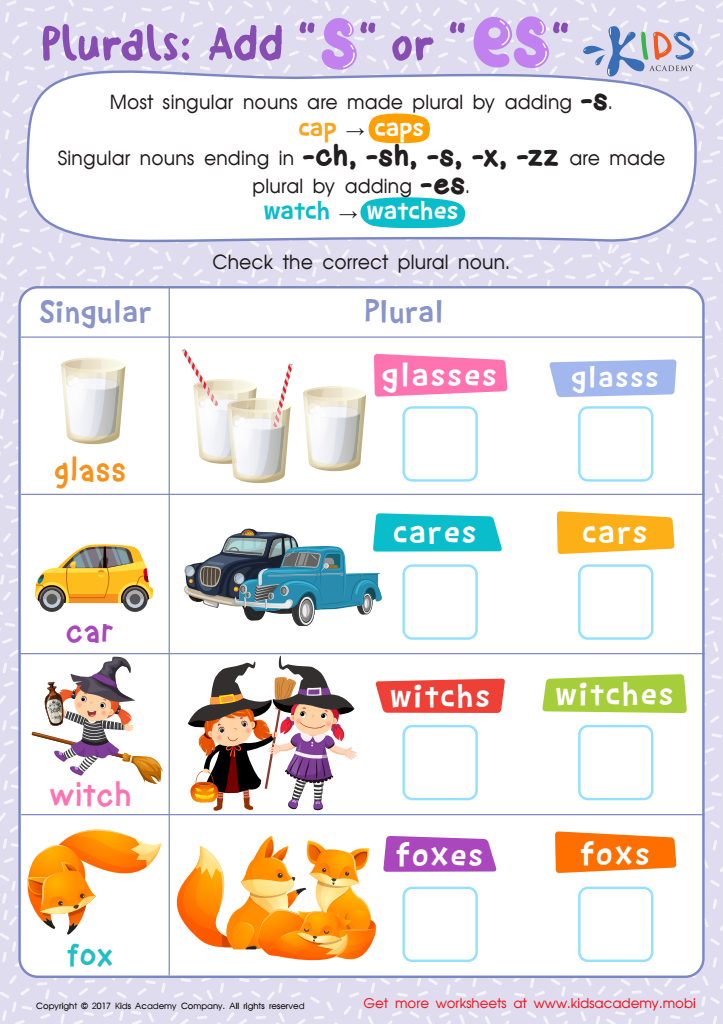
Plurals: "–es" or "–es"? Worksheet
Learning plural nouns can be tough for young readers. This worksheet shows them the difference between singular and plural spelling with cute images. Read each word and check the correct version. Remind them why the other ending can't be used.
Plurals: "–es" or "–es"? Worksheet
Worksheet
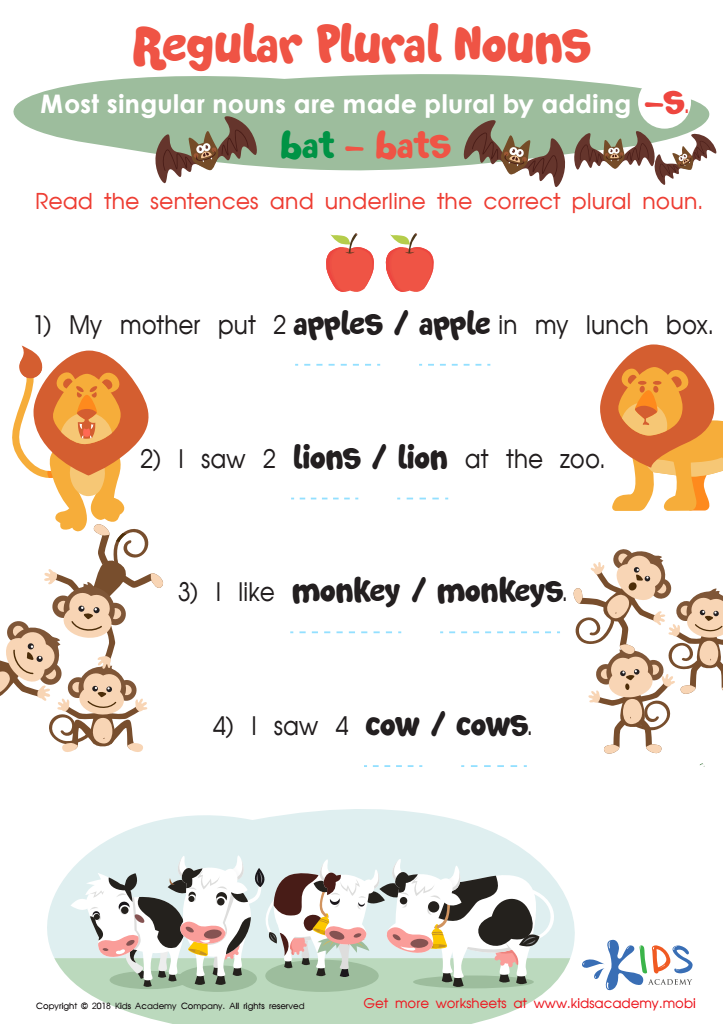
Regular Plural Nouns Worksheet
Your child should know the rule of adding '-s' to form plurals of nouns by now. Examples: bat-bats, cat-cats, song-songs etc. If they understand this, the task in the worksheet should be easy. Read the sentences and ask them to underline the correct plural noun.
Regular Plural Nouns Worksheet
Worksheet
Join Kids Academy for Free
Who is primarily going to use this learning content?





Understanding plurals is essential for young children's language development, and it's crucial for parents and teachers to emphasize this aspect of grammar between the ages of 4-7. At this stage, children are expanding their vocabulary rapidly and beginning to form more complex sentences. Knowing how to correctly use plurals not only enhances their ability to communicate more effectively but also lays a strong foundation for their future language skills.
Teaching plurals involves educating children about the basic rules, such as adding an "s" or "es", and recognizing irregular forms like "mice" for "mouse". These lessons are exciting opportunities for cognitive and memory development. Additionally, early mastery of plurals can improve reading comprehension and writing skills as students will recognize and use accurate word forms, making their communication clearer and more precise.
Engaging activities such as games, storytelling, and interactive worksheets not only make learning fun but also reinforce these grammatical concepts in everyday contexts. This active involvement boosts confidence in young learners as they navigate the complexities of language. Conclusively, by supporting children in mastering plurals early on, parents and teachers equip them with vital tools that contribute to their academic success and effective communication skills.